საერთო ცხელი ხაზი +995 577 07 05 63


საერთო ცხელი ხაზი +995 577 07 05 63
Introduction
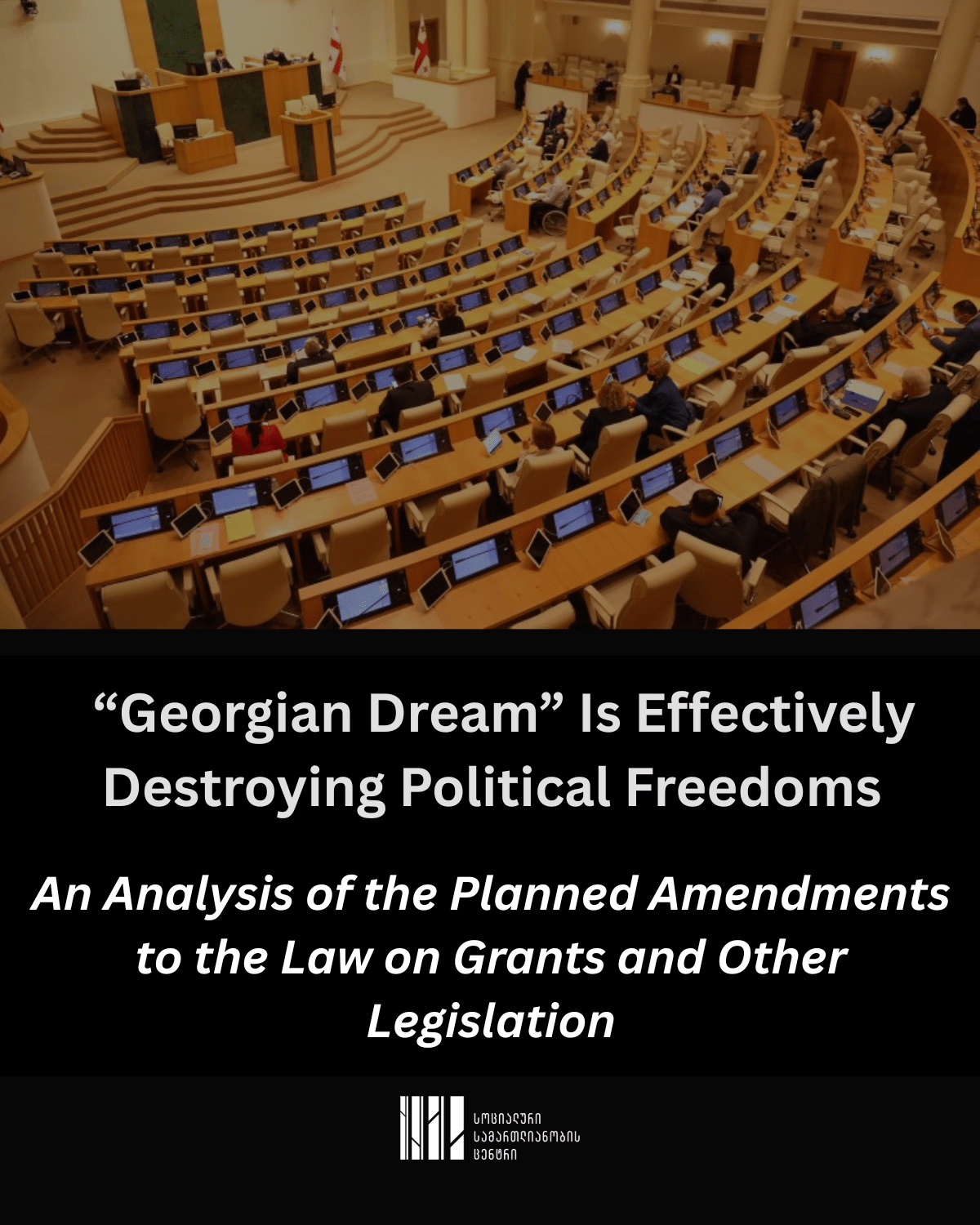
On 28 January 2026, “Georgian Dream” announced the adoption of another set of anti-democratic legislative amendments destructive to citizens’ political freedoms. Under the proposed changes, the definition of “a grant” is significantly expanded, placing under state control and criminalizing any individual’s political self-expression if that person receives financial resources from a citizen or a legal entity of another state. In addition, anyone employed by an organization that is largely funded from abroad will be prohibited from holding membership in a political party for a period of eight years. Legislative restrictions, financial transparency requirements, and monitoring obligations established for political parties are further expanded and extended to persons who are not political parties but, by the substance of their activities and their participation in the formation and implementation of citizens’ political will, resemble political parties. Furthermore, administrative liability is introduced for entrepreneurial legal entities that decide to engage in public political activity.
The legislative package includes amendments to the Law of Georgia “On Grants”, the Criminal Code, the Administrative Procedure Code, and the Code of Administrative Offenses, as well as to the organic laws “On Citizens’ Political Associations” and “On the State Audit Office’. It should also be noted that consideration of the amendments has been requested under the ordinary, rather than expedited, legislative procedure. Parliamentary consideration of the package begins on 2 February.
When discussing the announced changes, representatives of “Georgian Dream” referred to sharp assessments by international organizations and a number of foreign politicians, as well as their expressed readiness to support Georgian civil society and the media — which, according to them, constitutes a gross interference in the country’s sovereignty. According to Shalva Papuashvili, “legal entities should refrain and treat everyone equally and not become a political platform. Business exists to do business. It should engage in commerce; if they want politics, they should go into politics.” According to Irakli Kobakhidze, “political activity and content must not be financed from abroad. Accordingly, if a specific individual uses foreign funding to disseminate political content, they may become subject to these amendments.” Regarding the broad and opaque scope of the term “politics,” Kobakhidze stated that its content will be determined by the relevant authorities and, if necessary, by the court.
According to the assessment of Social Justice Center, the legislative amendments announced by “Georgian Dream” — which treat any type of financial cooperation between Georgian citizens and foreign states, natural persons, or legal entities as grounds for restricting political freedoms and subject such cooperation to state control and criminal liability — have effectively moved entirely beyond the framework of constitutional-legal and human rights standards. The announced reality of acquiring control over society as a whole outside democratic institutions and spaces, and of restricting political freedom to such a degree, takes on a far more dangerous form and assumes even more intensive and mass dimensions than the anti-democratic laws adopted to date. This comprehensive attempt to restrict and control society’s political freedom is virtually unprecedented even for most contemporary authoritarian regimes, largely replicates the content of the so-called “second-generation agent legislation” adopted in recent years in Russia and Belarus, and, if adopted in this form, will have devastating consequences for Georgian civil society.
Any Connection with the Foreign State as a Basis for Criminalizing Political Expression
According to the legislative package announced on 28 January, significant amendments are introduced to the Law of Georgia “On Grants”, the enforcement framework of which also envisages the determination of criminal liability measures.
In particular, the definition of a grant is substantially expanded and is deemed to include:
For the issuance of such grants, the grantor (donor) must obtain the consent of the Government of Georgia or its authorized representative.
At the same time, the amendments effectively envisage retroactive application. Specifically, if a person covered by the law received a grant before the law enters into force or in violation of the legislation and has not used it, or if the person received a grant that previously did not require government consent, they are obliged to apply to the government for consent to use the grant within 1month of the law’s entry into force. Until a decision is made, the use of the grant is prohibited and will entail criminal liability.
As for the enforcement mechanisms of these amendments:
The explanatory note to the legislative package, as in the case of previous waves of amendments, refers to the objective of protecting Georgia’s sovereignty from foreign influence. According to the explanatory note, the activities of legal entities funded from abroad have thus far been non-transparent, a situation that is also actively supported by various international organizations and foreign politicians, which is perceived as “gross interference” in the country’s sovereignty and, according to the authors, “cannot remain without a response from the state.” In this context, the explanatory note explicitly states: “At present, it is no longer a matter of dispute and is in fact unequivocally confirmed that there is always a danger that foreign funding may be used against Georgia’s sovereignty.”
Analysis of both the substance of the announced amendments and the official justification and rhetoric offered by Georgian Dream unambiguously points to a desire for, and a trajectory toward, total control over political expression in the country. From the perspective of democratic and human rights standards, this is alarming and represents the most severe forms of authoritarian consolidation and restriction of political freedoms.
In particular, the amendments implemented in several waves in previous periods to the Law On Grants, as well as the so-called “Russian law” and the Georgian analogue of the U.S. FARA, justified by the motive of protecting state sovereignty, were primarily aimed at controlling the substantive activities of civil society—non-governmental organizations, foundations, and independent media organizations—through intimidation and institutional destruction. This time, however, the announced amendments go beyond the organizational forms of civil society and explicitly extend state control to individuals’ political expression, beliefs, associations, and professional activities.
Moreover, unlike previous legislative waves, the official logic of the amendments treats foreign funding not merely as a transparency issue, but as an inherently suspicious premise that transforms otherwise lawful political expression into a criminally punishable act. This transformation clearly points to the formation of a rigid authoritarian legislative architecture, in which law functions not as a regulator of specific spheres but as a mechanism for preemptively restricting political agency—where political expression shifts from institutional and organizational forms into a personal risk.
Accordingly, it is evident that the announced amendments are in fundamental conflict with democracy, fundamental human rights, and European and international standards for the protection of political expression.
The European Convention on Human Rights interprets freedom of political expression in a democratic state particularly broadly and assesses its restriction with strict scrutiny. Articles 10 and 11 of the Convention, which protect freedom of expression and freedom of association, safeguard first and foremost individual freedoms alongside organizational actors—the right of every person freely to express opinions, to receive and impart information on matters of public interest. At the same time, the right of individuals to associate or self-organize with others for political purposes is protected, including through informal associations. The European Court not only prohibits the imposition of any negative label based on the fact that a civil organization is funded by foreign sources, but places the very receipt of funding within the sphere protected by freedom of association.[1] Accordingly, Georgian Dream establishes criminal liability for conduct that is recognized as the exercise of a right, if it has not been authorized by the state. This negates the very essence of rights as goods independent of the will of the state and constitutes an extraordinary violation of rights-based standards.
The initiated package of amendments directly disregards freedom of expression and freedom of association when it provides that an individual who receives any financial or other form of assistance or income from a foreign source—as a consultant, researcher, or simply as a citizen—may become subject to criminal liability if the state deems their expression or conduct to be “political.” Membership in a political party or civil organization, or public advocacy, is not required. It is sufficient that the individual’s expression “may influence society or public institutions.”
From the perspective of the Convention, such restrictions from the outset create a particularly severe chilling effect[2] on individuals in a sphere that enjoys the highest level of protection under freedom of expression. In relation to Russia’s more restrictive “foreign agents” law, the European Court found it necessary to explicitly acknowledge that the severity of the restrictions and sanctions bore no relation to transparency interests and that they were underpinned by the state’s (malicious) intent. In the Court’s words, the “chilling effect on public space and civic engagement” […] no longer fit within the concept of a democratic society and contained elements of a “totalitarian” regime.[3] Indeed, vague regulation of political expression and its criminal punishment—especially through imprisonment—push individuals toward self-censorship, as they cannot foresee how the state will interpret their views, aims, or associations, or whether they will become subjects of criminal prosecution, creating a reality characteristic of totalitarian states.
The announced restrictions are rendered particularly dangerous by the extremely broad and vague content of the concepts of “political activity” and “politics.” Moreover, the law declares criminally punishable not only activity, but also intent, belief, and potential future activity. Interpretation of these extremely vague terms, as indicated by Irakli Kobakhidze, is entrusted to executive and judicial bodies which, in Georgia’s current reality, are fully captured and, instead of performing oversight over the legislative and executive branches, function as instruments of punishment.
Thus, for individuals, the legality or punishability of their expression or conduct depends not on their actions, but on the interpretation assigned to them by authoritarian state institutions. Such an approach is impermissible under the European Convention on Human Rights, which considers the clear and foreseeable formulation of restrictions as the starting point for assessing limitations on freedom of expression and association. Extremely vague and abstract regulation of political expression fails to meet the requirements of legal certainty. For example, such a vague definition of “political activity,” according to the European Court’s case law concerning the Russian “foreign agents” law,[4] contradicts the standards of foreseeability. As the Court noted, the Russian law effectively equated the term “political” with any activity connected to the functioning of a democratic state, including the protection of human rights and advocacy in that field.
In circumstances where an individual’s criminal liability for political expression is based on unclear and vague concepts and their post factum interpretation by captured state institutions and courts, law ceases to function as a predetermined rule that society must follow and instead becomes an instrument of punishment and control.
Separate assessment must be given to the criminal punishability of political expression and the scale of liability, which render the announced amendments entirely incompatible with the idea of democracy and the protection of human rights. Imprisonment of up to 6 years for violations of grant-related legislation and up to 12 years for related “political activity” represent one of the most severe interferences with political rights across Europe. As noted, the European Convention on Human Rights subjects the criminal punishment of political expression to particularly strict scrutiny. The Court’s case law indicates that criminalization may be permissible only in extremely exceptional circumstances. Accordingly, the announced amendments effectively disregard the principle of proportionality and explicitly indicate that political expression linked to foreign actors is inherently suspicious and dangerous, and that punishment serves a preventive and intimidating effect rather than the restoration of justice.
These measures have virtually existential consequences for individuals—restriction of liberty, exclusion from political life (including a ban on party membership for 8 years), reputational stigma, and prolonged surveillance. The cumulative effect of such restrictions amounts de facto to civil “death,” depriving individuals of political agency. This clearly contradicts fundamental standards of civil and political rights and delivers an irreparable blow to democratic society, which is premised above all on pluralism of opinions and political participation.
Another deeply troubling aspect of the announced legislative amendments is their retroactive application, despite the explanatory note and the rhetoric of Georgian Dream representatives appealing to the contrary. In particular, the establishment of a post factum requirement for mandatory state consent for the use of a grant that was already lawfully obtained, combined with the imposition of criminal liability, fundamentally contradicts the principles of legal foreseeability and legal certainty. It violates not only the right protected under Article 7 of the European Convention on Human Rights—prohibition of punishment without law—but also broader requirements of a law-based order. Judicial practice unequivocally indicates that even in cases where formal retroactivity is not explicitly established, measures that retroactively alter the legal consequences of actions that were lawful at the time they were committed violate the requirements of the Convention.
Finally, from a comparative-law perspective, it must be noted that the announced amendments, in their severity, most closely resemble the so-called “second-generation foreign agents” legislation developed in recent years in Russia and Belarus. In these regimes, the initial focus on the organizational forms of the civil sector was subsequently extended to individuals, targeting activists, journalists, and ordinary private persons. A defining characteristic of these regimes is precisely the personalization of liability—the notion that an individual’s beliefs, connections, and professional relationships themselves become inherently risky for the state whenever any connection with foreign actors exists. It is this trajectory that distinguishes this type of authoritarianism: regulation not of conduct, but of political identity and objectives, which fundamentally undermines the idea of democracy.
Unfortunately, Georgia is following precisely this trajectory, as legislation erases the boundary between the individual and political actors, and between private life and criminal law. It should also be noted that restrictions imposed under the guise of law and used for the purposes of political repression are explicitly limited by the European Convention on Human Rights, and constitute a violation of Article 18 of the Convention, which deems such aims incompatible with the Convention.
Restricting Party Membership of Civil Society Actors While Extending Party Control Mechanisms Even Before entering Party Politics
The absurdity of the changes announced in the Law on Citizens' Political Associations, on the one hand, prohibiting civil society from access to party politics, and on the other hand, even prior to their engagement with party politics, extending the party control regime to them made excessively burdensome even for parties (see changes of December 17, 2025) can only be explained by the fact that 'Georgian Dream' is fulfilling an 'bad faith' intention to completely cleanse the vital space of institutional political and public organizations, including by making reasoned criticism of such autocratic laws impossible.
According to the announced changes to the Law on Citizens' Political Associations, persons who receive income (fully or partially) on the basis of an employment contract from an organization that has received more than 20% of its annual income from a foreign power are prohibited from membership in a political party for 8 years. To establish the fact of employment of political party members in such organizations, the State Audit Office is granted discretion to monitor their financial activities - an additional instrument of control over parties.[5] According to the explanatory note, this change serves to rid political parties of those persons who are motivated by external interests that supersede and exist beyond the bounds of Georgian statehood.
In fact, these changes replicate the Russian legislative amendments from 2015 discussed above, regarding which the ECtHR found a violation of freedom of association. The Russian law granted the government the authority to designate civil society organizations as 'undesirable' if they were deemed to serve anti-Russian interests. This latest change adopted in Georgia has an analogous purpose and effect - to make the fact of receiving foreign funding (over the past 8 years) - itself a sphere protected by freedom of association[6] - an automatic basis for deeming a person's participation in party politics undesirable,[7] and thereby to completely close off the possibility of participation by the most competent and independent segment of society for party politics.
This change also contradicts the standard of freedom of association because a person is prohibited from membership in a political party for an action - obtaining and using foreign funding - which is itself an interest protected by freedom of association.[8] The fact of exercising a right cannot become grounds for the denial of access not only to another fundamental right, but to any privilege in general[9], especially in such an important sphere as the activities of political parties. Precisely because interference in the activities of political parties poses a serious threat to the functioning of democracy, their prohibition/dissolution is permitted only in such narrowly defined cases where evidence about specific actions[10] by a particular party confirms a serious and immediate threat to public safety[11] and functioning of democracy.[12]
According to the changes announced in the Law on Citizens' Political Associations, the term 'declared electoral purpose' is replaced with the term 'declared party-political purpose,' which serves to extend all restrictions established for political parties and persons (including natural persons) with a declared electoral purpose to organizations and natural persons[13] whose activities serve public interests, for example, involve criticism of state policies and awareness-raising about them. According to the legislative changes, a subject with a declared party-political purpose is considered to be an entity 'which is not registered as a political party, but by the content of its activities and public actions, including participation in the formation and implementation of citizens' political will, substantially resembles a political party.'[14] With such a broad interpretation, subjects with a declared electoral purpose could be considered, for example, organizations and persons working on issues of reasonable accommodation for persons with disability (PWDs), election observation, or legal consultations. An organization or person is granted the status of a subject with party-political purpose by the Audit Service, whose decision on granting such status does not cease even in the case of an appeal to court.[15] According to the explanatory note, this change serves the comprehensive regulation of the issue in order to ensure substantive clarification, expansion of legal regulation and increase of its effectiveness.
As noted, the ECtHR considered the practice of broad interpretation of “political activity” to be a violation of the standard of foreseeability in the context of the Russian law on foreign agents, which equated political with any activity related to the functioning of a democratic state, including human rights advocacy.[16] The explanatory note leaves no doubt that the replacement of electoral purpose with party-political purpose similarly serves to include under it mainstream civil society organizations and to more fully and effectively silence critical voices.
The additional control mechanisms over such organizations and persons through the attribution of party-political purpose include both restriction of activities, imposition of additional bureaucratic burdens, as well as criminal liability.
Civil society organizations, through the attribution of party-political purpose, are prohibited from transferring material or immaterial valuables, as well as providing any services. For example, like parties, such organizations are prohibited from providing assistive devices to PWDs, compensating election observers with per diem, and providing legal services.[17]
The changes restrict CSOs from receiving donations from legal entities or/and other types of associations of persons registered in Georgia or outside the borders of Georgia, as well as from subjects that are part of the government system of another state. Under the Law on Grants, this possibility is already dependent on prior government permission and is effectively closed, however, with the changes introduced to the Law on Political Associations, and through the classification of public organizations as persons with declared party-political purpose, receiving donations of foreign origin becomes theoretically prohibited without exception.[18]
Moreover, receiving local donations also becomes extremely difficult for public organizations, because even in the case of small amounts, the anonymity of donors is not protected, and the State Audit Service will publicly publish the personal data of donors on a monthly basis.[19]
Like parties, CSOs will be required to submit annual financial declarations,[20] conduct annual financial audits of their activities,[21] and provide information about donations on a monthly basis.[22]
For failure to fulfill these obligations, the State Audit Service can motion the court with a request to fine civil society organizations.[23] Moreover, the Audit Service is granted the authority to freeze assets on the of these organizations even before the court confirms the respective decisions.[24]
The legislative changes are not limited to the possibility of fines and also provide for the possibility of criminal prosecution for the head of a CSO or a natural person working on public issues. The current version of Article 355 of the Criminal Code, which punishes persons holding corresponding political positions for repeated failure to submit an asset declaration and intentional entry of incomplete or incorrect data in the declaration, is supplemented with a new offence that punishes a subject with declared party-political purpose for receiving prohibited donations, failure to submit a declaration, or failure to correct defects within the established deadline, including deprivation of the right to engage in activities for a period of up to three years.[25]
According to the announced legislative changes, the Criminal Code is supplemented with a provision establishing the liability of a head of a political party (Article 319²), which punishes, including with a custody of up to six years, the head of a party for receiving any type of foreign donation by a political party.[26]
Moreover, according to the change of December 17, 2025, which enters into force on March 2, 2026, the State Audit Service is authorized, with the involvement of the court, to request non-public information about such civil society organizations or persons working on public issues,[27] as well as to interrogate any natural person before a magistrate judge for the purpose of obtaining information about them.[28]
Unlike political parties, which receive funding from the state budget, the freedom of activity of civil society organizations is broader and it cannot be subjected to the control characteristic of parties. Moreover, the ECtHR has considered the use of intensive measures such as suspension of a political party's activities for non-compliance with formal requirements and procedures to be impermissible not only in the case of CSOs, but even in the case of political parties.[29] Obviously, the approach of the ECtHR will be analogous or even stricter in such cases when criminal liability is applied.
As for the criminal liability of a political party leader in case of foreign financing, here too, given the intensity of this measure and its impact on the party, according to the ECtHR standard, it is permissible only in the narrowly defined cases discussed above, namely when evidence[30] of specific actions by members of a party confirms a serious and immediate threat[31] to public safety and the functioning of democracy.[32] Moreover, even without criminal liability, the ECtHR has so far accepted the prohibition of foreign financing permissible in the case of political parties only in relation to a foreign state or foreign political party, and not generally to any type of foreign donation.[33]
Taking away Freedom of Expression from Commerce
GD was not content with silencing the critical voices in the non-commercial sphere and took measures to suppress the already weak critical signals from commercial entities as well. Specifically, the changes added a new offence to the Code of Administrative Offenses, according to which public political activity by a commercial legal entity that is not related to its core commercial activity will result in a fine of 20,000 GEL for the entity, and in case of repetition - 40,000 GEL. The note to this article specifies that for the purposes of this article, political activity is considered to be activity carried out or to be carried out with the aim of exerting any influence on the Georgian government, state institutions, or any part of society, which will be directed toward the formation, implementation, or change of Georgia's domestic or foreign policy.[34]
The introduced offense blanketly deprives commercial entities of freedom of expression unconditionally recognized by human rights law, including the ECtHR. According to the ECtHR, restriction of freedom of expression of commercial organizations is permissible only if a specific instance of exercising this right contradicts a specific legitimate aim. Even the Georgian state did not dispute this in the case of Gachechiladze v. Georgia adopted against Georgia.[35] Moreover, the ECtHR considers the ban on political advertising on private television to be impermissible and holds the state responsible even when such placement is refused not directly by the state, but by a specific private television station.[36]
Conclusion
In summary, the announced legislative changes are systemically incompatible with international standards of democracy and human rights. The changes make actions protected by freedom of association punishable by criminal law if they are not permitted by the government. This completely reverses the logic of human rights, which exists independent of the state will These changes establish not a rights-based, but a permission-based legal regime, where political expression is no longer a pre-existing right of the citizen, but a privilege individually granted by the state and revocable at any time.
The most disastrous consequence of the legislative changes discussed above is not its individual parts, but its systemic, cumulative effect - the creation of such a legislative environment in Georgia where the political expression and freedom of the individual becomes conditional. This is not a democratic framework, but an order that makes politics and political expression in its broadest sense completely controllable by the state. Accordingly, such a legal order cannot be compatible with the standards of democracy and human rights, because it completely destroys the institutional and legal conditions that create the preconditions for the existence of a democratic society in the state.
The ultimate goal of the announced legislative changes is not only the restriction of political activity, but the complete depoliticization of the citizen and the practical deprivation of political freedoms and political agency from them. At the same time, its function is the normalization of fear and the creation of an environment where, due to unforeseeable and broad restrictions and high penalties, the citizen self-censors refraining from expressing their thoughts, associating with others, choosing specific professions,
The announced legislative changes clearly reflect a model of governance that can be called authoritarian legalism. A regime where law no longer serves the function of a normative framework limiting power, but itself becomes the main instrument of political control. In such conditions, repression is not carried out outside the law or against it; on the contrary, it takes on a formally legal character and is normalized precisely through this formal legality. Here, law no longer regulates specific actions with clear and foreseeable rules, but establishes vague, broadly interpretable categories whose content is determined post factum by the executive and captured judicial authorities. As a result, law no longer represents protection for the citizen from the state, but becomes a constant legal threat that preemptively restricts political expression, induces self-censorship, and establishes power through microscopic control and surveillance.
The paradigm shift is accompanied by an erosion of rights that occurs not through one-time prohibitions, but gradually and structurally. Fundamental rights - freedom of expression, association, and political participation - are no longer perceived as independent from the state and preceding it; they are transformed into conditional opportunities whose realization depends on state consent, assessment of loyalty, and administrative will.
In a democratic state, the independence and autonomy of civil society represent not a subsidiary supplement to the political sphere, but one of the fundamental pillars of the constitutional order. CSOs and informal associations exist precisely as spaces independent of state power, where citizens freely form interests, criticize public policy, control the authorities, and create collective political agency beyond institutional politics. The essence of this autonomy lies in the fact that the state has neither the right nor the competence to determine what content of activity is legitimate for civil society, since such an assessment itself leads to the concentration of power and the destruction of political pluralism.
The announced legislative changes directly contradict this principle because they dissolve the boundary between the state and civil society and turn autonomous spaces into objects of state control in contradiction with the Constitution. Through unforeseeable categories related to foreign financing, political purposes, and the possibility of exerting influence, the state grants itself the authority to determine not only the legal status of organizations, but also their political legitimacy. Thus, civil society loses its autonomous agency and is transformed into an actor permitted, regulated, and punishable by the state. In such conditions, CSOs can no longer fulfill the function of critical control of power. This transformation deprives civil society of the possibility of existing as an independent political space and turns it into an auxiliary or disciplined object of state governance, which essentially eliminates the functioning of democracy.
The announced legislative changes are based on the logic of preventive governance, which should be an exception in a democratic state, but becomes the norm of governance in authoritarian regimes. In this model, the state no longer responds to real, imminent, and ascertainable threats; it invents constant potential threats (for example, foreign influence, political interference, illegitimate interest) and precisely against the background of this fake state of emergency justifies the preemptive, mass, and undifferentiated restriction of rights. The logic of emergency here is no longer a temporary or extraordinary response to crisis; it is transformed into a permanent legal regime that regulates everyday political life. Under these conditions, democracy is destroyed not formally by its abolition, but substantively and in practice, because in this reality citizens retain legal status but lose the rights to freely think, organize, and act for social and democratic change, since the constant narrative of a state of emergency presents the restriction of rights as an inevitable and necessary reality.
[1] Ecodefence and Others v. Russia, nos. 9988/13 and 60 others, §165, 14 June 2022; Andrey Rylkov Foundation and Others v. Russia, nos. 37949/18 and 83 others, 18 June 2024.
[2] Ecodefence and Others v. Russia, §186; Andrey Rylkov Foundation and Others v. Russia, §111.
[3] Kobaliya and Others v. Russia, nos. 39446/16 and 106 others, § 86, 94-95, 22 October 2024.
[4] Ecodefence and Others v. Russia, nos. 9988/13 and 60 others, §96, 104, 14 June 2022
[5] Law on Citizens' Political Associations, article 10 (3-6).
[6] Ecodefence and Others v. Russia, §165.
[7] Andrey Rylkov Foundation and Others v. Russia.
[8] Ecodefence and Others v. Russia, §165.
[9] Grande Oriente d’Italia di Palazzo Giustiniani v. Italy, no. 35972/97, ECHR 2001-VIII; Maestri v. Italy [GC], no. 39748/98, ECHR 2004-I.
[10] United Communist Party of Turkey and Others v. Turkey [GC], no. 19392/92, 30 January 1998, § 54, 59; HADEP and Demir v. Turkey, no. 28003/03, 14 December 2010, § 80.
[11] Yazar and Others v. Turkey, nos. 22723/93 and 2 others, 9 April 2002, §49, 88-91; Herri Batasuna and Batasuna v. Spain, nos. 25803/04 and 25817/04, §79, 30 June 2009.
[12] Refah Partisi (the Welfare Party) and Others v. Turkey [GC], nos. 41340/98 and 3 others, §104, 13 February 2003.
[13] Law on Citizens' Political Associations, article 261 (1). At the same time, under paragraph 3 of the same article, such an individual is obliged to establish a special fund.
[14] ibid, article 71.
[15] Ibid, article 261 (7).
[16] Ecodefence and Others v. Russia, §96, 104.
[17] Law on Citizens' Political Associations, article 252 (1, 2). According to paragraph 2 of this article, any person is also prohibiting from this action, provided that it is performed for the benefit of such organization.
[18] ibid, article 26 (1, b,d).
[19] ibid, article 26 (1, e).
[20] ibid, article 32.
[21] ibid, article 33.
[22] ibid, article 271.
[23] ibid, article 342.
[24] ibid, article 342 (11, 12).
[25] ibid, article 261 (9).
[26] See also ibid, article 26 (7).
[27] ibid, article 341 (5, 6)
[28] ibid, article 341 (3)
[29] Savenko and Others v. Russia, no. 13918/06, § 69, 14 September 2021.
[30] United Communist Party of Turkey and Others v. Turkey [GC], § 54, 59. HADEP and Demir v. Turkey, no. 28003/03, § 80, 14 December 2010.
[31] Yazar and Others v. Turkey, § 49, 88-91; Herri Batasuna and Batasuna v. Spain, § 79.
[32] Refah Partisi (the Welfare Party) and Others v. Turkey [GC], § 104.
[33] Parti nationaliste basque – Organisation régionale d’Iparralde v. France, no. 71251/01, § 47-52, ECHR 2007-II.
[34] Code of Administrative Offences, article 15313.
[35] Gachechiladze v. Georgia, no. 2591/19, § 45, 48, 51 22 July 2021.
[36] VgT Verein gegen Tierfabriken v. Switzerland, no. 24699/94, § 44-47, ECHR 2001-VI.
The website accessibility instruction