საერთო ცხელი ხაზი +995 577 07 05 63


საერთო ცხელი ხაზი +995 577 07 05 63
Introduction
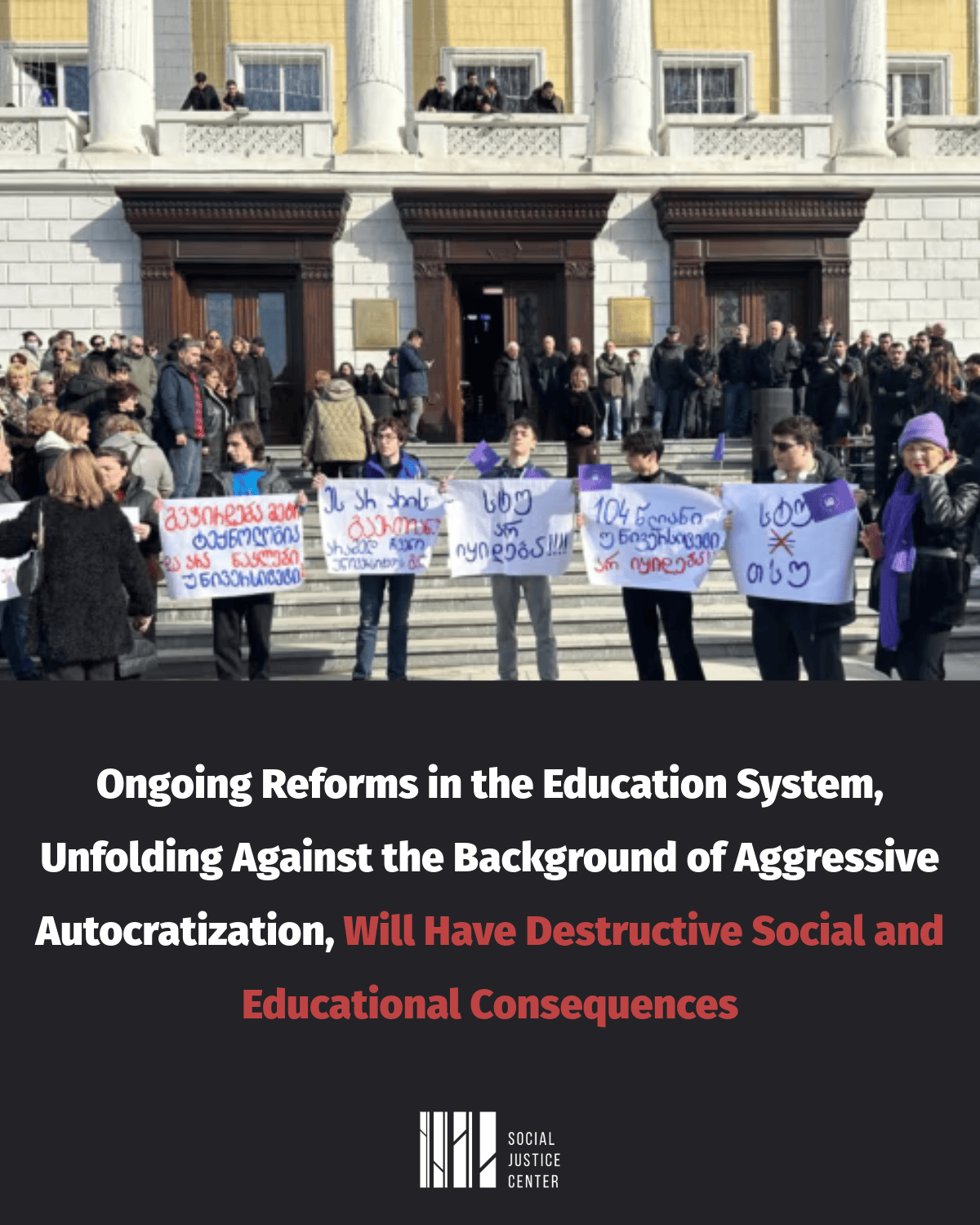
On 4 February 2026, the Parliament of Georgian Dream adopted, at final reading, amendments to the Laws of Georgia on General Education and Higher Education. The legislative changes encompass the following key areas.
Key Changes in General Education
Key Changes in Higher Education
This education reform, like other recent interventions by Georgian Dream in the education system—such as the merger of Tbilisi State University and the Georgian Technical University, the implementation of the “Profession: Police Officer” campaign in schools, the introduction of “values-based education” by representatives of the Patriarchate, and many others—does not aim to address the real and acute problems within Georgia’s education system. These problems include the shortage and poor condition of student dormitories, high tuition fees, and the large number of students with suspended status. Instead, the reforms serve the long-term consolidation of Georgian Dream’s power by bringing the last independent public spaces under its control and pursuing a deep and comprehensive ideological transformation of Georgian society.
If implemented, these reforms carry a high risk that schools will be transformed into sites of authoritarian discipline and indoctrination—factories for producing new authoritarian subjects—while universities will be reduced to narrowly specialized suppliers of labour for private business, where the production and dissemination of critical academic thought is minimized.
Given that the higher education reform forms part of Georgian Dream’s broader and more comprehensive political agenda, it is important not to consider it in isolation from other ongoing educational and political changes.
In recent months, several significant initiatives have been announced in the field of general education, including:
Many of these changes display clear potential indicators of authoritarianism.
The “one subject – one textbook” initiative will particularly affect subjects such as Georgian language and history. In discussing the need for a single textbook, the Ministry has placed its primary emphasis not on academic considerations, but on instilling traditional and national values and a patriotic spirit among students[1]. In the broader national context—where decisions are taken unilaterally and effective political and institutional checks and balances are absent—there is a high risk that school textbooks will be used for political indoctrination, the revision of certain historical periods and events, and the ideological shaping of education.
Although the “values-based education programme” is not formally mandatory and is implemented within the framework of informal education clubs affiliated with schools, it nevertheless creates risks of religious and political indoctrination within the secular space of schools. According to the Ministry of Education, within this programme clergy discuss topics such as faith, family, and homeland with students[2].
It is important to note that in Georgia a range of legal acts regulate freedom of religion and religious neutrality in the educational process in public schools, explicitly prohibiting religious indoctrination, proselytism, and discrimination.
The Law on General Education expressly excludes the imposition of obligations on students, parents, or teachers that fundamentally contradict their beliefs and conscience.[3] Article 13 of the Law directly prohibits the use of the educational process in public schools for the purposes of religious indoctrination, proselytism, or forced assimilation.[4] Furthermore, the placement of religious symbols on public school premises for non-academic purposes is deemed impermissible.[5] The conduct of religious rituals during the teaching process is clearly prohibited, even for academic purposes.[6] These provisions reflect the clear intent of the state to regard public schools as civic spaces free from religious content, where religion is approached not as belief, but as a system of knowledge, thereby aligning education policy with the requirements of a secular framework.[7]
The European Court of Human Rights prohibits indoctrination in the sphere of public education. While this does not amount to a blanket exclusion of non-formal teaching about religion, such teaching must not take the form of indoctrination. According to the Court, a compulsory subject may not give preferential treatment to a single religion, even if other “traditions” are mentioned, where they are presented as secondary and not recognized as equally valid belief systems.[8] The Court has also found elements of indoctrination in compulsory subjects where more than 50 percent of the curriculum concerns Christian belief and philosophical education is addressed only marginally.[9]
Moreover, implementing the values-based education programme exclusively through clergy of the Georgian Orthodox Church places it in a privileged position vis-à-vis other religious organizations, thereby creating a high risk of violating the constitutional principle of secularism and the state’s obligation of religious neutrality. Given documented cases of proselytism and indoctrination in public schools in regions populated by religious minorities over recent decades[10], there is also a risk that this programme will be used to indoctrinate non-Orthodox students in regions inhabited by ethnic and religious minorities, including Azerbaijani and Armenian-language schools and sectors in Georgia.
Additionally, despite the Ministry’s claim that the values-based education programme operates within informal education clubs and does not constitute a compulsory school subject, it remains unclear what degree of genuine freedom will students be able to enjoy in practice to decide whether to participate. With regard to legitimate procedures for exemption from compulsory subjects, the burden of justifying the need for exemption may not be placed on students or their parents, as this could require disclosure of deeply personal aspects of belief.[11] Furthermore, the Court has found that partial exemption from a compulsory religious subject is insufficient, as it imposes on parents both the burden of justification and the obligation to continuously monitor educational content.[12]
According to the Ministry of Internal Affairs, the “Profession: Police Officer” campaign aims to raise awareness among students about police work, popularize the profession, and build trust between students and police officers. However, in the context of the severe politicization of the police in recent years - where the police are perceived as an extension of the ruling regime - this campaign cannot be viewed as anything other than an attempt at political indoctrination of students.
The mandatory introduction of school uniforms in primary grades of public schools may likewise be understood as a tool for disciplining students through enforced uniformity and as another manifestation of authoritarian pedagogy. Moreover, in the context of an already difficult socio-economic situation, the additional financial burden of purchasing school uniforms will disproportionately affect economically vulnerable and poor families.
Reducing the duration of general education from 12 to 11 years is, in itself, a regressive step for a system already facing multiple challenges and often failing to equip students with basic skills and competencies even within a 12-year framework. Furthermore, 11 years of general education threatens the ability of Georgian applicants to enroll in undergraduate programs at Western universities, which typically require 12 years of schooling. Despite assurances from the Ministry of Education that all interested students will be able to register for and attend a 12th grade if they wish, it is likely that even under full implementation this process will be problematic, requiring students to change classes and possibly schools to complete a 12th year, thereby introducing unnecessary obstacles into the educational process. Failure to fully implement this promise will have a disproportionately negative impact on students from low-income and vulnerable families, who will lack the opportunity to complete an additional 12th grade in Georgian or foreign private schools.
From the planned reforms and ongoing programs described above, it is evident that rather than addressing the genuinely serious challenges facing general education, Georgian Dream is pursuing policies aimed at disciplining and indoctrinating students. Schools - which should be among the safest and most neutral spaces, where parents send their children to receive education and develop basic social skills - are being transformed, under Georgian Dream’s agenda, into the first stage of ideological indoctrination.
The decision of the Georgian Dream government to merge the Georgian Technical University with Tbilisi State University forms part of the National Concept of Higher Education presented on 16 October 2025 and approved on 1 December of the same year. The Concept states that existing higher education institutions “fail to provide knowledge aligned with modern standards and to develop students’ professional skills,” which, according to the document, additionally contributes to youth emigration abroad. The Concept identifies seven major thematic problems and envisages corresponding reforms to address them. These reforms are, in turn, reflected in Legislative Draft No. 234/2-XI MP on Amendments to the Law of Georgia on Higher Education, adopted into Law on 2 February 2026.
The main challenges identified in the Concept are:
To address these problems, the Concept sets out a number of thematic objectives, including: geographical deconcentration of higher education by establishing Kutaisi as the country’s second university centre alongside Tbilisi; relieving Tbilisi through the development of infrastructure in Rustavi; the creation of entirely new infrastructure in Tbilisi and Kutaisi; the introduction of the “one city – one faculty” principle; reducing the minimum duration of bachelor’s and master’s programs from 4 to 3 years and from 2 to 1 year respectively; central approval of academic curriculums and student admission quotas; subordinating admission quotas to labor market demands; hierarchical reorganization of academic staff through the introduction of the institution of leading professors; and a transition from a grant-based funding system to a state-commission model.
It is noteworthy that neither the Concept document nor the accompanying legislative draft cites any relevant empirical research, expert opinions, or dialogue with the academic community. Consequently, it remains unclear on what findings or evidence the Concept and the legislative proposal are based.
Significant amendments were also introduced to the rules governing the reorganization of higher education institutions. According to the explanatory note, these changes aim to clarify the legal framework for the reorganization of state-founded higher education institutions, enhance the efficiency of the process, and protect the public interest. Georgian Dream justifies these amendments by referring to the implementation of systemic reforms, the improvement of academic and scientific quality, increased administrative and economic efficiency, and enhanced international competitiveness. However, a substantive analysis of the proposed mechanisms raises serious questions regarding their constitutionality, proportionality, and compatibility with the principle of university autonomy.
The Problem of Restricting University Autonomy
The Constitution of Georgia and the Law on Higher Education grant universities academic, organizational, and financial autonomy, which constitutes one of the fundamental pillars of a democratic higher education system. The law authorizes the Government of Georgia, during a reorganization period, to “temporarily suspend or modify, for a defined period, the exercise of the powers of certain governing bodies as determined by law and/or the statutes of state-founded higher education institutions,”[13] if this is deemed necessary to achieve the objectives of reorganization. This provision substantially undermines the substance of institutional autonomy.
In addition, the Minister is empowered to appoint acting rectors, acting vice-rectors, an acting head of administration, an acting head of the quality assurance service, and to establish a temporary collegial governing body - a temporary governing council - which, within the scope and timeframe determined by a government decree, may exercise the powers of the academic council and/or the representative council.[14]
The temporary suspension of elected governing bodies (academic council, representative council) or their replacement by a temporary governing council appointed by the executive branch creates a real risk that university self-governance will be reduced to a purely formal institution.[15] Although the law characterizes these powers as “temporary and goal-oriented,” it fails to establish sufficient legal safeguards to prevent their use for political purposes.
According to the case law of the Constitutional Court, autonomy is not a privilege but a functional guarantee for the realization of academic freedom; therefore, any interference with it must satisfy a strict constitutional test (legitimate aim - necessity - proportionality).
The model introduced by the amendments - granting the executive authority the power to temporarily replace elected university governing bodies with appointed actors - fundamentally violates this functional nature of autonomy and effectively reduces it to administrative management.
Parallel to the adoption of the law, numerous public statements by representatives of Georgian Dream clearly indicated that decisions regarding reorganization were not preceded by consultations with the universities themselves and that these political decisions were not subject to revision, regardless of the position of the universities’ academic councils.[16]
The changes introduced in the education system have also been criticized by the Rectors’ Conferences of Austria, Germany, Poland, and Slovakia, which have called on Georgian Dream not to implement the initiated education reform. In a joint statement, the members of these conferences note that the Concept contradicts the principles Georgia committed to uphold by joining the Bologna Process and, consequently, the European Higher Education and Research Area. The measures envisaged in the Concept - aimed at restructuring the system and funding of higher education institutions, reorganizing teaching, research, and staff structures, and aligning institutional activities with state requirements - seek the complete dismantling of the existing structure and the subordination of what remains to full political control and direction.
The implementation of the planned reform poses a serious threat to the future of Georgia’s higher education system and risks destroying the achievements of comprehensive reform processes carried out in recent years. These reforms, implemented with substantial European support, have made Georgia a valuable participant in the European research and higher education space, rendering Georgian higher education institutions desirable partners for international cooperation in teaching and research.[17]
Broad Discretion Granted to the Government
The law grants extensive discretion to the Government of Georgia and the Minister of Education, enabling them to determine:
Most of these issues are not regulated in detail by the law itself and are instead left to government decrees. Such vagueness violates the principle of legal certainty and increases the risk of political interference in the academic sphere. Particularly problematic is the absence of clear criteria in the law defining when reorganization is necessary and the lack of an objective test for assessing whether a “public interest” genuinely exists in a given case.
The explanatory note also fails to indicate whether an education market analysis was conducted, whether the education system was assessed, or why such large-scale interference with university autonomy was deemed necessary.
The fact that the legislative amendments were initiated without consultations with universities is confirmed by statements from both university representatives and members of the Georgian Dream leadership[18]. According to Irakli Kobakhidze, the Technical University fails to adequately ensure the development and strengthening of technical disciplines[19]. One day prior to this statement, government-aligned media reported that teaching conditions at the Georgian Technical University were inadequate and that its infrastructure failed to meet academic standards. The Technical University responded by categorically demanding an apology and retraction for the dissemination of unverified and inaccurate information.[20]
Disregard for the Principles of Proportionality and Necessity
While the legislator repeatedly cites efficiency and quality improvement as the objectives of reorganization, it fails to substantiate why suspending the powers of university governing bodies is necessary to achieve these goals. Alternative, less intrusive mechanisms - such as enhanced oversight, institutional audits, or recommendation-based reforms - are not considered at all in the legislative proposal.
This raises a legitimate question as to whether the proposed regulation meets the proportionality test—namely, whether it is necessary to achieve the stated objectives and whether the restriction of rights exceeds permissible limits.
Deficit of Transparency and Participation
Despite declared aims, the adopted changes do not ensure effective participation of academic staff, students, and other stakeholders in the reorganization process. The law does not provide for:
This deficiency is particularly troubling given that the temporary governing council may replace precisely those bodies that constitute the primary mechanisms of democratic representation within universities.
The Formal Nature of “Temporariness”
Although the legislative amendments repeatedly emphasize the temporary nature of the mechanisms introduced, they do not establish strict maximum time limits or conditions that would automatically terminate executive-appointed governance. As a result, “temporary” arrangements risk becoming prolonged regimes, further weakening institutional resilience.
Despite the formal objective of ensuring legal clarity and efficiency in reorganization processes, the substance of the amendments poses serious risks to university autonomy, academic freedom, and the principle of legal certainty. The proposed changes significantly strengthen executive control over higher education institutions and lack sufficient safeguards to ensure that such interference remains proportionate and truly exceptional.
The introduction of the “one city – one faculty” principle - under which a given faculty may operate in only one state university per city - constitutes a direct path toward weakening those state universities that are not yet under Georgian Dream’s control. Despite assurances that academic staff and student admission numbers will not be reduced, it is likely that faculty mergers will lead to a reduction in admissions, as it is difficult to envisage a single university accommodating large numbers of merged faculties.[21] The hierarchical reorganization of academic staff envisaged by the draft law - subordinating associate and assistant professors to full and leading professors - creates a high risk of eliminating academic freedom and autonomy[22], as well as enabling party control over career incentives and life chances. Moreover, faculty mergers and potential reductions in student numbers increase the risk of staff downsizing, particularly affecting academic personnel critical of the regime. The transformation of comprehensive state universities into narrowly specialized institutions unable to define their own academic priorities or pursue multidimensional teaching and research will sharply reduce opportunities for multidisciplinary scholarship.
The creation of entirely new infrastructure in Tbilisi and the alleviation of pressure on the capital through the development of Rustavi likely aims at selling off centrally located state university buildings and replacing them with new infrastructure in peripheral districts of Tbilisi and in Rustavi. Relocating students from historic university buildings in the city centre to the outskirts or to Rustavi appears intended to geographically segment and neutralize the student body as a traditionally progressive collective actor by dispersing it and distancing it from centres of political decision-making.
The reform also envisages reducing the minimum duration of bachelor’s programs from four to three years and master’s programs from two to one year. Under the new system, a student completing a master’s degree will have spent only 15 years in secondary and higher education, compared to the current 18. Such a radical reduction in study duration threatens the quality of education provided in public schools and universities. Moreover, compressing existing programs into shorter timeframes risks severe curricular reductions and deterioration of educational quality. These changes also threaten the credibility and reputation of qualifications awarded by Georgian higher education institutions and their compatibility with, and recognition by, European and international quality assurance bodies.
Alongside its authoritarian features, the reform is also neoliberal in nature: rather than prioritizing personal development or social goods, it explicitly subordinates higher education to market demands. This approach restricts applicants’ and students’ freedom in career choice and personal development, while simultaneously delivering a heavy blow to the social sciences and humanities, which have traditionally served as spaces for critical thought.
Conclusion
The changes underway in general and higher education cannot be viewed as neutral administrative optimization or sectoral policy adjustment. They represent a fundamental redefinition of the function of the education system, in which education gradually loses its role as a public good and a space for the development of critical thought, transforming instead into a mechanism of political loyalty, discipline, and social control. In this process, education ceases to serve the autonomous formation of free individuals and becomes oriented toward reproducing a predetermined social and ideological order.
At the level of school education, the strengthening of discipline, uniformity, and standardized content creates a hegemonic educational space in which difference, critical questioning, and pluralism are systematically suppressed. Schools - meant in democratic societies to function as safe and neutral spaces for social learning and the development of civic competencies - are transformed into instruments of early socialization that produce obedient and politically neutralized subjects. Under such conditions, knowledge loses its capacity for interpretation and critique and functions instead as a closed, authoritative narrative.
Changes in higher education even more clearly demonstrate the political subordination of the education system. The weakening of universities’ institutional autonomy, the centralization of governance, and the transformation of academic self-governance into a formal shell undermine the structural preconditions without which academic freedom cannot meaningfully exist. Universities gradually lose their status as public spaces and come to resemble administrative units whose primary function is the implementation of predetermined economic and political objectives.
Furthermore, subordinating education to narrow labor market demands diminishes its value as a critical, social, and cultural practice. Teaching is reduced to a short-term instrumental process, prioritizing immediately applicable skills, while value-based, humanistic, and critical components are declared secondary or superfluous. As a result, education loses its potential to generate social change and instead serves to stabilize existing power structures.
These reforms have particularly severe consequences from the perspective of social equality. The degradation of the public education system and the weakening of ties with the international educational space disproportionately harm groups for whom education is the only realistic mechanism of social mobility and advancement. Thus, education which should theoretically reduce social inequality - begins in practice to reinforce and normalize it.
Ultimately, the changes in the education sector should be understood as part of a long-term strategy of autocratic transformation aimed not only at controlling institutions, but at capturing the processes of knowledge production, transmission, and legitimation. Such a restructuring of the education system produces a society in which critical thought is structurally undesirable, dissenting positions are marginalized, and education becomes one of the most effective instruments for maintaining power.
[1] Tea Topuria, One Subject - One Textbook, why does the talk about the future of school textbooks remind the publishers of the past? Radio Liberty, 6 December 2025.
[2] Priest participating in the values-based education programme received relevant certificates, The Ministry of Science and Education, 20 September, 2025.
[3] Law of Georgian on General Education, Article 18, paragraph 1.
[4] Law of Georgia on General Education, Article 13, paragraph 2.
[5] Law of Georgia on General Education, Article 18, paragraph 3.
[6] Law of Georgia on General Education, Article 18, paragraph 4.
[7] Social Justice Center, Study: “Religion in Public Schools (An Analysis of Education Policy from the Perspective of Freedom of Religion)”, p. 15.
[8] Mansur Yalçın and Others v. Turkey, no. 21163/11, 16 September 2014.
[9] Folgerø and Others v. Norway [GC], no. 15472/02, ECHR 2007-III.
[10] Social Justice Center, The Violation of the Principle of Religious Neutrality in Tsalkа Public School Requires the State to Take Positive Measures, 29 February 2024. https://socialjustice.org.ge/ka/products/tsalkis-sajaro-skolashi-religiuri-neitralitetis-printsipis-darghvevis-fakti-sakhelmtsifosgan-pozitiuri-zomebis-mighebas-sachiroebs#_ftn5
[11] Hasan and Eylem Zengin v. Turkey, no. 1448/04, 9 October 2007.
[12] Folgerø and Others v. Norway.
[13] Law of Georgia on Higher Education, Article 13, paragraph 21.
[14] Ibid.
[15] Pursuant to Article 20 of the Law of Georgia on Higher Education:
“1. The highest representative body of a higher educational institution established as a legal entity of public law is the Academic Council. Its members are elected through direct, free, and equal elections by secret ballot by all members of the academic staff of the basic educational units, all members of the scientific staff of independent research units, and representatives of the student self-governance elected from among the members of the councils of the basic educational units.”
[16] BMG, “The Political Decision on the Merger of Universities Has Already Been Made; I Will Not Reconsider It in Any Way – Zviad Gabisonia.” https://bm.ge/news/universitetebis-gaertianebaze-politikuri-gadatsyvetileba-ukve-mighebulia-veranairad-gadavkhedav-zviad-gabisonia
[17] BMG, “Rectors’ Conferences of Austria, Germany, Poland, and Slovakia Are Concerned About Developments in the Higher Education Sector.” https://bm.ge/news/avstriis-germaniis-polonetis-da-slovaketis-reqtorta-konferentsiebi-sheshfotebulni-arian-umaghlesi-ganatlebis-seqtorshi-mimdinare-movlenebit
[18] Radio Free Europe/Radio Liberty, “I Learned Yesterday” – interview with the Rector of the Technical University:
“The academic staff and students of the Technical University learned this morning from television broadcasts, during Givi Mikanadze’s briefing, that the university with a 100-year history will become part of Tbilisi State University.”
[19] InterpressNews, “Irakli Kobakhidze: At the Georgian Technical University, the technical field has become secondary; this must change — we want to restore TSU to the condition in which it was originally established by Javakhishvili.” https://www.interpressnews.ge/ka/article/861172-irakli-kobaxize-sakartvelos-teknikur-universitetshi-teknikuri-mimartuleba-ikca-gerad-es-unda-sheicvalos-gvinda-tsu-s-agvudginot-mdgomareoba-rogorc-tavis-droze-sheikmna-javaxishvilis-mier
[20] InterpressNews, “The Georgian Technical University Requests an Apology from TV Company POSTV for Disseminating Unverified Information.” https://www.interpressnews.ge/ka/article/861085-sakartvelos-teknikuri-universiteti-telekompania-postv-is-gadaumocmebeli-inpormaciis-gavrcelebistvis-bodishis-moxdas-stxovs/
[21] Keti Tsotniashvili, Lela Chkhaia, Analysis of the National Concept of Higher Education Reform, Ilia State University, Center for Education Research, 5 January 2026. https://edresearch.iliauni.edu.ge/wp-content/uploads/2026/01/analizis-dokumenti-2.pdf?fbclid=IwY2xjawPwn9NleHRuA2FlbQIxMQBzcnRjBmFwcF9pZBAyMjIwMzkxNzg4MjAwODkyAAEeJ6fi04R9SYGlArjfVi2vyD76cxmyuTqBNyhgG6opbA_sZ9Ixn6CGeQeySZ8_aem_AHfoKmaGX29zIfq0JeWMlQ
[22] Ibid.
The website accessibility instruction