
საერთო ცხელი ხაზი +995 577 07 05 63


საერთო ცხელი ხაზი +995 577 07 05 63
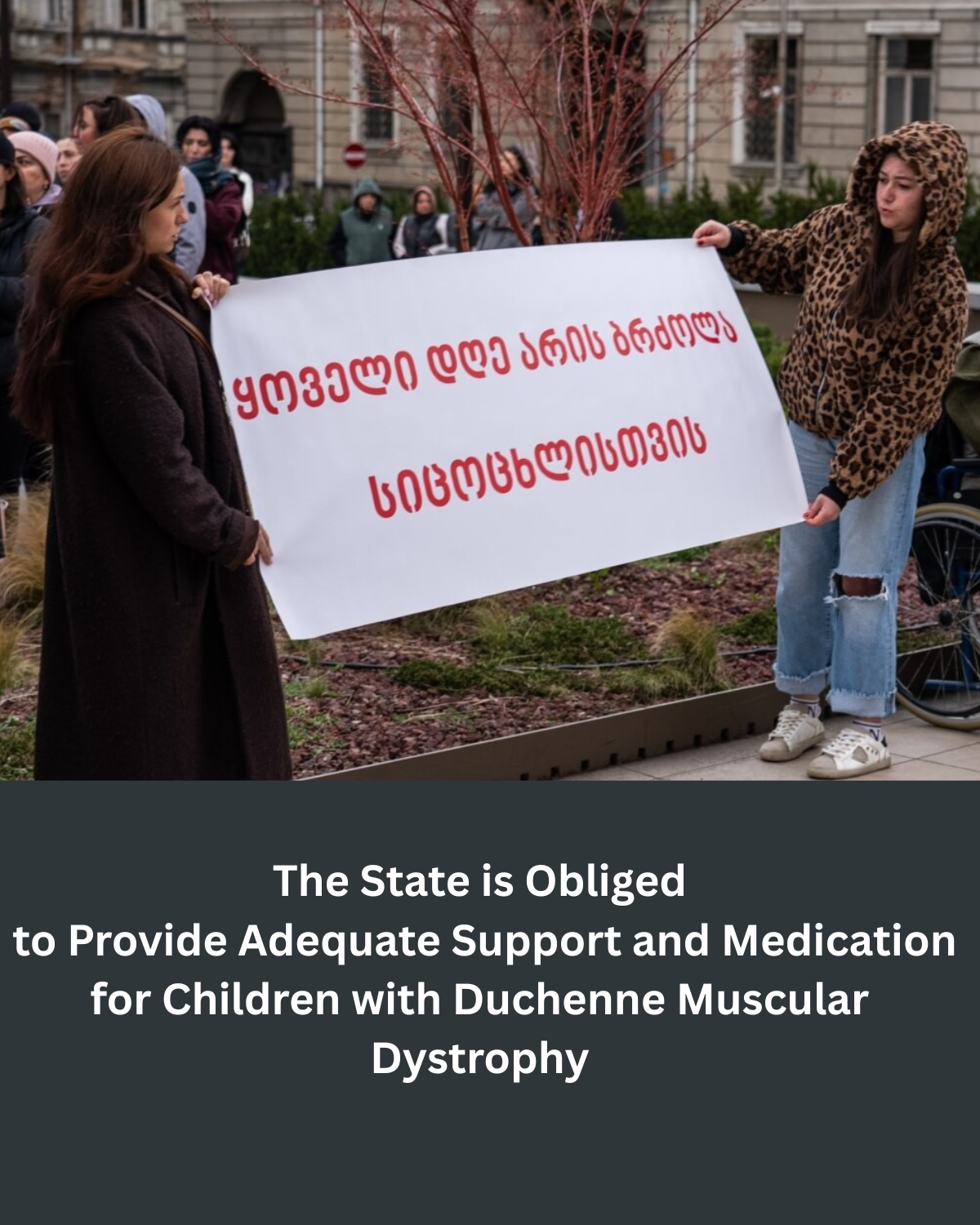
The Social Justice Center responds to the ongoing protests by children with Duchenne muscular dystrophy and their family members. We join the unprecedented marathon initiated in recent days by students of Ilia State University, which demonstrated extraordinary solidarity and public support for the protest launched by the parents. The Social Justice Center analyzes the context surrounding access to medication, including relevant human rights standards, and once again calls on the state to take into account the needs of these children and ensure access to medications that can improve their quality of life and extend their lifespan.
Today marks the 38th day of the continuous protest in front of the Government Administration demanding access to medication. Unfortunately, there is currently no cure for Duchenne muscular dystrophy. However, research indicates that available medications help children maintain independent mobility for a longer period and delay fatal outcomes. Therefore, refusing to fund medications that can alleviate the condition and prolong life constitutes a violation of the state’s obligations to guarantee the rights to life and health.
At this stage, several types of medications are considered relevant for these children, including: 1. Givinostat (Duvyzat), which has authorization from both the U.S. Food and Drug Administration (FDA) and the European Medicines Agency (EMA); 2. Elevidys, a gene therapy authorized by the FDA and by several countries, including Japan and Brazil; 3. Vamorolone (Agamree), a next-generation steroid authorized by the FDA, EMA, and the United Kingdom; 4. Exon-skipping therapies (e.g., Eteplirsen/Exondys 51, Casimersen/Amondys 45, Viltolarsen/Viltepso), which are used for individuals with specific medical conditions, some of which have also received FDA authorization.
Although Duchenne muscular dystrophy is a continuously progressive medical condition in which every day is critically important, statements made so far by representatives of the “Georgian Dream” party indicate that the purchase of these medications is not planned in the near future. Moreover, observation of the process clearly reveals the neglect of the children’s needs by all three branches of government - the executive, legislative, and judicial branches.
Specifically, before the active protests began, the families of the children had been working with the Minister of Internally Displaced Persons from the Occupied Territories, Labour, Health and Social Affairs of Georgia for nearly two years. Unfortunately, this process did not result in the funding of the above-mentioned medications. On the contrary, according to Mikheil Sarjveladze, the requested medications merely delay patients’ need for wheelchairs, and the state will wait for specific evidence before making a decision on importing the drugs.
Unfortunately, the executive authorities are not only refusing to make a decision regarding the funding of these medications, but are also obstructing families from exercising their right to protest. For example, the police did not allow protesters to set up tents.
In December 2025, the parents’ organization - “Together Against Duchenne Muscular Dystrophy”, submitted a petition to Parliament requesting access to the medications. The Parliamentary Committee on Healthcare and Social Issues responded only four months later and forwarded the petition text to the ministry. The Parliament’s letter stated that the Ministry should provide information regarding the issues raised in the petition to both the petition author and the legislative body within one month, by the end of May, even though the Ministry’s position has already been publicly known.
The judicial system also turned overlooked the needs of the children. The court of first instance rejected the request for an interim injunction filed by the organization “Partnership for Human Rights” seeking provision of the medications just two days after the application was submitted.
The main reasons cited by the government for refusing to fund the medications are weak and unsubstantiated. One of the primary arguments concerns the drugs’ side effects, the risks of death associated with taking them, and allegedly insufficient research. Considering that Duchenne Muscular Dystrophy is classified as a rare disease, comprehensive long-term observation of these medications naturally requires significant time. However, authorization by relevant agencies in democratic countries demonstrates that the benefits of these drugs outweigh the risks and that there is a need for immediate action. Regarding the alleged lethality of the medications, it is also important to note that such risks do not apply equally to all of the drugs mentioned. Furthermore, all of them are used only for strictly defined patient groups and under intensive supervision by medical institutions, which substantially reduces serious risks. As for side effects, these are not unique to any particular medication. Even the drug already covered under Georgia’s healthcare program for people with Duchenne muscular dystrophy (Deflazacort) has side effects.
Another reason cited by the government is the high cost of the medications. For example, Irakli Kobakhidze stated that the estimated total cost of the drugs would amount to several tens of millions of GEL, which, according to him, would represent an impractical use of taxpayers’ money and enrich the pharmaceutical mafia. Although high prices imposed by pharmaceutical companies are internationally recognized as one of the major barriers to the realization of the right to health, this cannot serve as grounds for the state to refuse access to life-saving medications. This is especially true considering that there are opportunities to negotiate with companies and obtain the drugs at reduced prices. Moreover, when tens and hundreds of millions of GEL are spent on public officials’ business trips, bonuses and salary supplements, New Year decorations and events, or lost through allegedly corrupt or otherwise improper budget management by municipalities, focusing solely on the cost of medications as a matter of fiscal responsibility demonstrates unfair treatment and double standards on the part of the government.
Regardless of the position expressed by the government, meeting the needs of people with Duchenne muscular dystrophy and ensuring their access to medication remains an obligation of the state. This obligation derives from both domestic and international legal standards.
Given that Duchenne Muscular Dystrophy is classified as a rare disease, international practice concerning the needs of people with this medical condition and their access to medication is extremely limited. However, existing international instruments, such as the International Covenant on Economic, Social and Cultural Rights, the Convention on the Rights of Persons with Disabilities, the Convention on the Rights of the Child, the European Convention on Human Rights, and the European Social Charter, make it possible to determine the scope of the state’s obligations.
According to these standards, the state is obligated, first and foremost, to protect the right to life. This includes the duty to systematically identify the major risks threatening children’s lives, survival, and development, and to implement evidence-based interventions.
At the same time, international standards point to states’ obligations to guarantee the right to health, which requires ensuring that people have access to timely, safe, accessible, adequate, and affordable healthcare services. The issue of access to healthcare services for people with rare diseases was also emphasized by the United Nations General Assembly in its 2021 resolution. The resolution highlights the importance of promoting multidisciplinary expert networks and properly empowering affected individuals and their family members.
In the provision of healthcare services, one of the key issues is prioritizing the best interests of the child, as well as ensuring children’s involvement and participation. Another essential aspect is the early identification of disabilities, early intervention, medical assistance, rehabilitation, and the provision of assistive devices - issues emphasized by the United Nations Committee on the Rights of the Child in its General Comment N 9.
Another important component of the right to health is access to medication, which has been emphasized in numerous international documents. For example, according to the UN Special Rapporteur on the Rights of Persons with Disabilities, access to medication is a prerequisite for a dignified life, independence, and full integration into society for persons with disabilities. Likewise, according to the UN Special Rapporteur on the Right of everyone to the enjoyment of the highest attainable standard of physical and mental health, access to medicines is an integral part of the right to health standard, and states are obligated to ensure access to medications without financial or geographical barriers.
In addition to these general standards, it is also important to consider the interpretations of courts in different countries regarding guarantees of access to medication. Although there are practically no international court decisions on this issue, the reasoning of national courts points to the fundamental principles that should guide state actions in this area.
One important national-level precedent is the Brazilian court decision (case PET 1246). The case concerned a person with Duchenne Muscular Dystrophy who requested that the government fund an experimental treatment available only in the United States. Despite these circumstances, the court granted the claimant’s request and stated that, when choosing between the inviolability of the right to life and the financial or secondary interests of the state, ethical and legal considerations leave the judge with only one possible option - unwavering respect for human life. The court also considered the issue of funding Elevidys and ultimately ruled in favor of a strictly defined group of patients, in parallel with a reduction in the price of the medication.
The court adopted a stricter position regarding the exon-skipping drug (Exondys 51). It relied on the fact that the medication had not been authorized in Brazil and stated that a decision to provide the drug could be made only in exceptional circumstances (such as 1. when there was an application for the drug’s registration in the country; 2. when the medication had already been authorized abroad by another country’s regulatory agency; 3. when there was no therapeutically equivalent alternative registered domestically; and 4. when the national competent authority had unduly delayed the registration process). Despite the outcome, the court still established conditions under which the government could be obligated to provide a medication even in the absence of national authorization.
Another important case (Nikolausbeschluss) concerning access to treatment is the decision of the Federal Constitutional Court of Germany. The court found unjustified the refusal of the social insurance fund to reimburse the costs of a new treatment method (immunobiological therapy) for a person with Duchenne muscular dystrophy on the grounds that the treatment was not sufficiently evidence-based. The court held that legislative criteria restricting healthcare benefits must be interpreted in accordance with the right to life, physical integrity, and the principle of the social state. It emphasized that, in cases involving life-threatening medical conditions, denying even experimental treatment that offers the possibility of recovery or a tangible positive effect solely because of insufficient scientific evidence is impermissible.
In the context of Duchenne Muscular Dystrophy, certain decisions have also developed the concepts of humanitarian access to medication and the “right to try”. Among these is a decision by a U.S. district court granting a child access to a medication that was still undergoing clinical research. The decision was influenced by several factors, including the life-threatening nature of the condition, the absence of adequate alternative treatment, the fact that active clinical studies of the medication were underway, and the pharmaceutical company’s active efforts to secure approval for the drug. Although the ruling was later overturned by a higher court, it still remains an important reference point in discussions concerning the right of access to medication.
The representative organizations of persons with disabilities (“Families Against Discrimination” (FAD), “Platform for New Opportunities” (PNO), and “Alliance of Women with Disabilities” (AWD)) have applied to the UN Committee on the Rights of Persons with Disabilities and the UN Committee on the Rights of the Child. In this submission, they describe the difficulties faced by children with Duchenne muscular dystrophy in accessing medication and urge the Committees to take action. It is crucial how these Committees will assess the situation and what positions they will issue to the government.
From the above, it is clear that by refusing to fund the medications, the government is violating children’s rights, including their right to health. While it is evident that state intervention in this area must fully take into account safety considerations, adherence to strict regulatory requirements, including clearly defined patient groups and treatment protocols, makes it possible to ensure uninterrupted access to medication and to improve the children’s condition.
At the same time, another important perspective must be emphasized. The needs of children with Duchenne muscular dystrophy should not be viewed solely through a medical or charitable lens. Modern standards of rights of persons with disabilities recognize these children not only as patients, but as rights-holders who are entitled to dignity, autonomy, and full participation in social life. Accordingly, the state’s obligation is not limited to prolonging life. It also includes creating conditions that enable access to education, mobility, social integration, and the highest attainable level of independent living.
The situation of Duchenne muscular dystrophy reveals structural failures in Georgia’s policy on rare diseases. The current reality forces families into long and individual struggles to obtain support that should instead be part of a predefined state policy. It is essential for the state to improve its rare disease program, ensuring mechanisms for early diagnosis, specialized services, access to medication, and rehabilitation for all such conditions.
It should also be noted that, beyond medication, families have wide social and healthcare needs that are not adequately covered by the existing social package for persons with disabilities (470 GEL per month for children with disabilities) or by available services and which require immediate attention. In parallel with the unprecedented public fundraising efforts, the state must assume its own responsibilities in this area.
In this context, it is vital for the state to move away from a defensive position, listen to the community, especially to children themselves, and fully understand its obligations. Instead of avoiding responsibility, it should take real steps to support individuals with Duchenne muscular dystrophy. This requires a multidisciplinary approach to fully identify children’s needs, determine the scale of medication requirements, and develop a timely and clearly structured plan for access to treatment.
Given the progressive nature of Duchenne muscular dystrophy, delaying decisions cannot be regarded as a neutral administrative process. Under such circumstances, the passage of time directly affects children’s physical condition, loss of functional abilities, and life expectancy. Therefore, waiting for “additional evidence” in the context of a rapidly progressing disease leads to real and irreversible harm. For this reason, in cases of rare and life-threatening diseases, the state has a heightened duty of urgency and careful responsiveness.
The Social Justice Center once again expresses its solidarity with children with Duchenne muscular dystrophy and their family members in this just and important struggle.
The website accessibility instruction