საერთო ცხელი ხაზი +995 577 07 05 63


საერთო ცხელი ხაზი +995 577 07 05 63
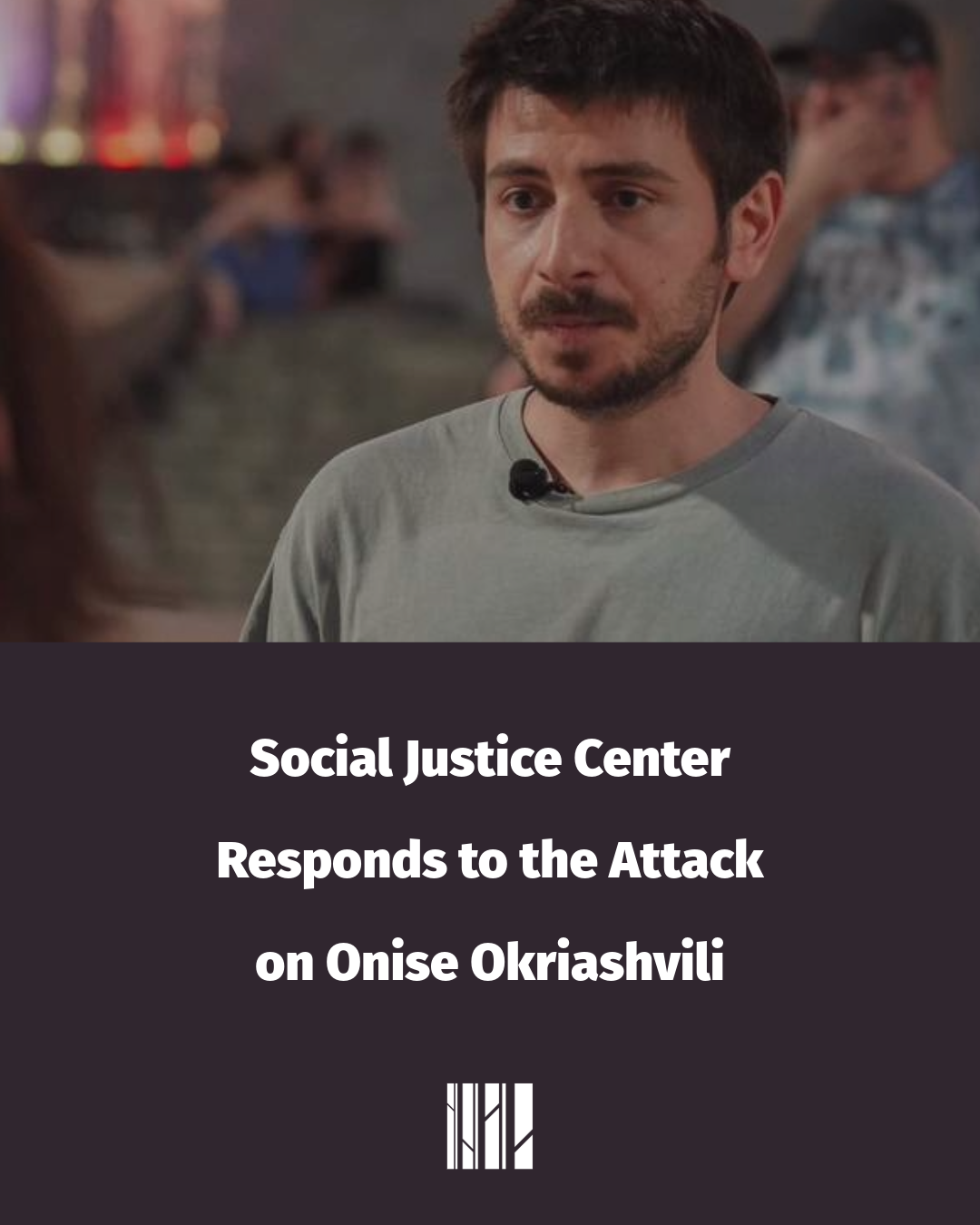
The Social Justice Center responds to the physical attack carried out yesterday against comedian and activist Onise Okriashvili. We consider that, in addition to the legal responsibility of the specific individuals who committed the violence, the case also raises the issue of the political responsibility of the ruling party and the media organizations under its control, which made the prominent activist and comedian the target of a coordinated campaign of discreditation, dehumanization, and persecution.
Yesterday, on 22 July, the media reported that comedian and activist Onise Okriashvili had been ambushed near his home and physically assaulted. According to Okriashvili, he was returning home from the protest on Rustaveli Avenue when three unknown individuals stopped him in the street and asked, “Aren’t you the one who insulted Nodar Dumbadze?” before beginning to beat him. The individuals involved in the attack fled the scene shortly afterwards. One of them appeared at a police station voluntarily several hours later and admitted his involvement in the incident.
According to a statement issued by the Ministry of Internal Affairs on 23 July, the investigation into the attack on Onise Okriashvili is being conducted under Article 126 of the Criminal Code of Georgia.
On 19 July, Onise Okriashvili recorded a video in which he stated that Georgian Dream’s propaganda apparatus was attempting to discredit and dehumanize him. The controversy concerned a manipulatively edited video clip in which Okriashvili, appearing as a guest on a podcast, was asked, “Is there anyone you hate?” In response, he gave a hypothetical example, saying that it would be absurdly funny if a guest were to say that they hated Nodar Dumbadze, and used profanity in that context. Pro-government propaganda, however, removed Okriashvili’s joke from its context and presented it to the public as though he had directly insulted Nodar Dumbadze.
On 19 July, the activist and comedian explained that, in responding to a question about whom he hated most, “we were speaking hypothetically, and the most absurd thing that came to mind at that moment was Nodar Dumbadze.” Okriashvili’s reference to Nodar Dumbadze formed part of a comedic performance. Dumbadze himself had served as editor of a satirical-humorous magazine and had repeatedly used provocative forms of expression to convey his views and criticism.
According to a report published on the website of Imedi TV on 20 July, the ruling party characterized the incident as the “discrediting of national values.” In the report, the journalist stated that Okriashvili’s joke was “unacceptable to a large part of Georgian society.” Representatives of the ruling party also appeared in the report and, while discussing the comedy program, referred to external and foreign forces allegedly fighting against Georgian traditional values. More broadly, the content of these media reports contributed to constructing a narrative in public perception that those participating in the ongoing protest on Rustaveli Avenue are people who oppose national values. At the same time, the reports portrayed Onise Okriashvili as an activist affiliated with opposition political parties.
Okriashvili recalls that, following the campaign conducted by propaganda media outlets, over the course of the previous three days he received numerous threatening messages through social media relating to his comedic performance. Some of those messages included threats to confront him outside his home and subject him to violence.
For these reasons, it is clear to us that, viewed structurally, this incident of violence is the result of the discreditation campaign organized by Georgian Dream and its propaganda media.
The pattern of conduct employed by propaganda broadcasters and affiliated pages is clear: they target individuals and groups known for expressing criticism of the government and then, by removing their statements from context, producing large volumes of material about them, and conducting coordinated discreditation campaigns, seek to generate negative public attitudes toward specific individuals. Such deliberate cultivation of hostility not only deepens polarization in society but, in some cases, ultimately leads to physical violence.
There is also another important context to this case, connected to Onise Okriashvili’s distinctive experience as an activist in recent years. For more than two years, he has been actively involved in the protests on Rustaveli Avenue and in protests in defense of the Public Broadcaster, and has carried out significant activist performances in different parts of the city. In his public activities, Okriashvili is distinguished by an activist approach grounded in trust. Through performances in the city’s peripheral neighborhoods, on the metro, and on buses, he has shared his views with the public about the authoritarian and anti-social decisions and policies being pursued in the country. Against this background, it is not accidental that Georgian Dream and the media under its control targeted one of the prominent activists of the Rustaveli protests and sought to subject him to public and social punishment.
In our view, the group attack, particularly if it was organized in advance by the perpetrators, is connected not only to Onise Okriashvili’s comedic performance but, more broadly, to his activist work, and appears aimed at intimidating and silencing him.
It is also noteworthy that today Georgian Dream MP and prominent party spokesperson Irakli Zarkua effectively justified the violence, stating: “If you do not have enough common sense not to joke about the Church, the Patriarch, or writers, the police cannot protect you everywhere... What happened is bad, but Georgian society will not let anyone get away with this.”
A similar pattern can be observed in other cases. In April and May 2024, numerous incidents were documented in which participants in protests against the “Russian Law” and civil activists were physically assaulted. Among those attacked were Giorgi Mumladze, Niko Managadze, Gia Japaridze, Dimitri Chikovani, Zurab Berdzenishvili, and others. In each case, the victims were confronted by groups consisting of several individuals. The attacks were generally carried out demonstratively near the victims’ homes, workplaces, or in other public spaces. As a rule, videos depicting the violence were subsequently posted on social media accompanied by insulting comments, further underscoring the political nature of the attacks. It is important to emphasize that Georgian Dream representatives have, as a matter of principle, never condemned these incidents of violence. Moreover, Dimitri Samkharadze, an active member of the party, has openly expressed support for such violence. According to the Public Defender of Georgia, the violent acts in question displayed signs of persecution on the grounds of political opinion, professional activity, and views, and it was therefore essential for the cases to be investigated promptly.
Humorous expression, even where it may be offensive or unacceptable to some, is protected by the right to freedom of expression[1] and must never be invoked to justify violence. The State has a positive obligation to ensure that individuals do not become targets of attacks because of their expression.[2] It is equally essential that the State ensure an effective investigation into such incidents.
According to a report of the UN Special Rapporteur on freedom of expression, State-sponsored disinformation may originate directly from State institutions or from proxy groups acting under State direction. In the digital age, new techniques have significantly expanded the scale, speed, and reach of such operations. When combined with the power, resources, and extensive reach available to the State, their impact can have devastating consequences for human rights.[3]
Against this background, it is even more problematic that the authorities speak of combating hate speech and have created a special unit within the Ministry of Internal Affairs for this purpose—while in practice using it to pursue policies of censorship on social media and in the media—when media outlets operating under the government’s control and coordination themselves organize coordinated campaigns of hatred against specific individuals.
Unfortunately, there is a real risk that developments of this kind will have a chilling effect and negatively affect the freedom of expression of other activists, artists, and other socially and politically engaged individuals.
It is important that the investigation carefully establish whether the individuals involved in the attack followed Onise Okriashvili from the protest, whether they were waiting for him in advance near his home, or whether the attack occurred spontaneously. The investigation must also identify all other persons who may have participated in organizing or coordinating the violence.
In addition, the investigation must determine the motive for the crime and ensure its appropriate legal classification, including by examining whether the attack was motivated by intolerance on the grounds of political or other expression and whether elements of persecution are present.
Accordingly, the Social Justice Center calls on:
Investigative authorities
Georgian Dream and the propaganda media under its control
[3] Disinformation and freedom of opinion and expression Report of the Special Rapporteur on the promotion and protection of the right to freedom of opinion and expression, Irene Khan, A/HRC/47/25, 13 April 2021, para 47.
[1] Vereinigung Bildender Künstler v. Austria, no. 68354/01, § 33, 25 January 2007; Alves da Silva v. Portugal, no. 41665/07, § 27, 20 October 2009; Eon v. France, no. 26118/10, § 60, 14 March 2013; see also Telo de Abreu v. Portugal, no. 55986/18, § 40ff, 7 July 2020.
[2] Human Rights Committee 102nd session Geneva, 11-29 July 2011 General comment No. 34 Article 19: Freedoms of opinion and expression, para. 23.
The website accessibility instruction