საერთო ცხელი ხაზი +995 577 07 05 63


საერთო ცხელი ხაზი +995 577 07 05 63
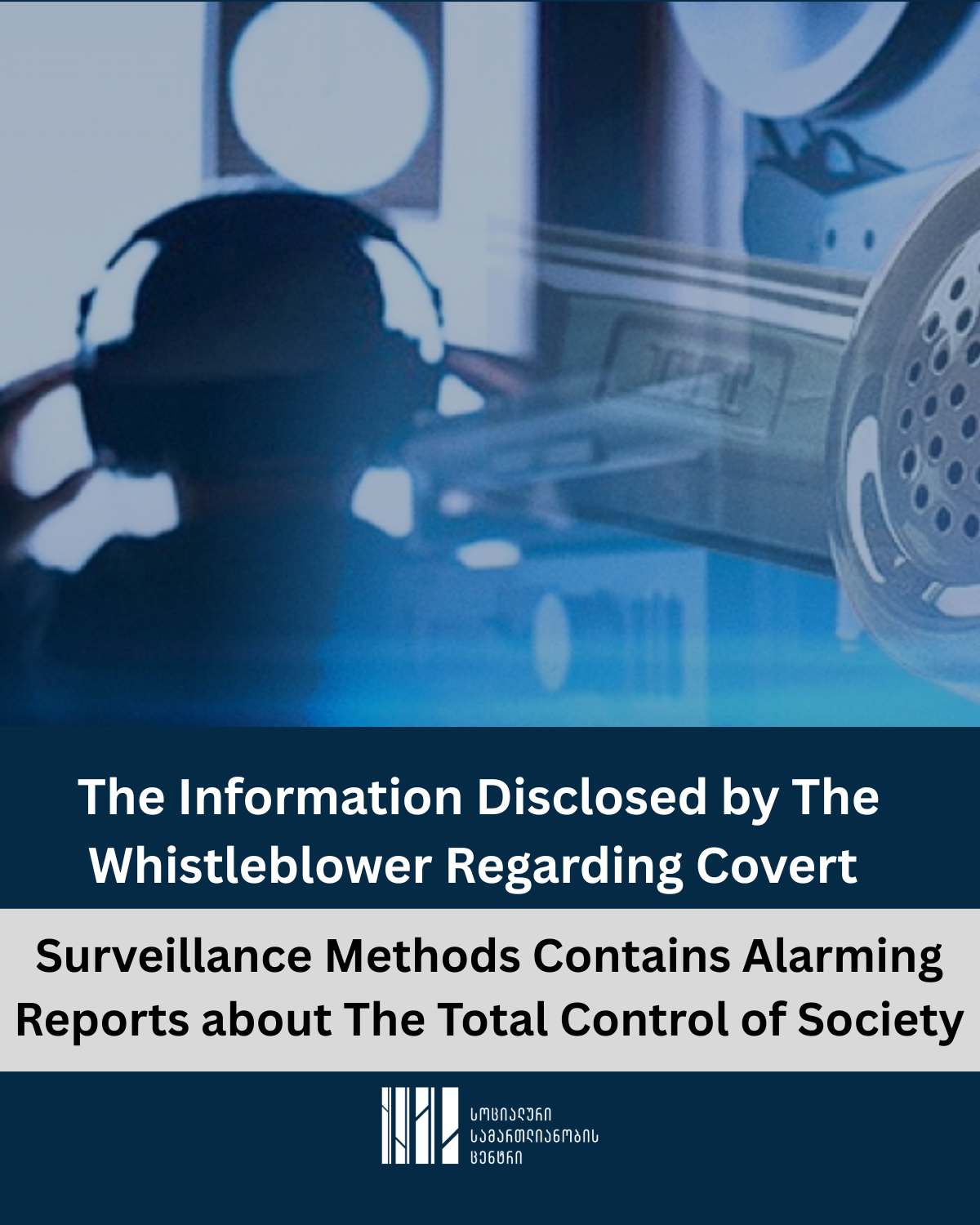
On April 26, 2026, former police officer Lieutenant Colonel Giorgi Iremashvili, who has 19 years of experience working in various positions within the Ministry of Internal Affairs, gave an extensive interview to the YouTube channel “Mismine.”[1] In the interview, he spoke about the characteristics of the architecture of covert surveillance, the surveillance and control software and technologies that law enforcement agencies, acting under the directive of “Georgian Dream,” use for the purposes of total control over the private lives of opponents, journalists, opposition politicians, members of civil society, and public figures, as well as for their coercion and recruitment.
In the interview, the whistleblower described in detail the alternative and extra-legal regime of covert surveillance that was established after the political party “Georgian Dream” came to power; the radically increased scale of covert surveillance and the methods of using the information thereby obtained; the intensified and close cooperation of Georgian law enforcement agencies with their Belarusian and Russian counterparts for the purpose of sharing experience in this field; and the practice of using special mobile phone surveillance software, including “Pegasus.”
Alternative Infrastructure for Total Surveillance and Control
According to the whistleblower, the equipment necessary for covert wiretapping was first created under the previous government. However, this was done through licensed procurement, and any decision to initiate surveillance against a specific individual was subject to prosecutorial and judicial oversight and carried out on the basis of a court order. Accordingly, there was formally a lawful basis for surveillance. Nevertheless, the problem lay in the absence of effective oversight, as courts and prosecutors approved investigators’ motions in almost every case.
After “Georgian Dream” came to power, despite promises that unlawful surveillance practices would cease, the scale of illegal covert surveillance increased even further. In particular, a covert alternative to the surveillance infrastructure was created, which has been used for covert surveillance purposes without any prosecutorial or judicial oversight or legal basis whatsoever. At the same time, covert surveillance for politically motivated purposes continued uninterrupted, with responsibility for it being assumed by the State Security Service.
Specifically, according to his account, under the previous government the covert surveillance equipment was located in various Ministry of Internal Affairs buildings, including the so-called “Module Building,” the Tbilisi Police Department building, the Financial Police building, and the Ministry of Internal Affairs building of the Autonomous Republic of Adjara. “Georgian Dream” used this equipment to create an alternative surveillance architecture. As a result, the use of this equipment made it possible to conduct covert surveillance of individuals without a court order, solely on the basis of oral authorization from the investigator’s immediate superior. Meanwhile, for official and documented surveillance purposes, alternative equipment was placed within the LEPL Operational-Technical Agency, whose building is located on Kavtaradze Street in Tbilisi. The whistleblower also indicated that every department of the State Security Service conducts covert surveillance, despite the fact that, under Georgian legislation, covert surveillance equipment is legally possessed only by the LEPL Operational-Technical Agency.[2]
According to Giorgi Iremashvili, the creation of so-called “alternative surveillance equipment” within the law enforcement system was justified by reference to the necessity of combating the increase in crime following the 2012 Law on Mass Amnesty and the mass release of prisoners. In particular, it was argued that the use of an alternative covert surveillance system was necessary in order to reduce rising crime rates without reflecting the increased scale and volume of surveillance in official statistics. However, this “temporary measure” subsequently became a permanent practice.
At the same time, in response to public criticism of mass surveillance practices under the previous government, the evidentiary standard required for conducting covert surveillance was raised. As a result, it became practically impossible for investigators to justify the use of covert surveillance through official procedures.
It should also be noted that the credibility of the information disclosed by the whistleblower is reinforced by the fact that, following persistent demands from civil society and after the change of government, amendments were indeed introduced into the Criminal Procedure Code in 2014.[3] However, human rights organizations stated that the legislative amendments implemented were fragmented and did not eliminate the possibility of continuing unlawful surveillance practices. In particular, the so-called “black box” (the lawful interception management system), which provides direct access to telephone conversations and the content of internet-based communications, remained within the Ministry of Internal Affairs, thereby ensuring its uncontrolled, real-time access to communications data.[4]
In its 2016 decision, the Constitutional Court of Georgia declared the aforementioned amendments unconstitutional and gave Parliament until March 31, 2017, to develop new regulations and ensure the institutional and technical restructuring of the system.[5] However, subsequent amendments to the legal framework governing covert surveillance made the problems relating to the absence of independent oversight over the surveillance process even more apparent.[6]
Systemic Problems in the Legislative Framework Governing Covert Surveillance and Monitoring
Under Georgian legislation, covert surveillance is permitted on the basis of the Criminal Procedure Code and the Law on Counterintelligence Activities. However, neither of these legal frameworks provides the safeguards necessary to protect against unlawful surveillance, thereby granting the authorities the possibility of unrestricted and arbitrary interference. In particular:
It was precisely the result of the mass practice of unlawful covert surveillance and the fundamentally flawed legislative framework that, between 2013 and 2021, the State Security Service illegally intercepted the private communications of clergy members, politicians, representatives of civil society, and journalists, and compiled so-called “files” (“krebsebi”), which were leaked in 2021 by an employee of the State Security Service. Information obtained through unlawful surveillance was used to collect compromising photo and video material against surveillance targets, as well as for the purposes of control and coercion.[8] Giorgi Iremashvili likewise confirmed the existence of such practices.
As became evident from the contents of the leaked “files,” the intercepted communications were unrelated to the investigation of crimes and/or the protection of state security, clearly demonstrating the entirely unlawful and arbitrary nature of the surveillance. Furthermore, the Prosecutor’s Office failed to provide victims with any document explaining the legal basis for the interception of their communications. Five years after the dissemination of the “files,” the investigation ongoing within the Prosecutor’s Office of Georgia remains formalistic and ineffective, as it has failed to identify those responsible for the unlawful surveillance. In connection with the grave violation of the victims’ right to privacy and the ineffective investigation, Social Justice Center has also filed an application before the European Court of Human Rights.[9]
Alarmingly Increased Scale of Total Social Control
It should be noted that, on April 22, Mamuka Mdinaradze, the former head of the State Security Service and State Minister for Coordination of Law Enforcement Agencies, indirectly confirmed the further expansion of covert surveillance and monitoring practices. In particular, in an interview with the pro-government television channel “Imedi,” he stated that the volume of covert information obtained by the State Security Service, including information acquired through telephone interception, had significantly increased. According to him, the number of telephones subjected to interception on the basis of court orders had doubled or even increased two-and-a-half times.[10] He also stated that the State Security Service had radically expanded its capacity to obtain new streams of information, although he did not specify what he meant by these additional sources.
For comparison, the figures cited by the former head of the State Security Service do not correspond to the statistics reflected in the agency’s activity reports from recent years. For example, according to the 2025 report, investigative bodies submitted a total of 2,132 requests to the LEPL Operational-Technical Agency operating under the State Security Service.[11] According to the 2024 report, this number stood at 1,738; in 2023 at 1,986; and in 2022 at 2,437.[12] Thus, data from the past four years do not support the conclusion that the scale of covert surveillance has doubled or increased two-and-a-half times. On the other hand, the statement made by the former head of the State Security Service lends further credibility to the whistleblower’s account that official statistics do not reflect the true scale of covert surveillance and that the actual number of affected individuals is substantially higher.
According to Giorgi Iremashvili, the covert surveillance infrastructure described above is capable of intercepting up to 50,000 telephone numbers simultaneously, although he believes that the actual capacity is likely even greater. Beyond this, however, the scale of surveillance over private communications is far broader, since interception affects not only the subscriber whose telephone number is directly targeted, but also their network of contacts — namely, all individuals with whom the targeted subscriber communicates during the day — thereby exponentially expanding the scope of surveillance.
Furthermore, according to the whistleblower, the operators directly responsible for telephone interception monitor four to five times more subscribers than is objectively manageable, which is also reflected in the poor quality of the so-called “files” (“krebsebi”). At the same time, no one verifies the information they collect, despite the fact that intercepted conversations can be recorded and stored. As a consequence, victims discovered distorted and inaccurate information about their private communications and personal lives in the “files” leaked in 2021.[13] As a result, hundreds of victims became not only targets of grave violations of privacy but also suffered damage to their public reputation due to the dissemination of inaccurate information contained in these “files.”
Alarming Reports Regarding the Use of the Mobile Phone Surveillance Software “Pegasus”
The whistleblower also spoke about the active use by law enforcement agencies of phone surveillance software, including the “Pegasus” program. According to his account, despite the fact that acquiring this software is significantly more expensive than traditional telephone interception equipment, the authorities nevertheless actively use it against persons of interest.
The spyware software “Pegasus” is a technology developed by the Israeli company NSO Group,[14] which is available exclusively to states and is not licensed for use by private individuals. Once it infiltrates a victim’s phone, the software grants law enforcement agencies unlimited access to a person’s private communications, messages, applications, electronic files, videos, and photographs. The program can also activate the phone’s camera and microphone and manipulate materials stored on the device. Moreover, detecting the presence of Pegasus on a victim’s phone is extremely difficult, meaning that a victim may unknowingly provide critically important information to state agencies for months or even years without ever becoming aware of the intrusion. For this reason, Pegasus is considered one of the most sophisticated, complex, and powerful surveillance tools in existence.[15]
Furthermore, unlike traditional spyware programs, Pegasus does not require any active action by the phone owner, such as opening a malicious link sent as bait. Instead, Pegasus can infect a device through “zero-click” methods, entirely without the user’s knowledge. For example, in 2019, the company WhatsApp discovered that Pegasus operators had managed to infiltrate victims’ phones merely by placing a missed call through the WhatsApp application, after which the record of the missed call disappeared along with traces of the intrusion.[16]
Although a number of states justify the use of Pegasus spyware for the stated purpose of combating terrorism and other serious crimes, international journalistic investigations have established that it has been widely used for the unlawful surveillance of journalists, human rights defenders, and politicians. For example, as of 2021, the software had reportedly been used by various states against at least 180 journalists.[17] Currently, the European Court of Human Rights is examining several applications against Azerbaijan concerning the use of Pegasus against Azerbaijani journalists and human rights defenders.[18]
The use of intrusive technologies such as Pegasus has a severe impact not only on the effective exercise of the rights to privacy and freedom of expression, but also on personal autonomy and physical security.[19] Usually, information obtained through such surveillance is used for the persecution, detention, retaliation against, blackmail of, and coercion of journalists, activists, politicians, individuals critical of the authorities, and their family members.[20]
According to the Council of Europe Commissioner for Human Rights, programs such as Pegasus are extremely invasive in terms of both the unrestricted access they provide to information stored on mobile phones and the duration of such access. Even in states where the legal framework governing interference with private life is detailed and strictly regulated, it is practically impossible to limit the effects of these technologies through traditional mechanisms of prior and subsequent oversight. Accordingly, in the Commissioner’s assessment, it is difficult to imagine a scenario in which the use of such a powerful and intrusive program could be considered proportionate to the legitimate aim pursued and compatible with human rights standards.[21]
Unfortunately, detecting Pegasus on a victim’s phone is associated with considerable difficulties. In particular, even where there are well-founded suspicions that the software has infiltrated a device, Georgia lacks any specific legal framework regulating victims’ rights and the mechanisms for exercising those rights. Decisions regarding the procurement of Pegasus and its use against specific individuals are entirely classified, and there are no mechanisms for prior or subsequent judicial oversight over its deployment. Consequently, apart from the whistleblower’s testimony, no other publicly available information exists confirming the use of this software by Georgian law enforcement agencies.
It should also be noted that, under the rule of “Georgian Dream,” the Ministry of Internal Affairs has actively employed other modern technologies for the purpose of persecuting and harassing protest participants. Since 2025, hundreds of citizens have been subjected to unlawful, unsubstantiated, and disproportionate administrative liability in connection with the exercise of freedom of assembly. Their identification has reportedly been carried out through video surveillance cameras installed on Rustaveli Avenue and through a special electronic program used by the Ministry of Internal Affairs, which automatically identifies citizens using facial recognition technology.[22] Facial recognition cameras installed in public spaces process the data of an indefinite number of individuals, including special category and biometric data that enable the unique identification of a person. Given that the Ministry of Internal Affairs is capable of identifying alleged offenders through ordinary physical interaction during protests without difficulty, the automated identification of citizens lacks a legal basis, does not pursue any legitimate aim, and constitutes a manifestly disproportionate measure.
The above-mentioned trends indicate the consolidation of digital authoritarianism in Georgia. Digital authoritarianism refers to the use by governments of digital tools, automated surveillance systems, and technological infrastructure for the purpose of controlling populations, manipulating information, and suppressing dissent and protest, often under the pretext of modernization, combating terrorism, or maintaining stability.[23] These practices strip the concept of private life of its substantive meaning, normalize total control, and require an appropriate response from the international community.
Cooperation with the Security Agencies of Belarus and Russia
According to the whistleblower, Georgian law enforcement agencies actively cooperate with authoritarian regimes such as the Republic of Belarus and the Russian Federation. In this regard, Georgian officials reportedly conducted “constant visits” to these states in order to gain experience in this field.
The information disclosed by the whistleblower is corroborated by the cooperation agreement concluded between the State Security Service of Georgia and the State Security Committee of Belarus, which was signed in 2016 and entered into force in 2021.[24]
The international cooperation pursued by “Georgian Dream” with authoritarian regimes is also reflected in the dramatic democratic backsliding in Georgia, the complete erosion of the rule of law, and the severe human rights crisis in the country. These forms of cooperation constitute a clear manifestation of digital transnational repression, whereby authoritarian states jointly target freedom of expression, investigative journalists, and human rights defenders through coordinated attacks and the sharing of repressive tools and practices.[25]
In this context, the institutional cooperation of Georgian law enforcement agencies with authoritarian regimes cannot be viewed merely as an exchange of technical expertise. Rather, it creates a real danger that Georgian law enforcement and security practices will increasingly converge with the models of those states where covert surveillance, digital persecution, and political repression function as systemic instruments of governance.
Conclusion
For years, civil society organizations have unsuccessfully warned about the uncontrolled scale of covert surveillance, the extreme political instrumentalization of these mechanisms, and the need for a fundamental reform of the entire system. However, under conditions in which mechanisms of total control constitute one of the ruling party’s primary tools for maintaining power, expectations of such reforms are unrealistic. Nevertheless, the information disclosed by Giorgi Iremashvili and other whistleblowers is critically important for understanding the characteristics of the existing abusive system and the logic of its functioning. This information should serve as the basis for fundamental reforms following a change in government.
Against the backdrop of the “files” (“krebsebi”) scandal and the fundamentally flawed legislative framework, the whistleblower’s revelations concerning an extra-legal surveillance architecture point to a systemic model of governance established by “Georgian Dream,” in which digital technologies have been transformed into powerful yet largely invisible instruments of political control over society. This situation requires enhanced international oversight and the activation of accountability mechanisms, including within the framework of international data protection standards and global initiatives aimed at combating transnational repression.
[1] Misminé, “Shocking Details Brought Out from the System / Highlights,” 26.04.2026, https://www.youtube.com/watch?v=9EbdxwyFS7M&list=PL-Np5ia2nGkCwDlNWaPCN8lmSm05mmm8O&index=4
[2] Law of Georgia “On the Legal Entity of Public Law – the Operational-Technical Agency of Georgia,” Article 7, https://matsne.gov.ge/document/view/3597534?publication=10
[3] Law of Georgia “On Amendments to the Criminal Procedure Code of Georgia,” 01.08.2014, https://matsne.gov.ge/ka/document/view/2457218?publication=0#DOCUMENT:1;
[4] Transparency International Georgia, “9 Threats the New Secret Surveillance Legislation Poses to Your Right to Privacy,” 23.12.2014, https://www.transparency.ge/ge/content/stub-577
[5] Decision N1/1/625,640 of the Constitutional Court of Georgia of 14 April 2016 in the case “Public Defender of Georgia and Others v. Parliament of Georgia,” https://www.constcourt.ge/ka/judicial-acts?legal=2299
[6] Record of Proceedings N885-924, 928-929, 931-1207, 1213, 1220-1224, 1231 of the Constitutional Court of Georgia of 29 December 2017 in the case “Public Defender of Georgia, Citizens of Georgia – Avtandil Baramidze, Givi Mitaishvili, Nugzar Solomonidze and Others (326 Constitutional Complaints in Total) v. Parliament of Georgia,” https://www.constcourt.ge/ka/judicial-acts?legal=1958
[7] Statement of Civil Society Organizations, “We Call on the President to Veto the Deteriorated Surveillance Legislation,” 09.06.2022, https://socialjustice.org.ge/ka/products/movutsodebt-prezidents-veto-daados-faruli-miquradebis-gauaresebul-kanonmdeblobas
[8] Tabula, “What You Should Know About the Materials Allegedly Obtained Through Secret Surveillance by the State Security Service,” 13.09.2021, https://tabula.ge/ge/news/672924-ra-unda-itsodet-masalebze-romlebits-savaraudod
[9] Social Justice Center Applied to Strasbourg in the Mass Surveillance Case,” 09.07.2024 https://socialjustice.org.ge/ka/products/sotsialuri-samartlianobis-tsentrma-masobrivi-mosmenebis-sakmeze-strasburgs-mimarta
[10] Radio Free Europe/Radio Liberty, “According to Mamuka Mdinaradze, ‘Surveillance Has Increased’ in the State Security Service,” 22.04.2026, https://www.radiotavisupleba.ge/a/33739259.html
[11] These data combine court orders and prosecutors’ reasoned decrees issued under urgent procedures for conducting covert investigative activities.
[12] Annual Activity Reports of the State Security Service for the years 2022–2025.
[13] Netgazeti, “Moral Misconduct of Clergymen Will Be Verified — The Patriarchate on the ‘Files’ (‘Krebsebi’),” 07.10.2021, https://netgazeti.ge/news/567879/
[14] UCI Law International Justice Clinic, Basics of Pegasus https://ijclinic.law.uci.edu/clipping-pegasuss-wings/basics-of-pegasus/
[15] Forbidden Stories, “About the Pegasus Project”, https://forbiddenstories.org/about-the-pegasus-project/
[16] Joint Written Submissions in the Case of JAVADOV and OTHERS V. AZERBAIJAN, 21.04.2026, p. 2 https://www.accessnow.org/wp-content/uploads/2026/04/ECtHR-Intervention-Azerbaijan.pdf
[17] Ibid.
[18] Javad JAVADOV and Others against Azerbaijan (Application no. 30573/22) https://hudoc.echr.coe.int/eng?i=001-245593
[19] Information Society Department of the CoE, “Pegasus spyware and its consequences on human rights”, 2022 p. 19 https://edoc.coe.int/en/data-protection/11112-pegasus-spyware-and-its-impact-on-human-rights.html
[20] Joint Written Submissions in the Case of JAVADOV and OTHERS V. AZERBAIJAN, 21.04.2026, p. 3
[21] CoE Commissioner for Human Rights, “Highly intrusive spyware threatens the essence of human rights”, 27.01.2023 https://www.coe.int/en/web/commissioner/-/highly-intrusive-spyware-threatens-the-essence-of-human-rights
[22] Social Justice Center, “The Social Justice Center Challenges the Illegality of the Use of Facial Recognition Technology for Fining Citizens,” 19.03.2025, https://socialjustice.org.ge/ka/products/sotsialuri-samartlianobis-tsentri-sakhis-amomtsnobi-teknologiis-mokalakeebis-dajarimebis-miznit-gamoqenebis-ukanonobaze-idavebs?fbclid=IwY2xjawJHYpVleHRuA2FlbQIxMAABHZLqkuWFea-Jvw01UdeBZGfL19LPYETrAdnwsgPOVKvpIkMHdf0FkKDzYg_aem_I0AG1vAwSmRdNUWXyxGjrQ
[23] MacMillan Center for International and Area Studies at Yale, Digital Authoritarianism: A Guide for Practitioners to understand the Architecture of Repression in the Digital Era, 09.12.2025 https://macmillan.yale.edu/gsp/stories/digital-authoritarianism-guide-practitioners-understand-architecture-repression-digital
[24] Agreement “Between the State Security Service of Georgia and the State Security Committee of the Republic of Belarus on Cooperation,” https://matsne.gov.ge/document/view/5245639?publication=0
[25] Addressing transnational repression of human rights defenders, European Parliament resolution of 13 November 2025 on addressing transnational repression of human rights defenders (2025/2048(INI)), p. 4 https://www.europarl.europa.eu/doceo/document/TA-10-2025-0258_EN.pdf
The website accessibility instruction