საერთო ცხელი ხაზი +995 577 07 05 63


საერთო ცხელი ხაზი +995 577 07 05 63
Introduction
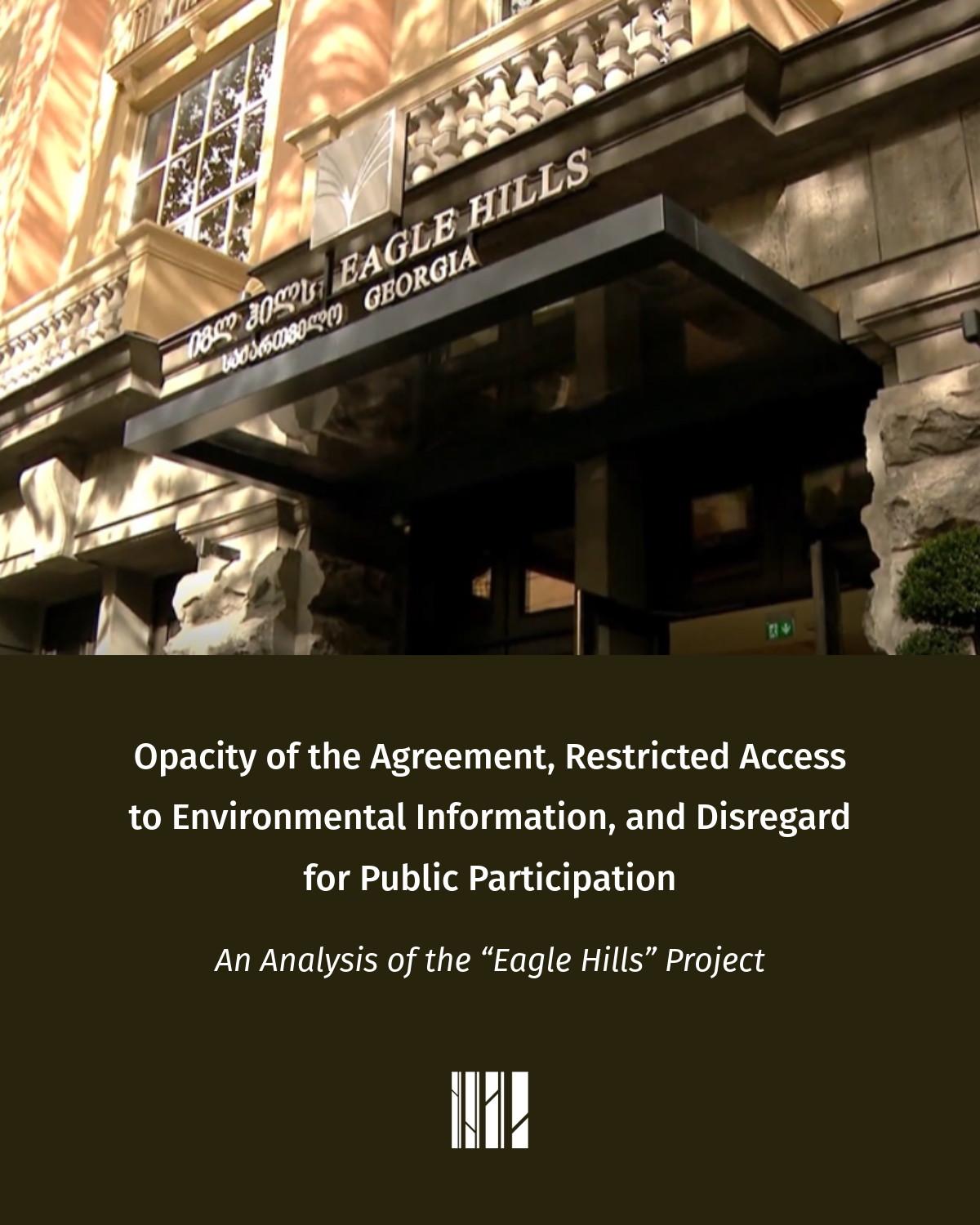
One of the most controversial projects recently announced by the “Georgian Dream” government is the construction planned in Tbilisi and Gonio by Eagle Hills, a company based in the United Arab Emirates (hereinafter also referred to as the “Eagle Hills project”). According to the company’s official website, “Tbilisi Waterfront” and “Gonio Yachts & Marina” are “leading development projects” in the real estate sector. The project envisages the transfer to the company of 590 hectares of land near Tbilisi and 260 hectares in Gonio.[1] According to statements by government representatives, the investment value of the project amounts to USD 6.6 billion.
By Decree No. 1712 of October 22, 2025, the Government of Georgia approved an investment agreement, the parties to which are the Government of Georgia, “Eagle Hills Development Holdings Limited”, “Jaona Investment LLC”, and “Eagle Hills Georgia LLC”. In addition to the agreement on the implementation of the project, the same Decree also approved the “Shareholders’ Agreement” of the latter company, which, among other matters, establishes the rights and obligations of the partners. Under paragraph 6 of the Decree, the “Investment Agreement”, the “Shareholders’ Agreement”, and their accompanying documentation were deemed commercial secrets.
The project-implementing company, the joint venture “Eagle Hills Georgia LLC” (ID No. 404770011), was established on April 28, 2025, and 66.67% of its shares are owned by “Eagle Hills Development Holdings Limited”, registered in the United Arab Emirates. The Georgian state owns 33.33% of the company’s shares, which are under the management of the Ministry of Economy and Sustainable Development. The state is represented on the company’s supervisory board by the Deputy Minister of Economy and Sustainable Development of Georgia. It is noteworthy that, in order to ensure state representation on the supervisory board, a legislative amendment was made specifically for this project. More precisely, since anti-corruption legislation prohibited a public official from serving on the supervisory board of a project in which the state’s shareholding is less than 50%, it became necessary to amend the Law of Georgia “on Entrepreneurs”.
Against the backdrop of the project’s secrecy, there are numerous questions concerning the reliability of the investor company and its past projects, the structure of the project and a possible corrupt deal, environmental damage, and other issues. The present document mainly focuses on analyzing the legality of classifying the agreement and its accompanying documentation, and also briefly reviews the governance, environmental, and social concerns that emerged in the decision-making process related to the project.
1. Description of the Context
Questions concerning the structure of the project and the company’s past projects
One of the biggest questions surrounding the project concerns its implementation model, which entails contributing more than 800 hectares of state-owned land to the capital of a joint venture established by the investor company and the state. The question is how the public interest is protected in this process and whether there is a reasonable guarantee that the state will receive benefits. It is noteworthy that an alternative to disposing of land in this manner is a model whereby state-owned land is sold through a public auction, the budget receives the corresponding compensation, and, at the same time, the state may set tender conditions concerning the volume, nature, and other parameters of the investment, thereby ensuring protection of the public interest.
According to economists’ assessments, in the model used in this case - the direct transfer of lands to the company - there is a risk that the state will receive no benefit or only a nominal benefit, both in the event of the project’s implementation and in the event of its failure. Based on publicly available information, in exchange for expensive real estate, the state is supposed to share in the profit received after the project is implemented. However, in the opinion of some, this model is problematic because it is unclear exactly what profit the joint venture whose shares are owned by the state will receive, or whether it will receive any profit at all (there is an assumption that profits will primarily be received by offshore-registered contractors and construction companies).[2]
On the other hand, if the implementation of the project is delayed or fails for any reason, it is unclear what mechanisms exist to protect public interests. Moreover, despite the confidentiality of the contractual terms, with a high degree of probability we can assume that the agreement between the parties provides for an arbitral tribunal as the dispute resolution mechanism, as is typical for projects of this type. In the scenario of non-implementation of the project, there is a risk that, if the investor company initiates a dispute, the state may be ordered to pay substantial compensation in favor of the investor, as has already happened in other cases.[3]
In addition, the name of “Eagle Hills” is associated with a number of controversial construction projects around the world. For example, the “Belgrade Waterfront” project in Serbia also faced resistance and protests from locals. According to Radio Liberty, although certain parts of the agreement concluded between the Republic of Serbia and the company were made public, many details of the agreement, including annexes, the financial obligations of the state and the investor, final deadlines, and possible guarantees, remain unknown to this day. The construction of this project is also linked to an extremely suspicious incident, when in 2016, in one district of Belgrade, masked individuals used bulldozers to demolish private buildings that obstructed the project. The process took place amid complete inaction by the police, deepening suspicions of a dishonest deal between the government and the company.[4]
The social impacts of the project
It should be noted that part of the population’s dissatisfaction surrounding “Eagle Hills” was also caused by the fact that the planned project was assessed as the construction of “Arab cities”. The ultra-right-wing “Alt-Info” also held a rally against the project. Government representatives generally labeled criticism of the project as a “xenophobic campaign”.
It is noteworthy that one significant part of the diverse criticism surrounding the project concerns the prospect of creating an isolated settlement in the city intended for the “ultra-rich”, which would have practically nothing in common with the rest of the city. Such “gated neighborhoods” are usually segregated districts separated from common public space and the city’s social organization.
In urban studies, the emergence of such closed, separate neighborhoods, whether for wealthy locals or foreigners, is assessed negatively.[5] The report of the UN High Commissioner for Human Rights also notes that the development of the real estate market in this form fragments cities, causes gentrification, and further deepens inequality among residents. The UN Special Rapporteur on the right to adequate housing dedicated a special report to spatial segregation within the city.[6] According to the document, over recent decades, “gated neighborhoods” have become a means of providing prestige, security, and privacy to wealthy urban residents. This model of urban development is accompanied by the privatization of spaces and services that are essentially communal and shared, such as the provision of security through private security services,[7] and by spatial segregation.[8]
Such settlements are also criticized because decision-makers who live in luxury neighborhoods are often spatially separated from their own voters,[9] just as the group that possesses social capital and the ability to influence the decision-making process is separated from the rest of the population. In addition, drawing such “boundaries” concentrates privilege in one particular settlement, fragments the city, and undermines solidarity among city residents;[10] it becomes practically impossible for different social groups to participate in political life in a way that is based on common goals and, accordingly, directed toward developing common solutions.[11] Moreover, in the opinion of some, such spatial divisions intensify social frustration and contribute to high levels of violence.[12] In addition, if the benefits generated by urban development are concentrated only in spaces accessible to a narrow group, the risk increases that urban development will become a mechanism that deepens spatial and economic inequality rather than promoting social integration.
The environmental impacts of the project
There are numerous questions regarding the environmental impact of the “Eagle Hills” project. Some ecologists believe that because the Krtsanisi Forest, where the “Tbilisi Waterfront” complex is planned to be built, is a riparian forest, which is a very sensitive ecosystem, construction cannot take place without damaging it. Accordingly, rough intervention in this type of ecosystem is considered problematic. In addition, ecologists also say that the ecosystem of the Krtsanisi Forest has a regulatory function for two cities: it regulates biodiversity migration and has a restraining function during floods. At the same time, the Krtsanisi riparian forest absorbs emissions and is an important corridor for the natural ventilation of the city. As for Gonio and the Chorokhi Delta, there is a wetland habitat that serves as a resting place for migratory birds.
At this stage, the only official publicly available source regarding the ecological impacts of the project is a short, general letter sent by the company to Radio Liberty, which states that the company “attaches the greatest importance to respecting the natural landscape, and the relevant studies and the project are guided by the instructions established by state agencies in these directions”.[13]
2. The illegality of the decision to classify the agreement
2.1. The inconsistency of classifying the agreement with Georgian legislation regulating the publicity of information and with human rights
As noted, by the same Decree of the Government of Georgia that approved the agreement to be concluded with the investor, the “Investment Agreement”, the “Shareholders’ Agreement”, and their accompanying documentation were deemed commercial secrets. Such broad and practically all-encompassing secrecy, which covers all existing documents related to the project, contradicts the requirements of Georgian legislation and international law.
In accordance with the General Administrative Code of Georgia, everyone has the right to access public information held by an administrative body, as well as to receive a copy of it, unless the information contains a state, professional, or commercial secret or personal data. In this case, the Government Decree indicates that the agreements and their annexes must be considered commercial secrets. Under the same Code, a commercial secret is information concerning a plan, formula, process, or means that has commercial value, or any other information used for producing, preparing, processing goods, or providing services, and/or that constitutes novelty or a significant result of technical creativity, as well as other information the disclosure of which may harm a person’s competitiveness.[14]
In this case, it is obvious that at least the general provisions of the agreement on the implementation of the “Eagle Hills” project, which establish the rights and obligations of the parties, cannot be considered information of commercial value under the Code’s definition. This is all the more so because, on the other side, there is a far weightier public interest that requires the openness of the agreement. The project envisages the transfer of more than 800 hectares of state-owned land plots to the company, which means the use of enormous public resources for a specific project. Accordingly, against the background of a substantial public contribution, society has the right to know under what conditions the land was transferred to the project-implementing company, what the investor’s reciprocal obligations are, how the public interest is protected, what happens if the project’s implementation is delayed, what the conditions are for the return of land to the state, and so on.
Article 19(2) of the International Covenant on Civil and Political Rights also includes the right of access to information held by public institutions, while any restriction of this right must be necessary and proportionate.[15] In turn, when considering the restriction of this same right protected under Article 10 of the European Convention on Human Rights, the European Court noted that access by a public organization to information concerning ownership of land plots was important for facilitating public debate on a matter of “legitimate public interest” and therefore assessed the refusal to provide information as a violation of the Convention.[16] In another case concerning the disposal of state-owned land plots to a private individual, the Court clearly indicated that relying generally on an exceptional provision and failing to cite specific grounds in order to justify withholding information that is of “undeniably high public interest” at the national level is problematic, and accordingly found a violation of the Convention in that case as well.[17]
Therefore, in this case too it is obvious that, in the presence of a high and legitimate public interest, the government’s decision, by which access to the full documentation related to the project was closed in a blanket manner by means of a general reference to commercial information, cannot be considered justified and, in addition to Georgian administrative legislation, also violates international human rights standards.
2.2. The problematic nature of classifying the agreement in light of the project’s environmental impacts
Classifying the agreement related to the “Eagle Hills” project in this form violates Georgian environmental legislation and the Aarhus Convention. Under Article 29 of the Constitution of Georgia, everyone has the right to receive complete information on the state of the environment in a timely manner, while the right to participate in decision-making related to environmental matters is guaranteed by law. The Law of Georgia “on Environmental Protection” enshrines the principle of access to information, meaning that information on the state of the environment must be open and accessible to the public.
Under Article 4(1) of the Aarhus Convention, the contracting parties are obliged to ensure that public authorities, upon request, provide environmental information, including documentation containing such information. The Social Justice Center requested information related to the “Eagle Hills” project, as environmental information, from the Administration of the Government of Georgia, the Ministry of Economy and Sustainable Development, and the Ministry of Justice of Georgia. From all of these agencies we received a response that the agreements and accompanying documentation had been deemed commercial secrets.[18]
We believe that this explanation and, on its basis, the classification of the agreement are unlawful and directly violate the mandatory requirements established by the Convention.
2.2.1 The agreement and accompanying documentation constitute environmental information and must be disclosed
The Convention defines environmental information broadly and includes, among other things, such components as measures and activities, including administrative measures, plans, and programs that affect or may affect elements of the environment.[19] According to the implementation guide to the Convention, which is an authoritative source for interpreting the agreement, this definition of environmental information clearly includes decisions on specific activities, including permits and licenses. Moreover, the guide directly indicates that environmental information also includes agreements concluded with private actors that may have an impact on the environment.[20]
Therefore, it is obvious that the agreement concluded between the Government of Georgia and the investor on the implementation of a large-scale project, which envisages the development of more than 800 hectares of public land, including riparian forests, and intensive intervention in the environment in the form of the construction of residential complexes, is clearly a document containing environmental information within the meaning of the Convention, at least part of which must be accessible to the public.
Moreover, under the Convention, environmental information accessible to the public also includes “cost-benefit and other economic analyses and assumptions used in environmental decision-making”.[21] This category establishes the relevance of economic information in relation to environmental issues.[22] Economic analysis may have key importance in deciding which project will be implemented and which will not. It is precisely for this reason that economic modeling and related analytical material are considered part of the environmental decision-making process, and such information, within the meaning of the Convention, is environmental information that must be open to the public.[23] There is every reason to assume that relevant economic information is contained both in other documents related to the project and in the agreement concluded with the investor itself, which establishes the rights and obligations of the parties, the benefits to be received by them, allocates risks, and establishes liability for breach of the agreement. Accordingly, the government’s decision, by which not only the agreement of the “Eagle Hills” project but also the accompanying documentation was classified, is problematic from this perspective as well.
2.2.2 The conditions established by the Convention for withholding environmental information on the grounds of protecting commercial information have been violated
As stated, Article 4(1) of the Convention enshrines the obligation to provide environmental information upon request. Subparagraph “d” of paragraph 4 of the same article permits refusal to provide information if disclosure would adversely affect “commercial or industrial information”, where such confidentiality is protected by law in order to protect a legitimate economic interest. In order to satisfy the Convention’s test, it is not sufficient that national legislation protects commercial secrets and that there is an administrative process for classification; the Convention also requires that the exception for withholding information be applied only where disclosure of the data would substantially harm legitimate economic interests and assist the private company’s competitors.[24]
An exception to this exception exists where the matter concerns information related to emissions. In other words, information concerning emissions is subject to disclosure in any case, regardless of whether the provision of information would harm the interest of protecting commercial information. Under Georgian legislation, emission is defined as “the direct or indirect release of a substance, vibration, heat, or noise from a stationary or diffuse source into atmospheric air, water, or land”.[25]
The project under consideration envisages large-scale construction, which naturally also implies the release of emissions, whether in the form of emissions from construction machinery, noise, the disposal of construction waste, the discharge of substances into soil or drainage systems during construction, or other forms. We can assume with near certainty that at least part of the agreement contains information relevant to the issue of the project’s emissions. Such data defined by the agreement may include the precise scale and characteristics of the project, the ratio of commercial and residential spaces, which may determine traffic flow and the volume of emissions, the company’s environmental obligations, construction conditions, energy efficiency and energy consumption requirements in accordance with the Law of Georgia “on the Energy Efficiency of Buildings”, and other matters. Accordingly, the interest in protecting commercial information, to which the Government of Georgia refers, cannot be a lawful basis for withholding this type of information, and access to information related to emissions must be ensured unconditionally.
In addition, the Convention further establishes that grounds for refusing to provide information must be interpreted narrowly, while at the same time the public interest served by disclosure of the information must be taken into account.[26] In accordance with the standard established by the supervisory body of the Convention, the Compliance Committee, in cases where there is a substantial public interest in favor of providing environmental information, the likelihood of relatively minor harm to commercial interests cannot be considered a basis for withholding information.[27]
Therefore, for the Convention, even harm to an economic interest in itself is not sufficient for information to be deemed secret. It requires that the interests in withholding information, on the one hand, and openness, on the other, be weighed against each other. In this case, it is unclear which legitimate economic interest of the company is served by closing the agreement in full, and it is also unclear what harm the company would suffer from disclosure of the terms of the agreement. On the other hand, there is an extremely high and legitimate public interest in the provisions of the agreement, since we are dealing with a large-scale project that is to be implemented on state land and that will have significant environmental and social impacts.
2.3 The use of public resources for the project as a precondition for the publicity of information
Based on publicly available information at this stage, it cannot be determined under which sectoral legislation the “Eagle Hills” project was developed. This question is relevant insofar as, considering the project’s characteristics and based on publicly available information, at first glance it should be qualified as a “public-private partnership” project, and accordingly its development and implementation should take place in compliance with the requirements of the Law of Georgia “on Public-Private Partnership” (hereinafter also referred to as the “Law”).[28] More precisely, since the Decree of the Government of Georgia by which the draft investment agreement was approved also provides for the transfer of state-owned immovable property - land plots - to the project-implementing company,[29] a form of state support envisaged by the Law is present,[30] which means that instead of a private project, we are dealing with a “public-private partnership” project.[31]
The logic of projects in this category is that, because the state participates in the project with public resources, the requirements of transparency, accountability, and protection of the state interest increase in the process of developing, implementing, and operating the project. The Law ensures protection of the public interest through a number of additional procedural and substantive requirements, which fundamentally distinguish a public-private partnership project from other projects.[32]
Under Article 5 of the Law, public-private partnership is based on the principle of transparency, which means ensuring public access to information about the public-private partnership project, while Article 16 further establishes that information about a public-private partnership project, as well as about its development and implementation, is public, except for documentation classified as secret information under Georgian legislation.
Therefore, in addition to the requirement for the publicity of the agreement and environmental information, in the case of large-scale projects of this type it is important that the public have access to the state’s assessment of the economic feasibility of the project. This is especially true when the project is based on the large-scale transfer of state land and the direct participation of the state. Such an assessment, as a rule, includes analysis of the project’s expected economic benefits, fiscal consequences, employment effects, infrastructure costs, and possible risks. Merely referring to the total volume of investment naturally does not make it possible to assess whether the project creates real public value and whether its benefits exceed the goods that could be obtained in the case of alternative development. Based on publicly available information at this stage, it is not apparent whether there existed an economic analysis of the project that would assess the value of the resources transferred by the state, the expected public benefit, and the risks in the event of non-fulfillment or delay of the project.
Unfortunately, the confidentiality of the “Eagle Hills” project agreement is not an isolated case, but rather another manifestation of a broader, systemic crisis of opacity regarding information and documentation of public importance, as indicated by the sharply deteriorated statistics on the provision of public information in recent years and by Georgia’s expulsion from the Open Government Platform in April of the current year.[33]
3. Exclusion of the public from the decision-making process
Considering the scale of the project and its expected social and environmental impacts, it is even more problematic that the public is not given the opportunity to participate in the decision-making process at the early stage of the project’s development, as required by international human rights standards. The Constitution of Georgia establishes that the right to participate in decision-making related to environmental matters is guaranteed by law.[34] Article 25 of the International Covenant on Civil and Political Rights enshrines the public’s right to participate in decision-making on matters of public importance (“public affairs”). According to the interpretation of the Human Rights Committee, “public affairs” is interpreted broadly and includes various manifestations of the exercise of public authority, including administrative powers.[35] The Aarhus Convention on Access to Information, Public Participation in Decision-making and Access to Justice in Environmental Matters (hereinafter the “Aarhus Convention” or the “Convention”) requires that public participation be ensured in decision-making on environmental matters.[36] In accordance with Georgia’s Environmental Assessment Code, the “Eagle Hills” project, as a large-scale urban development project, must be subject to environmental impact assessment and related public participation procedures.[37]
In Georgia, the right to participate in the decision-making process on environmental matters is largely interpreted as only part of the environmental impact assessment procedure (hereinafter also “EIA”), and the relevant agencies often rely on the argument that adopting various decisions in advance - in this case, approval of the agreement by the government - is not a problem, because public participation will be ensured at the subsequent EIA stage. In reality, equating the participation procedure envisaged by the Aarhus Convention with the EIA, and accordingly limiting public participation only to this stage, is inherently mistaken and inconsistent with the Convention. In reality, the obligation to ensure public participation may apply to various decisions of environmental significance.[38] The main question is whether the Government of Georgia’s approval of the agreement to be concluded with the company and the issuance of the corresponding Decree constitutes a decision of such significance which is a prerequisite for the application of the participation obligation established by the first paragraph of Article 6 of the Convention.
According to the assessment of the supervisory body of the Convention, the Compliance Committee, this issue must be decided in light of the national context and the legal force of each decision.[39] A decision that is, by its nature, individual and that grants a developer the right to implement a project on a specific territory under specific conditions[40] will, as a rule, be considered such a decision. In this case, it is obvious that the Decree by which the Government of Georgia approved the investment agreement, which in turn contains the key parameters of the project and the content of the parties’ agreement, is a decision of essential importance, and its adoption behind closed doors violates the public’s right to participate.
Effective and genuine public participation is possible only when initial decisions are being made and when all options are open, including the possibility of rejecting the project.[41] Unfortunately, it has become a trend with large-scale projects for the government to conclude an agreement with an investor behind closed doors, without public participation, to classify the agreement, and later, when it encounters public resistance, to try to suppress it by force or otherwise neutralize public protest.[42]
Conclusion
Thus, it is obvious that the Eagle Hills project raises serious doubts both in terms of compliance with Georgian legislation and international standards and in terms of protection of the public and societal interest.
First of all, transparency and publicity requirements were grossly violated during the development of the project. Treating the “Investment Agreement”, the “Partners’ Agreement”, and other documentation related to the project in full as commercial secrets is incompatible with both Georgian administrative and environmental legislation and the Aarhus Convention. In particular, commercial secrecy cannot be an automatic basis for refusing to provide information, especially where there is a high public interest in the information. The case law of the European Court of Human Rights also confirms that decisions related to the disposal of state lands must be subject to public control, while their classification may constitute a violation of freedom of expression protected by the European Convention on Human Rights.
At the same time, it should be noted that such secrecy only contributes to the emergence of additional questions and speculation surrounding the project. By declaring the “Eagle Hills” agreements commercial secrets, the possibility of informed, fact-based public debate was prevented from the outset, thereby damaging the public interest.
In addition, the question must also be raised as to how appropriate the direction of urban development embodied by this project is. Gated neighborhoods detached from the social fabric of the rest of the city contribute to spatial segregation between the rich and the poor, deepen inequality, and undermine social solidarity. This question is especially relevant against the background that the tendency toward such privatization in Georgia is not limited to residential complexes alone and extends to other services as well, including schools and kindergartens. As a result, we are left with a situation in which the social group that holds power and resources gradually withdraws from shared spaces and institutions. The “Eagle Hills” project is an even more severe continuation of this dynamic, whereby unique state-owned lands, which have significant public and ecological value, are turned into a private “elite” residential complex that, given the value of real estate, excludes the majority of the population by design.
[1] According to unofficial information disseminated in the media by one politician, the precondition for contributing the land plots to the capital of the implementing company is the preparation by the Arab side of the architectural designs for the planned complexes.
[2] For a detailed discussion of the criticism related to the structure of the project, see Mtis Ambebi, “How to Steal $2 Billion - Levan Nadibaidze on the Krtsanisi and Gonio Projects”, February 14, 2026, available at: https://mtisambebi.ge/news/item/1833.
[3] Ibid.
[4] For more detail on other controversial projects related to the company, see Mtis Ambebi, “What We Do/Do Not Know About the Projects of the Arab Eagle Hills”, December 6, 2025, available at: https://mtisambebi.ge/news/item/1826.
[5] For example, see Lemanski, Charlotte (2004) The new apartheid? The spatial implications of fear of crime in Cape Town, South Africa, Environment and Urbanization, available at: https://journals.sagepub.com/doi/10.1177/095624780401600201.
[6] Spatial segregation and the right to adequate housing Report of the Special Rapporteur on adequate housing as a component of the right to an adequate standard of living, and on the right to non- discrimination in this context, 10 November 2022, A/HRC/49/48, available at: https://docs.un.org/en/A/HRC/49/48.
[7] Bislev, Sven. "Privatization of Security as Governance Problem: Gated Communities in the San Diego Region." Alternatives: Global, Local, Political 29, no. 5 (2004): 599, HeinOnline.
[8] Spatial segregation and the right to adequate housing Report of the Special Rapporteur on adequate housing as a component of the right to an adequate standard of living, and on the right to non- discrimination in this context, 10 November 2022, A/HRC/49/48, available at: https://docs.un.org/en/A/HRC/49/48, para. 23.
[9] Report of the United Nations High Commissioner for Human Rights, 15 May 2018, E/2018/57, available at: https://docs.un.org/en/e/2018/57.
[10] Sheridan Bartlett, Diana Mitlin and David Sattertwaite, “Urban inequities”. Available at: www.equityforchildren.org/wp-content/uploads/2013/11/sherry-Barlet-Urban-Inequalities.pdf.
[11] Caldeira PR (1996) Fortified enclaves: The new urban segregation, Public Culture 8, available at: https://housingchallenges.wordpress.com/wp-content/uploads/2018/10/caldeira-teresa-1996-fortified-enclaves.pdf.
[12] Burgess, Rod (2009) Violence and the fragmented city, in Falu, Ana (ed) Women in the City: On Violence and Rights, Women and Habitat Network of Latin America, available for download at: https://www.google.com/url?sa=t&source=web&rct=j&opi=89978449&url=http://www.sitiosur.cl/publicaciones/Coediciones/sur-women_in_the_city.pdf&ved=2ahUKEwibsYSKj5iVAxUw1wIHHb2nIoEQFnoECBkQAQ&usg=AOvVaw1qJ35PTjHksw0C8KfelsCz.
[13] The letter also states that “both projects prioritize the protection of natural habitats and biodiversity, as well as the preservation of migratory bird sites on the Black Sea coast, through sustainable design, responsible management of land and the coastal zone, and the protection of untouched landscapes”.
[14] The General Administrative Code of Georgia, Article 27(1).
[15] Human Rights Committee, 11-29 July 2011, General comment No. 34, Article 19: Freedoms of opinion and expression, available at: https://www.ohchr.org/sites/default/files/english/bodies/hrc/docs/gc34.pdf.
[16] Österreichische Vereinigung v. Austria (Application no. 39534/07), available at: https://hudoc.echr.coe.int/fre#{%22itemid%22:[%22001-139084%22]}.
[17] Leshchenko v. Ukraine (2021) (Applications nos. 14220/13 and 72601/13), available at: https://hudoc.echr.coe.int/eng#{%22itemid%22:[%22001-207416%22]}.
[18] According to information disseminated on May 1 of the current year by the online publication “Mtis Ambebi”, the Ministry of Economy also refused to provide the documents to them, in response to which the media outlet challenged the classification of the agreements in court.
[19] Convention on Access to Information, Public Participation in Decision-making and Access to Justice in Environmental Matters, Article 2, paragraph 3(b), available at: https://matsne.gov.ge/document/view/1210443?publication=0.
[20] UNECE, Convention on Access to Information, Public Participation in Decision-making and Access to Justice in Environmental Matters (Aarhus Convention), The Aarhus Convention: An Implementation Guide, p. 53, available at: https://unece.org/fileadmin/DAM/env/pp/Publications/Aarhus_Implementation_Guide_interactive_eng.pdf.
[21] Convention on Access to Information, Public Participation in Decision-making and Access to Justice in Environmental Matters, Article 2, paragraph 3(b), available at: https://matsne.gov.ge/document/view/1210443?publication=0.
[22] UNECE, Convention on Access to Information, Public Participation in Decision-making and Access to Justice in Environmental Matters (Aarhus Convention), The Aarhus Convention: An Implementation Guide, p. 54, available at: https://unece.org/fileadmin/DAM/env/pp/Publications/Aarhus_Implementation_Guide_interactive_eng.pdf.
[23] Ibid.
[24] Ibid, 88.
[25] Law of Georgia “on Industrial Emissions”, Article 2(h).
[26] Convention on Access to Information, Public Participation in Decision-making and Access to Justice in Environmental Matters, Article 4, paragraph 4, final paragraph, available at: https://matsne.gov.ge/document/view/1210443?publication=0.
[27] ECE/MP.PP/C.1/2009/2/Add.1, para. 30 (c).
[28] Based on publicly available information, it is currently unknown whether the Government of Georgia considered the project to be a “public-private partnership” project. At the same time, the reasoning set out in this subsection is limited by the fact that the agreement and the related documentation are closed, which deprives us of the opportunity to assess the nature of the project in a more nuanced manner in light of the Law of Georgia “on Public-Private Partnership”.
[29] The transfer of the land plots is carried out by contributing immovable property to the capital of the project-implementing company, “Eagle Hills Georgia LLC”, if all preconditions provided for in the investment agreement are met (paragraph 5(b) of the Decree of the Government of Georgia), the nature of which is unknown because the agreement has been classified.
[30] Article 28 of the Law of Georgia “on Public-Private Partnership” lists the forms of state support that bring a given project within the scope of the Law. These include “the transfer of land and/or the issuance of permits and licenses provided for by Georgian legislation in cases envisaged by Georgian legislation” (Article 28, paragraph 1(f)).
[31] The project has the characteristics of an “institutional public-private partnership project”, because a new joint venture, which is the project implementer, was established with state and private participation. For more information on institutional public-private partnerships, see Article 29 of Decree No. 426 of the Government of Georgia of August 17, 2018, “on the Approval of the Rules for the Development and Implementation of a Public-Private Partnership Project”.
[32] See International Bank for Reconstruction and Development / The World Bank, Public-Private Partnerships, Reference Guide, 2017, available at: https://ppp.worldbank.org/sites/default/files/202408/PPP%20Reference%20Guide%20Version%203.pdf.
[33] Georgia’s expulsion from the organization followed its failure to comply with the following recommendations issued to Georgia by the OGP in May 2024: 1. to withdraw legislation that hinders, is discriminatory toward, or stigmatizes the freedom of expression and association of civil society organizations, the media, and vulnerable groups; 2. to protect freedom of expression and assembly and civic space, and to ensure their functioning without physical or verbal attacks. Georgia is the ninth country whose OGP membership has been terminated.
[34] See Constitution of Georgia, Article 29, paragraph 1.
[35] General Comment adopted by the Human Rights Committee under Article 40, paragraph 4, of the International Covenant on Civil and Political Rights. UN Human Rights Committee, 57th session, 1996, paragraph 5, available at: https://digitallibrary.un.org/record/221930?v=pdf#files.
[36] Convention on Access to Information, Public Participation in Decision-making and Access to Justice in Environmental Matters, Article 6, paragraph 1, available at: https://matsne.gov.ge/document/view/1210443?publication=0.
[37] More precisely, under Annex II of the Code, urban development projects with a development area of more than 10 hectares (Annex II, paragraph 9.2) are first subject to the screening procedure and, subsequently, if the relevant decision is made, also to the preparation of scoping and environmental impact assessment (EIA) reports, accompanied by public hearings of the relevant reports.
[38] UNECE, Convention on Access to Information, Public Participation in Decision-making and Access to Justice in Environmental Matters (Aarhus Convention), The Aarhus Convention: An Implementation Guide, p. 128, available at: https://unece.org/fileadmin/DAM/env/pp/Publications/Aarhus_Implementation_Guide_interactive_eng.pdf.
[39] ECE/MP.PP/C.1/2006/4/Add.2 (Findings and recommendations with regard to communication ACCC/C/2005/11 concerning compliance by Belgium), para. 29.
[40] UNECE, Convention on Access to Information, Public Participation in Decision-making and Access to Justice in Environmental Matters (Aarhus Convention), The Aarhus Convention: An Implementation Guide, p. 124, available at: https://unece.org/fileadmin/DAM/env/pp/Publications/Aarhus_Implementation_Guide_interactive_eng.pdf.
[41] Convention on Access to Information, Public Participation in Decision-making and Access to Justice in Environmental Matters, Article 6, paragraph 4, available at: https://matsne.gov.ge/document/view/1210443?publication=0.
[42] On the methods and strategies used by the authorities against environmental defenders, see the extensive report of the Social Justice Center: “Government Approaches Toward Environmental Resistance - Neglect, Discreditation and Repression”, 2025, available at: https://socialjustice.org.ge/ka/products/khelisuflebis-midgomebi-garemosdatsviti-tsinaaghmdegobebis-mimart-ugulebelqofa-diskreditatsia-da-represia.
The website accessibility instruction