საერთო ცხელი ხაზი +995 577 07 05 63


საერთო ცხელი ხაზი +995 577 07 05 63
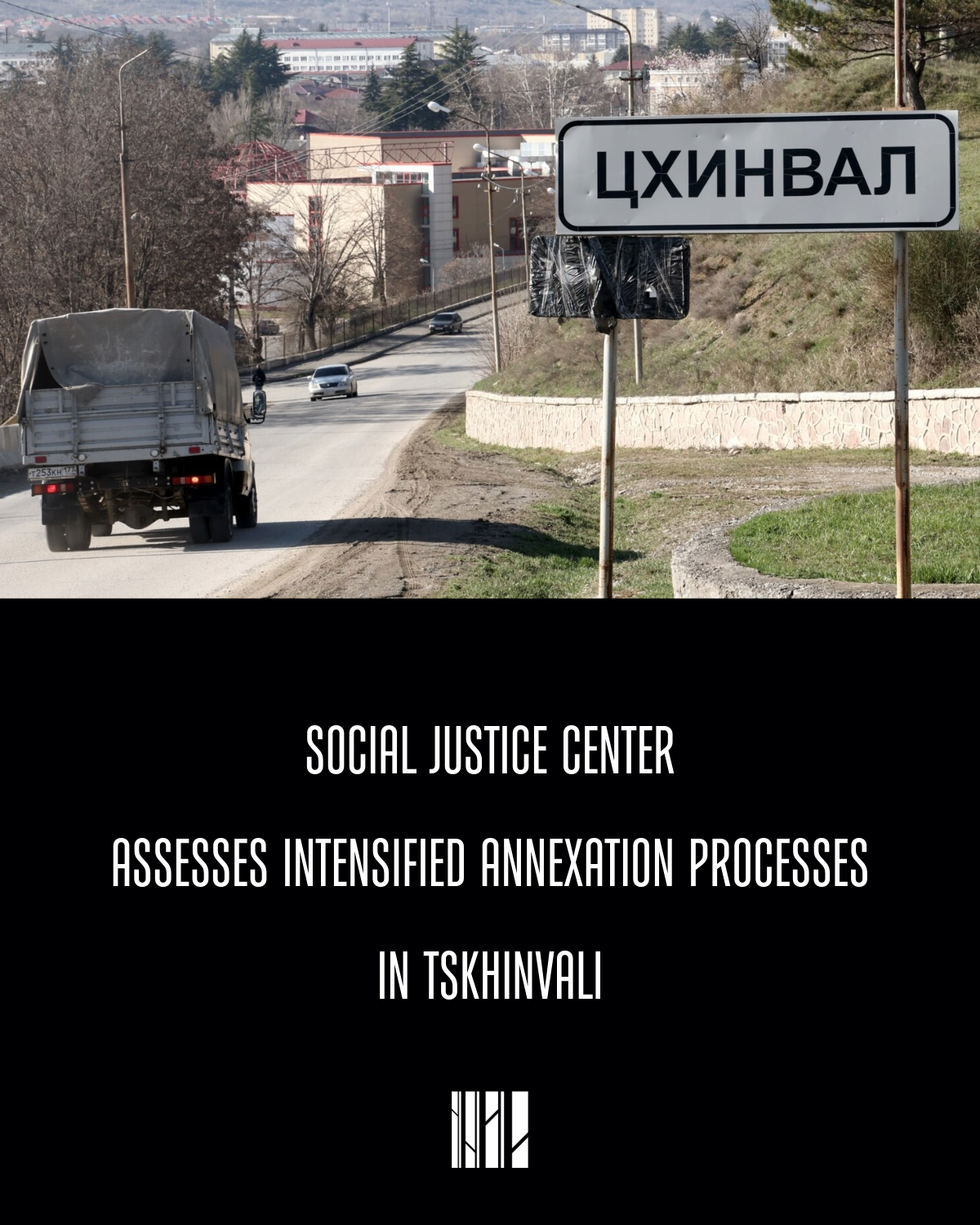
Developments in the occupied Tskhinvali region over recent weeks—including the new so-called treaty arrangements between Tskhinvali and Moscow, the resignation of Alan Gagloev from the position of de facto president on 23 June, and the appointment of a non-local person to this position—demonstrate that the Russian Federation’s policy of de facto annexation of the region has entered a new, more overt and aggressive stage. While following the 2008 war Moscow consolidated its control over the Tskhinvali region through a policy of recognition, military presence, subordination of the security sector, and mechanisms of financial and economic dependency, this policy has now developed into the direct personnel and administrative management of de facto institutions.
The latest manifestation of this was the appointment of Marat Kambolov, from North Ossetia and from the political and administrative sphere of the Russian Federation, as the so-called Prime Minister of the occupied Tskhinvali region. Following Alan Gagloev’s resignation from the position of de facto president on 23 June, Kambolov has assumed presidential duties. This development began with the signing, on 9 May 2026, of the third treaty between Tskhinvali and Moscow, the so-called “Treaty on Deepening Allied Cooperation,” which brought Ossetian-Russian relations to a new stage after the preceding two agreements. Under the treaty, citizens of one party may hold state and municipal offices, as well as positions in state and municipal service, within the state and municipal bodies of the other party. It was precisely after this provision was adopted that Russia was able to put forward its own candidate for the position of the so-called Prime Minister of South Ossetia. Moreover, there is discussion in Tskhinvali that presidential elections may be scheduled no later than 21 September, after which Kambolov himself may become president.
Marat Kambolov, a representative of North Ossetia, was appointed as the so-called Prime Minister of the occupied Tskhinvali region by Alan Gagloev’s decree on 17 June. The decree was preceded by the full support of the so-called parliament for Kambolov’s candidacy on 16 June. His appointment had been under discussion since early June, and speculation regarding Kambolov’s candidacy began after the resignation, several days earlier, of former so-called Prime Minister Dzambolat Tadtayev. In May 2026, Kambolov had also been appointed as Gagloev’s state adviser.
Shortly after these developments, on 23 June, Alan Gagloev resigned from the position of de facto president, reportedly due to taking up a new position in the administration of the Russian president. Marat Kambolov then became the acting de facto president.
It should be noted that, according to Dmitry Peskov, the press secretary of the Russian president, the personnel changes in Tskhinvali are not related to the issue of the region’s possible accession to, or unification with, Russia.
It should also be said that Gagloev’s resignation was met with largely positive reactions among the local political elite. For example, according to Atamaz Bibilov, a representative of United Ossetia, Gagloev’s resignation was the only correct step because his regime had led Tskhinvali towards economic collapse: development programmes had been suspended, the implementation of Russian investments had been postponed year after year, and local prices had risen sharply. According to Bibilov, Gagloev had failed to fulfil any of his election promises. It is also noteworthy that the media had for years reported on possible crimes and corrupt interests involving Alan Gagloev and members of his family.
Kambolov’s appointment cannot be regarded as an ordinary personnel change or a technical solution to a local political crisis. Through this move, Moscow has directly inserted its own administrative cadre into the de facto governing system of Tskhinvali, demonstrating that Russia is no longer satisfied with indirect control over the region. Russia is thus moving towards the direct governance of the Tskhinvali region, placing less trust in local elites and political clans and instead dispatching its own representative.
This development is the result of Russia’s consistent annexation policy and represents a continuation of the so-called treaties concluded between Russia and the de facto Tskhinvali regime in 2008, 2015, and 2026. An analysis of these treaties reveals a unified, consistent, and gradual logic of annexation pursued by Russia.
The so-called “Treaty on Friendship, Cooperation and Mutual Assistance” of 17 September 2008 created a legal framework following Russia’s occupation of part of Georgia’s territory and its recognition of the region’s so-called independence. Although the treaty formally refers to South Ossetia’s “sovereignty,” “territorial integrity,” and relations based on “friendship” and “mutual assistance,” in reality it created the legal basis for Russia’s military, security, border, and political influence. The treaty envisaged the possibility of deploying military infrastructure and military bases, jointly protecting the state border, regulating issues of dual citizenship, mutually recognising documents, and bringing economic systems closer together. Through these provisions, Russia transformed its military and political presence in the occupied territory from a temporary security measure into a long-term regime.
The so-called “Treaty on Alliance and Integration” of 18 March 2015 deepened this process even further. While the 2008 document formally used the language of “cooperation,” the 2015 text explicitly referred to the creation of a “single defence and security space.” Under this treaty, the Russian Federation assumed responsibility for the so-called defence and security of South Ossetia, including the protection of its state border. Particularly alarming is the provision according to which individual units of the so-called armed forces and security agencies of South Ossetia could be incorporated into the armed forces and security agencies of the Russian Federation.
The logic of integration under the 2015 treaty was not limited to military and security matters. The document also envisaged the integration of customs authorities, a simplified regime for acquiring citizenship, harmonisation of social and pension systems, and the transition of education, healthcare, culture, and administrative relations to Russian standards. In this way, Moscow created a system of dependency in which the Tskhinvali region could formally retain de facto institutions, while its politics, finances, security, social administration, and public services increasingly became embedded within the legal and administrative space of the Russian Federation.
As for the third and most recent treaty—the so-called “Treaty on Deepening Allied Cooperation” of 9 May 2026—it represents a substantially new stage in this process. The document is no longer limited to matters of security, defence, or financial assistance. It aims to establish a single economic space; ensure the free movement of capital, goods, services, and labour; harmonise legal norms; align property regimes; unify labour and social legislation; and gradually merge energy—including gas transport—transport, communication, and telecommunications systems. Such provisions go beyond the ordinary framework of cooperation and constitute a mechanism for the economic, administrative, and infrastructural absorption of the occupied territory.
Of particular concern is the provision of the 2026 treaty allowing citizens of one party to hold state and municipal offices in the state and municipal bodies of the other party. This provision creates a legal and political basis for Russian Federation citizens to be directly appointed to the de facto governing structures of Tskhinvali. Marat Kambolov’s appointment as so-called Prime Minister is a practical result of this norm. Thus, the 2026 treaty is no longer merely a declaration of integration; it is also a declaratory act concerning the transfer of governing power.
Accordingly, the analysis of these treaties makes clear that the dynamics of Russian-Ossetian relations over the past 18 years have been directed towards the complete integration of South Ossetia into Russia: in 2008, Russia created a legal façade for military occupation through a treaty; in 2015, it accelerated integration in the security, military, customs, social, and administrative spheres; and in 2026, it moved to the stage of directly absorbing political and governing institutions. In this process, the rhetoric of “alliance,” “strategic partnership,” “the unification of the Ossetian people,” and “integration” is used as the language of annexation.
Kambolov’s appointment is a turning point within this dynamic. It demonstrates that Moscow no longer relies solely on local de facto elites and is beginning to fill key governance positions with its own political and administrative personnel. In addition to Russia’s direct appropriation of governance in South Ossetia, this move also creates demographic, property-related, and social risks, since the new regimes for property, labour, public service, and freedom of movement provide a basis for the more extensive entry of Russian citizens, capital, and institutions into the occupied territory. It is notable that Abkhazia has shown greater resistance to the process of so-called “harmonisation” and the deepening of Russian influence, while the existing project in the Tskhinvali region has proved insufficient to halt this dynamic.
These developments are of particular significance from the perspective of Georgia’s sovereignty and territorial integrity. The so-called treaties concluded between Russia and the de facto Tskhinvali regime cannot create international legal obligations for Georgia and do not alter the legal status of the Tskhinvali region as an occupied territory of Georgia. However, their practical consequences are severe: the treaties strengthen Russia’s effective control over the region, reduce the political space available to the local population, and increase Russia’s military, economic, and administrative involvement, thereby creating a situation of de facto annexation. This is particularly significant given that the issue of incorporating the region into Russia has been raised in Tskhinvali on more than one occasion.
The Social Justice Center considers that the current developments should not be assessed as an isolated personnel change, but rather as a continuation of Russia’s institutional absorption of the Tskhinvali region. The 2026 treaty and Kambolov’s appointment together create a new reality in which the de facto administration of the occupied region is increasingly becoming an extension of Russia’s administrative system. The ongoing developments in the Tskhinvali region once again demonstrate that Russia’s occupation is not a frozen situation. It is a living, evolving, and progressively intensifying process of annexation, which requires a principled and coordinated response from the Georgian state, civil society, and international partners.
Against this background, the response of the Georgian authorities, international partners, and human rights protection mechanisms must be clear, timely, and principled. It is essential that these processes be assessed internationally as a deepening of Russia’s de facto annexation of Georgian territory. The Georgian state must intensify its diplomatic, legal, and political work on all international platforms so that the integration and annexation policies currently underway in the Tskhinvali region are clearly identified as the strengthening of an occupation regime that has now developed into an annexation regime.
Unfortunately, the Georgian Dream government has not issued a special statement outlining how it intends to respond to the ongoing developments or which international mechanisms it plans to use in response to this aggressive annexation policy. The Georgian Dream party also blocked the adoption in parliament of a special resolution relating to the new agreement signed between Tskhinvali and Moscow on 9 May.
It should be noted that as a result of Georgian Dream’s political instrumentalisation of the 2008 war and subsequent events—including in the assessments of the parliamentary investigative commission established in 2025—the government’s policy towards the Tskhinvali region has become even more ambiguous.
At the same time, Georgian politicians and experts have criticised the Georgian Dream government for its unconsidered peace policy and the country’s isolation. Against the backdrop of warming relations with Russia and an aggressive anti-European policy, they point to the failure of the government’s foreign and peace policies. Such criticism has been voiced by Giorgi Gakharia, Giga Bokeria, Paata Davitaia, Grigol Gegelia, Khatia Dekanoidze, and Teona Akubardia.
The Social Justice Center calls on the Georgian authorities to:
The website accessibility instruction