
საერთო ცხელი ხაზი +995 577 07 05 63


საერთო ცხელი ხაზი +995 577 07 05 63
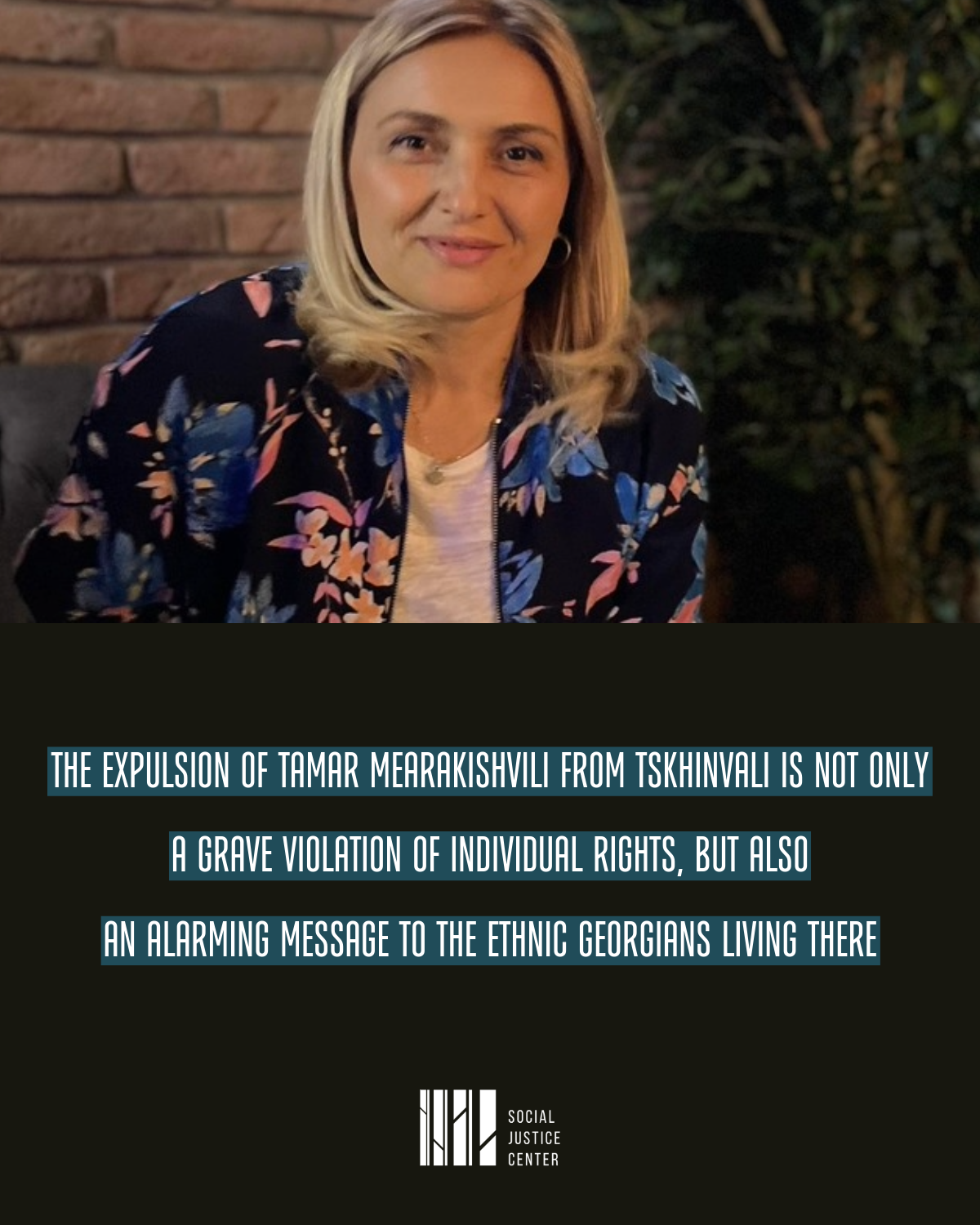
Social Justice Center assesses the case of Tamar Merabishvili’s forcible expulsion from Tskhinvali and considers that this decision grossly violated not only the rights of the Georgian woman activist but also cast doubt on the legal status of the ethnically Georgian population living in the region.
As is known to the public, on the night of December 22, 2025, Akhalgori-based activist and journalist Tamar Mearakishvili was arrested in Tskhinvali at her own residence. The de facto prosecutor’s office accused her of espionage under Article 276 of the Criminal Code of the Russian Federation. This offense carries a sentence of 10 to 20 years of imprisonment.
As later became known, on the night of December 22, special forces entered Tamar Mearakishvili’s home through the balcony and unlawfully detained the woman activist as part of a demonstratively aggressive and large-scale special operation. Tamar Mearakishvili herself described that more than 20 masked and armed law enforcement officers suddenly stormed into her home, while more than 100 special forces officers surrounded the area around the house. Prior to her arrest, she was not informed of the charges, and only after her detention did she learn that she was being accused of espionage. In protest, Tamar Mearakishvili began a dry hunger strike in prison. During this period, she also became the target of threats of torture and ethnic hatred from representatives of the de facto authorities.
Case materials indicate that the de facto law enforcement bodies accused Tamar Mearakishvili over a video recorded in Tskhinvali depicting a communication antenna/tower, which the de facto authorities consider to be a strategic facility. Since Tamar Mearakishvili publicly shared the video on social media, the local authorities claimed that her actions caused harm to the “Republic of South Ossetia’s” external security.
On December 24, 2025, the de facto Tskhinvali City Court stated that Tamar Mearakishvili’s actions resulted in the leakage of strategically important information and harmed the “republic’s national interests and security”. According to the de facto prosecutor’s office, this served as the basis for initiating criminal prosecution against her on charges of espionage. On the same day, the court ordered two months of pre-trial detention as a preventive measure. Citing the gravity of the alleged crime, the higher court rejected her cassation appeal seeking a change of the preventive measure, leaving the woman activist in detention. She continued her dry hunger strike and felt extremely weak.
On December 31, 2025, the de facto Tskhinvali City Court adopted another decision against Tamar Mearakishvili, this time on a different legal basis. Under Article 18.8 of the Code of Administrative Offenses of the Russian Federation, Tamar Mearakishvili was found administratively liable on the grounds that she had allegedly obtained so-called “South Ossetian” citizenship in violation of the law while simultaneously holding Georgian citizenship. On this basis, the court decided to fine her and expel her from the Tskhinvali region.
The decision on expulsion came as a surprise to Tamar Mearakishvili, given that the criminal case against her envisaged long-term imprisonment. It remains unknown what political processes led to such a radical change in the position of the de facto Tskhinvali regime. The Georgian side has also failed to explain the circumstances surrounding Tamar Mearakishvili’s release and expulsion, raising reasonable suspicions that the activist’s expulsion was primarily based on political considerations and aimed at suppressing her critical activism.
At this stage, Tamar Mearakishvili is appealing the expulsion decision in court, believing it to be unlawful, unsubstantiated, and aimed at suppressing her activist activities. It should be noted that when applying Article 18 of the Russian Code of Administrative Offenses, the de facto authorities of Tskhinvali were required to substantiate whether Tamar Mearakishvili indeed held Georgian citizenship and whether she had unlawfully obtained “South Ossetian” citizenship. This should have been followed by a citizenship termination procedure, after which expulsion could be carried out.
Under the de facto legislation of “South Ossetia,” expulsion from the country without termination of citizenship is impermissible. Moreover, in cases of suspected unlawful acquisition of citizenship or dual citizenship, the de facto prosecutor’s office was required to apply to the court to establish the relevant facts, after which the president and the citizenship commission were to decide on terminating or renouncing citizenship. These procedures were completely ignored by the de facto authorities of Tskhinvali, and on December 31, Tamar Mearakishvili was immediately expelled from the region.
Furthermore, the fact that a serious criminal charge was “replaced” with an administrative sanction indicates that the regime pursued the criminal case for political reasons, with the primary aim of silencing Tamar Mearakishvili.
For many years, Tamar Mearakishvili was an important critical voice in Akhalgori and the Tskhinvali region more broadly. She spoke openly about human rights and social problems in the region, exposed local corruption, and did not conceal her criticism of local politicians and public officials. Tamar Mearakishvili defended not only the interests of local Georgians, but also those of the Ossetian community.
The first attempt to silence the activist occurred in 2017, when she was arrested on charges of defamation, document falsification, and unlawful acquisition of official documents. After a five-year legal process, the de facto court system acquitted her, and the investigation was terminated. Despite this, after 2017 the de facto regime did not return her passport and other personal documents, restricting her freedom of movement. As a result, she lived in near-complete isolation.
Despite ongoing repression, Tamar Mearakishvili did not cease her public activism and critical stance, which ultimately culminated in her arrest and expulsion at the end of 2025. It is noteworthy that her arrest was preceded by protests and multiple demands for the return of her passport and documents necessary for movement. On this issue, she sought a meeting with the de facto president of the “Republic of South Ossetia” and planned to begin a hunger strike. It was precisely one day before the planned protest and hunger strike that she was arrested at her residence, which, according to many local activists and journalists, aimed to silence her and halt protest practices in Tskhinvali.
Tamar Mearakishvili’s activism was particularly important given that since 2014, following the introduction of the Russian so-called “foreign agents” law, civil society and independent media in the Tskhinvali region have been virtually destroyed. Despite constant harassment and persecution, Tamar Mearakishvili continued her human rights work and consistently raised the real needs, concerns, and interests of the region’s population. The importance of her work was recognized by both Georgians and Ossetians, as she spoke about shared problems and sought to maintain dialogue.
The arrest and expulsion of Tamar Mearakishvili represent not only a discriminatory and repressive measure against a specific human rights defender but also create a dangerous precedent for ethnic Georgians living in the Tskhinvali region, who are mainly compactly settled in the Akhalgori district. Due to restrictions on freedom of movement and severe socio-economic conditions, the number of Akhalgori residents has been steadily declining, and the region is undergoing depopulation. The decision to expel Tamar Mearakishvili carries a clear political threat toward ethnic Georgians who have retained Georgian citizenship and creates a real risk that their legal status is fragile and that they too may face expulsion from the region.
Particularly alarming is the fact that the Georgian authorities not only failed to condemn the expulsion of an ethnically Georgian citizen from the occupied region, but some politicians even accused Tamar Mearakishvili of provocation, effectively justifying her expulsion. Moreover, the Georgian state has not taken effective steps to provide housing for the expelled activist or to ensure her psycho-social rehabilitation after severe stress and hunger strike. After being transferred to Georgian-controlled territory on December 31, Tamar Mearakishvili did not even have a place to stay, and no social service engaged with her.
Social Justice Center continues to support Tamar Mearakishvili and to protect her interests.
The website accessibility instruction