
საერთო ცხელი ხაზი +995 577 07 05 63


საერთო ცხელი ხაზი +995 577 07 05 63
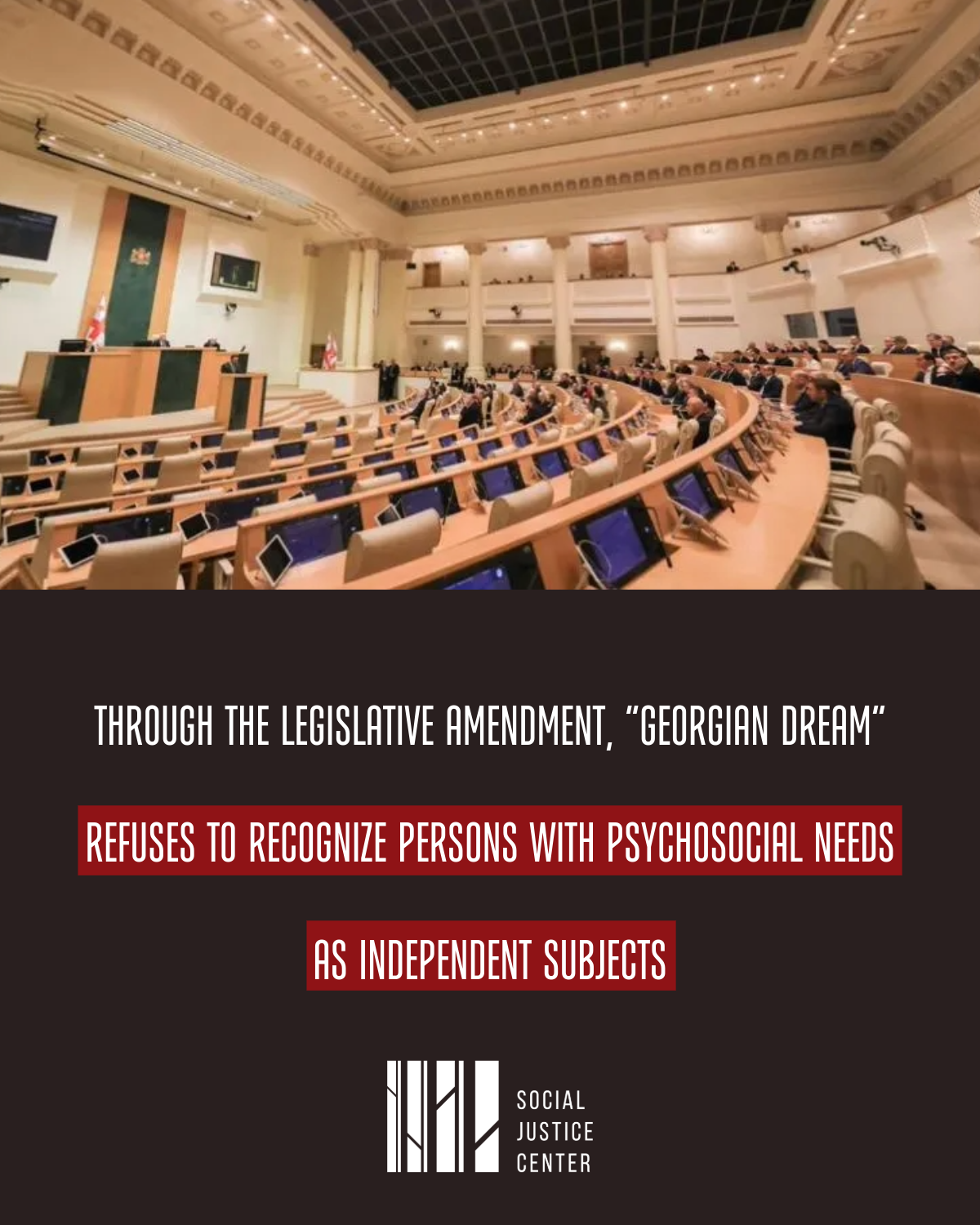
The Social Justice Center responds to the package of legislative amendments adopted by the MPs of “Georgian Dream”, which introduces the concept of “procedural incapacity” into criminal legislation. The existing amendments, given their content, disregard international human rights standards, including the provisions of the UN Convention on the Rights of Persons with Disabilities (hereinafter – “the Convention”). The package entirely undermines the legal capacity reform carried out years ago, which, following the ratification of the Convention, represented the only fundamental change in the country in terms of the protection of the rights of persons with disabilities.
Legislative amendments were introduced, on the one hand, into the Criminal Procedure Code of Georgia, and, on the other hand, into the Law of Georgia “On Mental Health”. As a result of the amendment, a new term was introduced into the legislative framework - “procedurally incapable person”. This term covers an accused person who, due to a mental disorder, is unable to perform a procedural action that must be carried out with their direct participation. The amendments regulate the participation of a “procedurally incapable person” in the hearing on the merits of a case and the conditions for serving a sentence.
According to the amendments, if an accused person develops a mental health problem after committing a crime and becomes so-called “procedurally incapable”, an expert examination is conducted, and based on its content and a party’s motion, for the purpose of treatment, the judge does not commence the hearing on merits of the case or suspends it for a period of three months. If the person becomes “procedurally capable” or if three months elapse, the hearing on merits shall begin or continue. If the accused was “capable” at the time of committing the crime but became “procedurally incapable” afterward, in the event of a conviction, the court determines the placement of the convicted person in a medical institution until recovery, after which the serving of the sentence continues under general rules.
According to the explanatory note to the package of legislative amendments, the basis for its initiation was a decision of the Constitutional Court, according to which it is unconstitutional to find a person guilty who is unable to perform procedural actions that are exclusively theirs to perform and cannot be fully substituted by a lawyer. However, it should be noted that in its decision, the Constitutional Court states that depriving the accused of the opportunity to defend themselves renders the proceedings unfair, and therefore, appropriate opportunities must be created for the accused to participate in the proceedings. In reasoning on the constitutionality of the norm, the Constitutional Court pointed to several important circumstances that remained unclear within the scope of the legislative amendment and still do not allow for the application of an individual approach.
In the criminal case considered by the Constitutional Court, the so-called “incapacity” was temporary and, after a certain period, it would have been possible to conduct the proceedings. Based on this factor, the author of the constitutional submission noted that, in such a case, there should be a procedural possibility to postpone the consideration of the criminal case. At the same time, due to the heterogeneity of mental health problems, individual response mechanisms should have been created for each case. Within the framework of the mentioned case, the Constitutional Court established the unconstitutionality of finding a “procedurally incapable” person guilty; however, it also pointed out that the consideration of a case in court may result either in a conviction or an acquittal, and therefore, the state, when legislatively regulating the issue, should have ensured an appropriate balance.
By its content, the adopted amendments contradict international standards in several significant respects. First and foremost, this concerns Article 12 of the Convention, which reinforces equality before the law and legal capacity of persons with disabilities. According to the existing standard, considering a person “incapable”, depriving or restricting legal capacity, whether legislatively or de facto, is not permissible, including in the criminal justice sphere. Accordingly, instead of ensuring effective support for individuals during proceedings, the state automatically recognizes a person as “procedurally incapable” on the basis of a mental health diagnosis and subjects them to coercive measures.
The legislative amendments are also quite vague and allow for the possibility of abuse of authority. For example, it is unclear on the basis of which criteria a person’s “procedural incapacity” should be determined. In turn, the amendments provide for the conduct of an expert examination for the purpose of determining “procedural incapacity”. The Social Justice Center, as well as other organizations working on the issue, has for years criticized the work of the Levan Samkharauli National Forensic Expertise Bureau, considering it arbitrary and incompatible with the Convention. Moreover, court decisions, as a rule, are based exclusively on the conclusions of the Bureau, which, in turn, does not safeguard against risks of abuse of power by this institution (which is a legal entity of public law).
Another significant problem of the legislative amendments is the compulsory institutionalization of individuals and the implementation of forced treatment. The concept of compulsory treatment is recognized by Georgia’s criminal legislation and is actively used in practice. However, compulsory psychiatric care, by its nature, contradicts the essence of the Convention and a number of its provisions. According to Article 25 of the Convention, any type of medical intervention must be based on a person’s free and informed consent, which, in this case, is entirely disregarded. Additionally, it should be noted that persons subjected to compulsory treatment not only fail to receive appropriate support, but are kept in harsh conditions - subjected to practices of physical and chemical restraint and living in isolation, outside effective psychosocial rehabilitation, in an environment that is less oriented toward recovery.
The most serious risks associated with the legislative regulations relate to the indefinite deprivation of liberty. In particular, under the Criminal Procedure Code, if it is established that the accused was “capable” at the time of committing the crime but became “procedurally incapable” afterward, in the event of a conviction, the court determines the placement of the convicted person in an appropriate medical institution until recovery, after which the serving of the sentence continues under general regulations. This creates risks of broad and abusive use of authority and allows for the possibility that a person may remain in a psychiatric institution for an indefinite period solely because their “recovery” has not been achieved. It should be noted that long-term placement in psychiatric institutions has been a widespread and problematic practice in Georgia for years.
After the legislative amendment, it remains permissible to issue a conviction against a person whom the legislation considers “procedurally incapable”. However, the package of legislative amendments does not answer the question of how a person’s rights will be protected in court if, after the expiration of the three-month period, their “procedural capacity” cannot be restored, and the consideration of the case continues. This is one of the most critical issues, as the amendments overlook such cases and create an unjustified and dangerous precedent of compulsory treatment. At the same time, the goal of “Georgian Dream” to adopt amendments in line with the decision of the Constitutional Court cannot justify a gross violation of a person’s constitutional rights.
Based on the content of the legislative amendments, one of the most problematic provisions is the suspension of the term of detention. This provision is discriminatory - if detention is applied as a measure of restraint and, upon the motion of the prosecution, the person is placed in a medical institution, the running of the detention term is not suspended; whereas if the motion is initiated by the defense, the running of the term is suspended. This creates the risk that, in the absence of a motion by the prosecution, a person may be punished twice - subjected to compulsory psychiatric treatment while, at the same time, their detention term is not reduced.
The consequences of enforcing this legislation will be detrimental to the population. Through its adoption and implementation, the country once again regresses in the field of human rights protection and disregards the legal capacity reform and the related paradigms implemented years ago, which, despite serious shortcomings in implementation, represented one of the most important reforms aimed at improving the human rights situation of persons with disabilities.
It should also be noted that, despite the implementation of the legal capacity reform, reform of the criminal justice sphere and alignment with the provisions of the Convention did not take place. This includes the failure to consider the decision of the Constitutional Court, which emphasized the need for an individual approach by the legislator at the stage of regulating the issue. In this regard, the UN Committee on the Rights of Persons with Disabilities and the UN Special Rapporteur on the rights of persons with disabilities have spoken about particular challenges. For example, in its concluding observations on Georgia, the Committee negatively assessed the practice of involuntary psychiatric care based on disability status and emphasized the impermissibility of legislation that allows for compulsory treatment and other restrictive measures. The UN Special Rapporteur on the rights of persons with disabilities shared the same concern and additionally stated that the provisions of the Criminal Procedure Code call into question the legal capacity of persons with psychosocial needs. The above-mentioned international mechanisms urged Georgia to repeal legislation allowing for compulsory treatment and to transition the existing system to voluntary support mechanisms that would respect the right to liberty and autonomy of persons with disabilities, as well as to repeal those provisions of the Criminal Procedure Code (including Article 191 of the Criminal Procedure Code) that restrict the participation of persons with disabilities in proceedings and access to justice.
Instead of fulfilling international recommendations and focusing on how to ensure procedural accommodations for persons with disabilities and identify and eliminate existing barriers, the legislative amendments lead to the complete objectification of people with mental health problems.
It should also be noted that, as with many other draft laws, this amendment was adopted under an expedited procedure, without the participation of relevant actors, including members of the disability community and experts, and without a review of good practices from other countries. It is noteworthy that one of the initiators and authors of the package of legislative amendments is Rati Ionatamishvili, who formally positioned himself as a defender of the rights of the community, but in reality, is a co-author of initiatives that significantly roll back the rights of persons with disabilities.
The Social Justice Center expresses its solidarity with persons with psychosocial needs and declares its readiness to provide support and assistance during the process of enforcement of legislation directed against them.
The website accessibility instruction