საერთო ცხელი ხაზი +995 577 07 05 63


საერთო ცხელი ხაზი +995 577 07 05 63
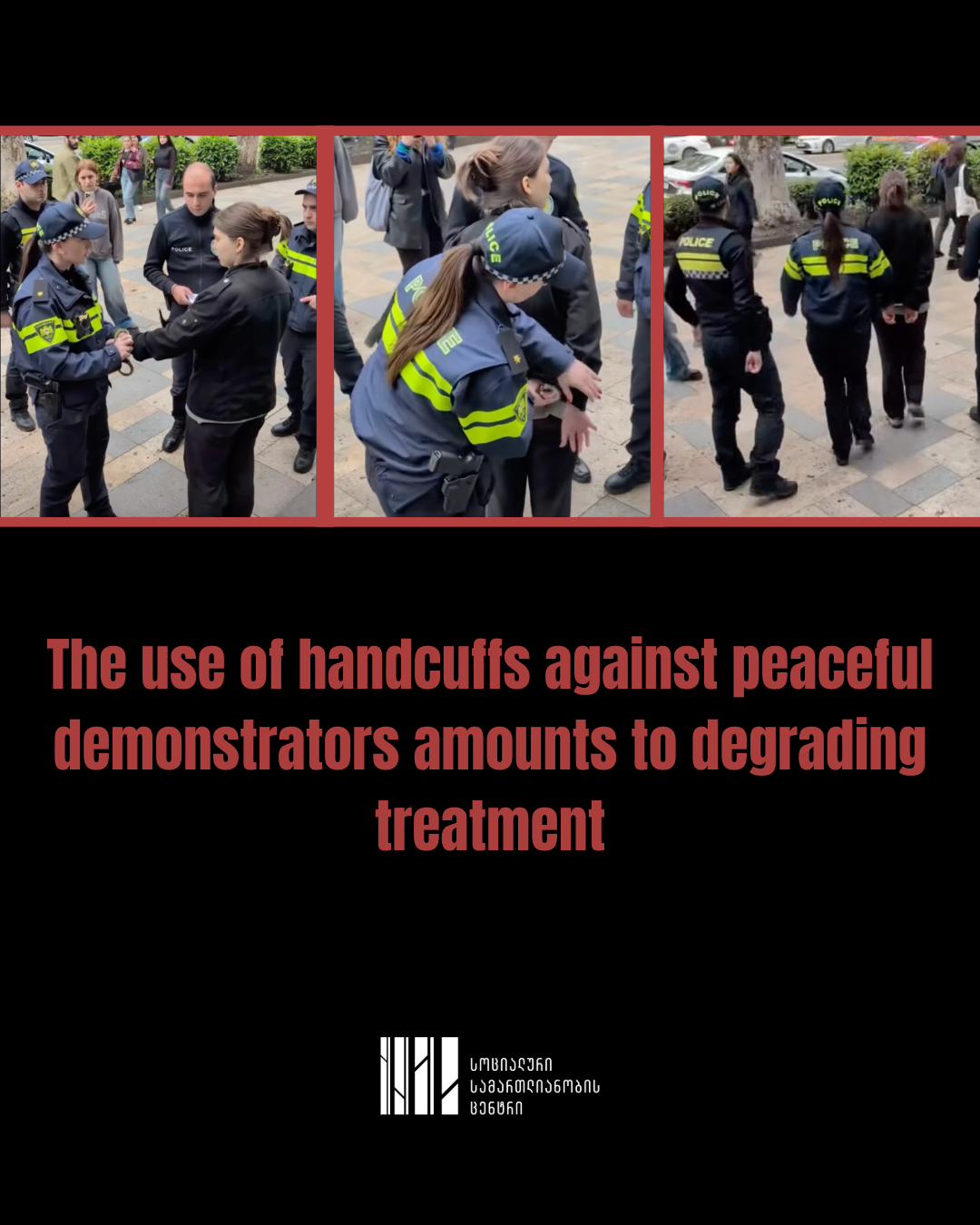
The Social Justice Center responds to the cases of activists detained over the past days under the pretext of “blocking the sidewalk,” and we consider that, alongside the problematic nature of the grounds for detention, the form and manner of the detention constituted a deliberate attempt by the authorities to demonstrate force, intimidate citizens, and violate their dignity.
On 6 May 2026, on the grounds of obstruction of pedestrian movement and through the use of handcuffs, the Ministry of Internal Affairs detained student Ana Fridonishvili, member of the party “Akhali” Nodar Chachanidze, and activists Tamar Giorgadze and Natia Gofodze. The court imposed administrative detention of 2–3 days on them. The detention of these individuals did not take place at the location or at the time of the obstruction of pedestrian movement. For example, student Ana Fridonishvili was detained near Ilia State University. In addition, it is evident that there was no necessity to handcuff the individuals who were subjected to administrative detention.
Impossibility of imposing liability for “blocking the sidewalk”
The possibility of using administrative detention for blocking pedestrian movement (sidewalks) was introduced through legislative amendments adopted in December of the previous year. These amendments prohibited the intentional creation of obstacles to the movement of people and, in order to prevent such obstruction, established an obligation to notify the Ministry of Internal Affairs about a planned assembly five days in advance.
At the same time, in conjunction with earlier amendments to the Criminal Code, it has already become possible to impose criminal liability and a sentence of up to one year of imprisonment for the artificial obstruction of pedestrian movement on sidewalks, as well as for repeated failure to notify the Ministry of Internal Affairs five days in advance of an assembly, following an initial imposition of administrative detention of up to 15 days.
Although neither the Constitutional Court of Georgia nor the European Court of Human Rights has examined a case specifically concerning the restriction of the right of assembly on sidewalks under this legislation, their established standards unequivocally exclude the restriction of assemblies on the grounds of obstruction of pedestrian movement. It follows directly from the standards developed by the Constitutional Court and the European Court of Human Rights that minimal disruption is an inherent consequence of the exercise of freedom of assembly and cannot serve as a ground for restriction if it is necessitated by the number of participants and is not self-serving in nature.
Moreover, in the case “Free Georgia v. the Parliament of Georgia,” the Constitutional Court considered it a disproportionate restriction to demand the termination of an assembly even when, given the small number of participants, blocking the roadway was not necessary. According to the Court, such a violation of the rules of assembly should result in bringing it into compliance with the law, rather than its immediate termination. [1]
Similarly, the European Court of Human Rights imposes on states a duty of tolerance even in cases of self-serving disruption, provided that it is linked to the aims of the protest. .[2] For example, the Court includes within the scope of freedom of assembly the blocking of highways in order to exert pressure on the authorities [3] , the deliberate temporary disruption of the functioning of a legislative body [4]when the protest is directly aimed at its activity, and extends protection under freedom of expression and assembly to performances involving the temporary occupation[5] or obstruction of public institutions or privately accessible spaces. [6]
This standard clearly implies that the minimal inconvenience created for pedestrian movement through an assembly—namely, having to reach the destination via a detour (a minimally increased route), which by its nature can arise only naturally due to the number of assembled persons—cannot justify a higher level of protection than the freedom of assembly (for the case-law of the Constitutional and European Courts, see here). [7]
The importance of this understanding of freedom of assembly is also emphasized by the Public Defender of Georgia in an amicus curiae submission to the Tbilisi Court of Appeal on 29 April 2026. The Public Defender noted that any assembly, by its very nature, may cause some disruption to the normal rhythm of daily life; however, such disruption must be tolerated by the authorities, except in cases where a competing interest is disproportionately harmed.
Incompatibility of the manner of arrest with human rights standards
The use of handcuffs without necessity during arrest may be examined under Article 3 of the European Convention on Human Rights, which prohibits torture and inhuman or degrading treatment or punishment. In one case, the Court indicated that such treatment—namely, the wearing of handcuffs in a public place—may affect a person’s self-esteem and cause psychological harm. [8] At the same time, the Court takes into account such circumstances as the prior conduct of the arrested person, which may have given rise to security concerns, or evidence that the person would pose a danger to themselves or others, or that they had previously committed criminal acts, including acts of self-harm or violence against others. [9]
At the national level, the general rule for the use of handcuffs is established by Article 33 of the Law on Police, which provides that handcuffs are used against a person who has committed a criminal or socially dangerous act and who resists or may resist a police officer, or attempts to escape; during the escorting of a detained or arrested person; or where a person’s dangerous conduct may cause harm to themselves or others. In addition to this general norm, there is no unified and detailed protocol within the law enforcement system that clearly defines the scope of the use of handcuffs, the criteria of necessity, and the standard of proportionality.
In January 2024, the Special Investigation Service, in the context of criminal cases, approved for its own agency internal rules restricting the use of handcuffs. According to the document, the main purpose of the use of handcuffs must be the neutralization of a person’s physical resistance, the prevention of harm to oneself or to a third person, and the reduction of the risk of escape. Their use must take place only within the bounds of necessity and only with such intensity as is required to achieve the specific objective.Handcuffs must be applied in such a way as to avoid excessive tightening and physical injury, and the law enforcement officer is obliged to ensure that the detainee does not suffer physical pain or injury. In addition, the use of handcuffs must be recorded in the relevant protocol, and in each individual case there must be a clear justification for their use.[10]
A police power–limiting instruction, which at a minimum excludes the use of handcuffs without an individual assessment, must be even stricter in cases concerning administrative offences. By its nature, an administrative offence involves less serious conduct; it is more frequent and, accordingly, creates an even higher risk of the widespread use of handcuffs and the humiliation of persons subjected to handcuffing.
In assessing the detention of participants in recent assemblies, it must be taken into account that they were not detained at the place and time of the alleged obstruction, but at a later stage, which in itself excludes any practical necessity for the use of handcuffs. In addition, there was no risk of escape, resistance, or danger. In turn, the ground for detention was the blocking of the sidewalk, which by its nature constitutes a minor administrative offence and cannot justify the use of handcuffs without an individual assessment. In the case of student Ana Fridonishvili, who was detained on the premises of Ilia State University, the particularly serious circumstance is that a young woman was handcuffed and detained in an educational setting, within a university space. It is evident that neither security considerations nor necessity can justify this act, and therefore it may amount to treatment prohibited under the European Convention on Human Rights, namely degrading and humiliating treatment.
Conclusion
As another wave of post hoc aggressive arrests for participation in sidewalk-based assemblies demonstrates, the regression in the protection of freedom of assembly has become a systemic and irreversible process. This regression is reflected not only in regressive legislation and its corresponding chilling effect, but also in the aggressive application of such legislation and the disappearance of its constraining function.
Under these conditions, even symbolic recognition of the importance of assembly is no longer preserved. This practice does not constitute isolated instances of unlawful application of legislation or rights violations; rather, it reveals a systemic intention to minimize any inconvenience created by protest, including through the use of degrading forms such as unexpected arrests with handcuffing near educational institutions. Accordingly, this aggressive practice of punishing protest on sidewalks cannot be regarded as a legitimate policing measure and serves only the effect of a “bare” demonstration of force and the humiliation of activists. The absence of objective necessity for the use of handcuffs, combined with the public and degrading manner of arrest, indicates that such conduct may amount to treatment prohibited by the European Convention on Human Rights, namely degrading treatment.
[1] Political Union “Free Georgia” v. Parliament of Georgia, 24/06/2014, paras. 47–48.
[2] Navalnyy and Yashin v. Russia, 2014, § 63; Kudrevičius and Others v. Lithuania [GC], 2015, § 97-98, 150.
[3] Barraco v. France (2009), no. 31684/05, 5 March 2009, paras. 43, 46–47.
[4] Makarashvili and Others v. Georgia, no. 23158/20, 1 September 2022, paras. 89–94.
[5] Taranenko v. Russia, no. 19554/05, 15 May 2014.
[6] Mariya Alekhina and Others v. Russia (2018), no. 38004/12, 17 July 2018; see also Annenkov and Others v. Russia (2017), §§123, 126.
[7] Public Defender of Georgia v. Parliament of Georgia, 14/12/2023, paras. 36, 38–39, 41, 43.
https://matsne.gov.ge/ka/document/view/6004741?publication=0
[8] Erdoğan Yağız v. Turkey (2007), Application no. 14687/05, para. 45.
[9] ibid.
[10] The document also emphasizes that, prior to the use of handcuffs, law enforcement authorities must take into account the detainee’s age, gender, health condition, physical capacity, and other individual circumstances. In particular, fastening hands behind the back is permissible only where security cannot be ensured by any other means. Nevertheless, in practice, handcuffs are often applied automatically to all detainees, irrespective of individual circumstances.
The website accessibility instruction