საერთო ცხელი ხაზი +995 577 07 05 63


საერთო ცხელი ხაზი +995 577 07 05 63
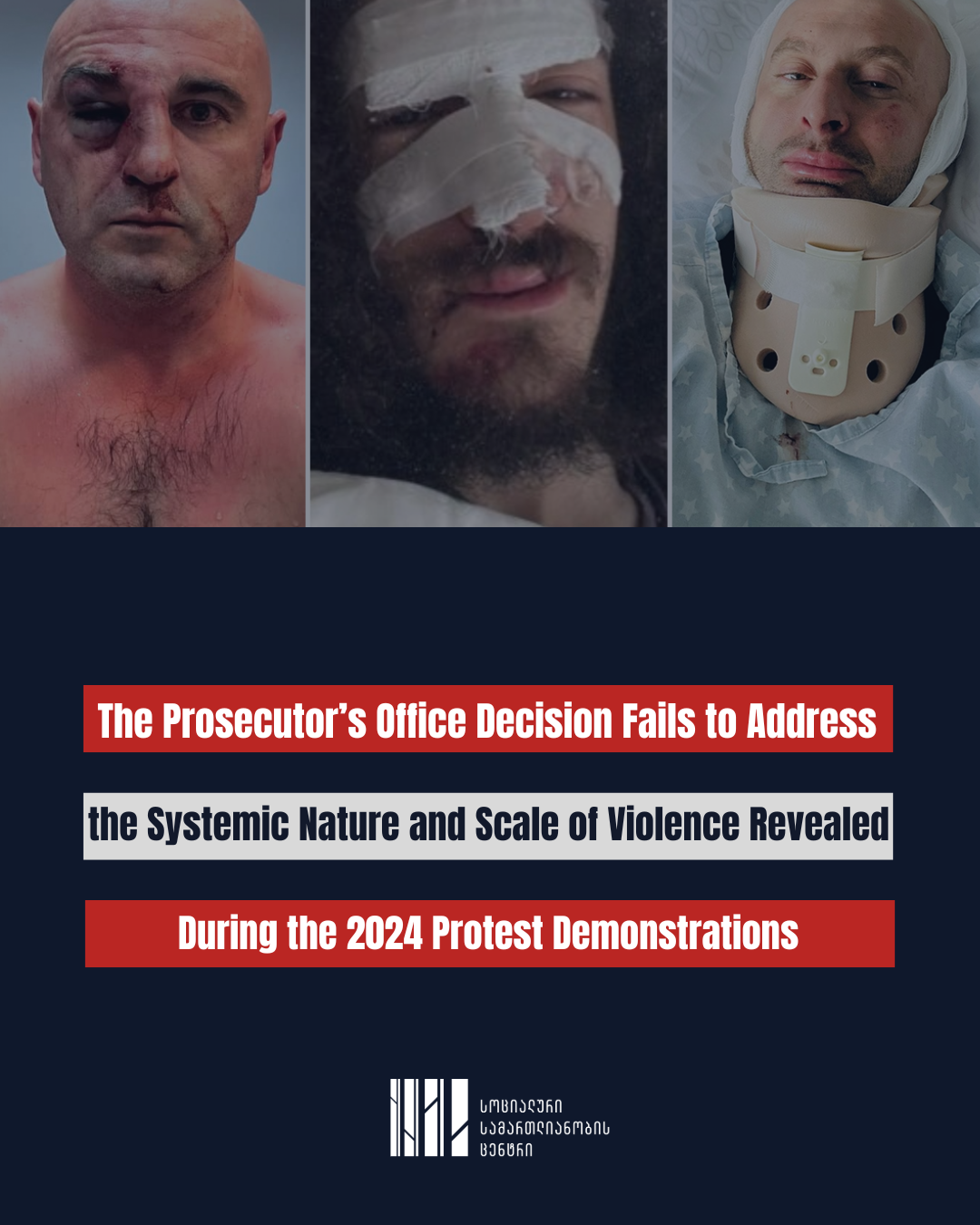
Social Justice Center responds to the Prosecutor’s Office statement issued yesterday regarding the arrest of 5 individuals in connection with acts of violence committed by law enforcement officers during demonstrations and considers that this decision fails to address the systemic nature and extraordinarily large scale of police violence revealed in the spring and autumn of 2024. It should be noted that Social Justice Center represents the interests of Zviad Maisashvili before the investigative authorities.
According to the statement released on May 7, 2026,[1] the Tbilisi Prosecutor’s Office arrested 5 individuals in connection with acts of violence committed against Zviad Maisashvili, Levan Khabeishvili, and Guram Rogava during the 2024 protests. Among those arrested are three former and one current special forces officers, as well as one current employee of the Ministry of Internal Affairs’ Security Police Department.
We believe that this decision within the framework of the investigation is positive; however, it still fails to adequately respond to the scale and nature of police violence revealed during the spring and autumn of 2024, and it does not appear that the investigative authorities are genuinely focused on effectively protecting the interests of victims. Moreover, as the analysis of recent investigative processes demonstrated (including the results of our review of case materials 10 days ago), the investigation had not intended to identify specific perpetrators, and this decision appears to have been adopted suddenly and hastily in response to journalistic investigations, raising suspicions that it was motivated by political expediency.
At the same time, it is particularly alarming that the state’s response still fails to reflect the depth of the constitutional crisis that emerged when the Ministry of Internal Affairs effectively transformed the use of force into an instrument of administrative governance aimed at restricting freedom of assembly. Under such circumstances, it is evident that assessing isolated episodes of violence separately cannot ensure either the establishment of truth or the resolution of institutional responsibility.
In particular:
As is publicly known, police forces dispersed demonstrations seven times within a ten-day period beginning on November 28, 2024.[2] During four of those seven days, the Ministry of Internal Affairs used three or more active special means simultaneously on Rustaveli Avenue (water cannons, pepper spray, tear gas, and, in some cases, rubber bullets).[3] In six out of those seven dispersals, no prior warning was issued before the use of active special means against protesters on Rustaveli Avenue, while there were multiple visible instances of their targeted use.[4] There are also suspicions concerning the use of prohibited chemical agents.[5] The intensive use of tear gas, pepper spray, water cannons, and other, as yet unidentified, means caused acute health problems for demonstrators. Beyond the immediate harm, medical professionals have also pointed to expected long-term consequences.[6] Between November 28 and December 8, 2024, several instances were identified (including during the night of December 1–2) where special forces encircled citizens during the dispersal of protests, contrary to both legislation and international standards.[7]
To date, the public still does not know who made the specific operational decisions concerning the use of special means, the dispersal of assemblies, and the actions of special forces units. Nor has the issue of political responsibility been identified, even though police operations of such scale and intensity could not have been conducted without high-level political consent and coordination. Therefore, it is important that the investigation assess not only the actions of direct perpetrators, but also the responsibility of senior officials.
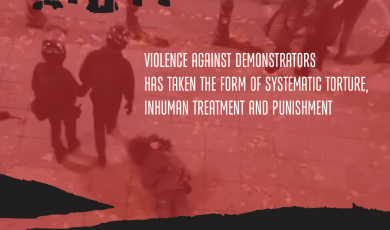
In the case of Zviad Maisashvili, as well as in dozens of other cases handled by Social Justice Center, the physical force used by police against peaceful demonstrators largely took the form of demonstrative physical violence. Physical abuse of detainees (including punching and kicking various parts of the body, dragging by the hair, forcefully throwing individuals to the ground, spitting, and verbal abuse after protest participants had already been placed under effective police control) had a systemic character. The force used against citizens did not serve the purpose of preventing unlawful acts; rather, it served only demonstrative retaliation and exemplary punishment of citizens.
In numerous episodes, the violence revealed not spontaneous or individual misconduct, but rather a deliberate practice of punishment and intimidation aimed at breaking the political will of protest participants and instilling fear in society.
The scale of violence against protest participants is clearly demonstrated by a joint report prepared by 11 Georgian civil society organizations. During the preparation of the report, interviews were conducted with 117 respondents, and 77.7% of them indicated that they had been subjected to violence and ill-treatment by police in the context of protests held between November 19 and January 28.[8] In 87.9% of cases involving respondents who experienced violence, the abuse by police was accompanied by detention. Special forces officers deliberately attempted to inflict injuries to protesters’ faces.[9]
The same is reflected in the data contained in the Public Defender’s report. According to the Public Defender, between April 15, 2024, and March 1, 2025, the Public Defender and his representatives visited 624 individuals detained or injured during protest demonstrations. Of these, 360 individuals (57.7%) reported ill-treatment. More specifically, among the 182 detained and injured persons visited during the protests held in April and May 2024, 93 spoke of ill-treatment (51.1%). Meanwhile, among the 442 persons visited between November 28, 2024, and March 1, 2025, 267 individuals (60%) reported ill-treatment. During the period from November 29 to December 2, 2024 alone, 79.5% of the visited individuals reported ill-treatment.[10]
The scale of the violence, the coordinated participation of various units of the Ministry of Internal Affairs, the consistency of torture victims’ testimonies, and the repetition of identical actions on different dates all indicate the systemic and organized nature of torture-related crimes. Under these circumstances, it is clear that violence on this scale requires the Prosecutor’s Office to respond adequately to every case of severe violence, and initiating prosecution against only five individuals is not a sufficient response from the investigation.
It is particularly problematic that, to this day, no political will has emerged on the part of the state to acknowledge the systemic nature of the violations. On the contrary, public statements by government representatives have often aimed at discrediting victims of violence and legitimizing police actions, thereby further reinforcing the climate of impunity. Moreover, senior officials of the Ministry of Internal Affairs involved in the violence were shortly thereafter awarded Medals of Honor by government representatives on January 30, 2025.[11] In addition, “Georgian Dream” abolished the Special Investigation Service, thereby intentionally dismantling the institutional foundations necessary for more independent, objective, and proper investigations of law enforcement misconduct.[12]
The climate of impunity constitutes a structural challenge that creates conditions for repeated violence, facilitates excessive concentration of state power, and weakens democratic institutions, ultimately threatening not only citizens, but the principle of the rule of law as a whole.
Accordingly, it is evident that, in the process of investigating hundreds of cases of violence against protest participants, the investigative authorities are not guided by the principle of the rule of law and are intentionally failing to investigate incidents of violence fully, objectively, and comprehensively. This creates an environment of impunity, undermines social peace within society, and leads to the complete erosion of trust in law enforcement institutions.
The existing practice raises signs of selective justice and political influence, whereby investigations respond only after high public interest and the public dissemination of evidence, while systemic responsibility continues to be ignored. This further weakens public trust in the independence of justice institutions.
If there is a genuine interest in effectively investigating the criminal cases under consideration, identifying those responsible for the crimes, and protecting the real interests of victims, it is important that the Prosecutor’s Office of Georgia take the following measures:
[1] Statement of the Prosecutor’s Office of Georgia, available at: https://l1nq.com/vya5y7g
[2] 11 Civil Society Organizations. Human Rights Crisis in Georgia Following the 2024 Parliamentary Elections: Collective Report. 2025. Available at: https://socialjustice.org.ge/ka/products/adamianis-uflebebis-krizisi-sakartveloshi-2024-tslis-saparlamento-archevnebis-shemdgom
[3] Ibid.
[4] Ibid.
[5] OSCE Fact-Finding Mission on Georgia. Report on Developments in Georgia in Respect of Human Rights and Fundamental Freedoms since Spring 2024, by Professor Patrycja Grzebyk, Sole Rapporteur, under Paragraph 12 of the Moscow Mechanism. 2026. Available at: https://odihr.osce.org/sites/default/files/documents/official_documents/2026/03/odgal0009c1%20ODIHR%20NV%2082-2026%20report_Moscow%20Mechanism%20invoked%20in%20respect%20of%20Georgia_0.pdf
[6] 11 Civil Society Organizations. Human Rights Crisis in Georgia Following the 2024 Parliamentary Elections: Collective Report. 2025. Available at: https://socialjustice.org.ge/ka/products/adamianis-uflebebis-krizisi-sakartveloshi-2024-tslis-saparlamento-archevnebis-shemdgom
[7] Ibid.
[8] Ibid.
[9] Ibid.
[10] Public Defender of Georgia. Report about Human Rights and Freedoms Protection in Georgia: 2024 Report. 2025. Available at: https://ombudsman.ge/res/docs/2025040121291438156.pdf
[11] Radio Free Europe/Radio Liberty (RFE/RL) Georgian Service, “Kavelashvili Awarded Orders of Honor to Sanctioned Senior Police Officials,” 2025. Available at: https://www.radiotavisupleba.ge/a/33296959.html
[12] Social Justice Center. “Dismantled, Captured, Abolished”: The Fate of Georgia’s Independent Oversight Institutions under Conditions of Autocratization. 2025. Available at: https://socialjustice.org.ge/ka/products/dashlili-mitatsebuli-gaukmebuli-sakartvelos-damoukidebeli-sazedamkhedvelo-institutebis-bedi-avtokratizatsiis-pirobebshi
[13] Subparagraph “b” of Part 3 of Article 333 of the Criminal Code of Georgia.
[14] Article 144³ of the Criminal Code of Georgia.
[15] Social Justice Center. Impunity for Violence: The Crisis in Investigating Cases of Police Violence during the 2024 Protests. 2025. Available at: https://socialjustice.org.ge/ka/products/dausjeli-dzaladoba-2024-tslis-protestebis-dros-sapolitsio-dzaladobis-sakmeebis-gamodziebis-krizisi-shualeduri-angarish
The website accessibility instruction