საერთო ცხელი ხაზი +995 577 07 05 63


საერთო ცხელი ხაზი +995 577 07 05 63
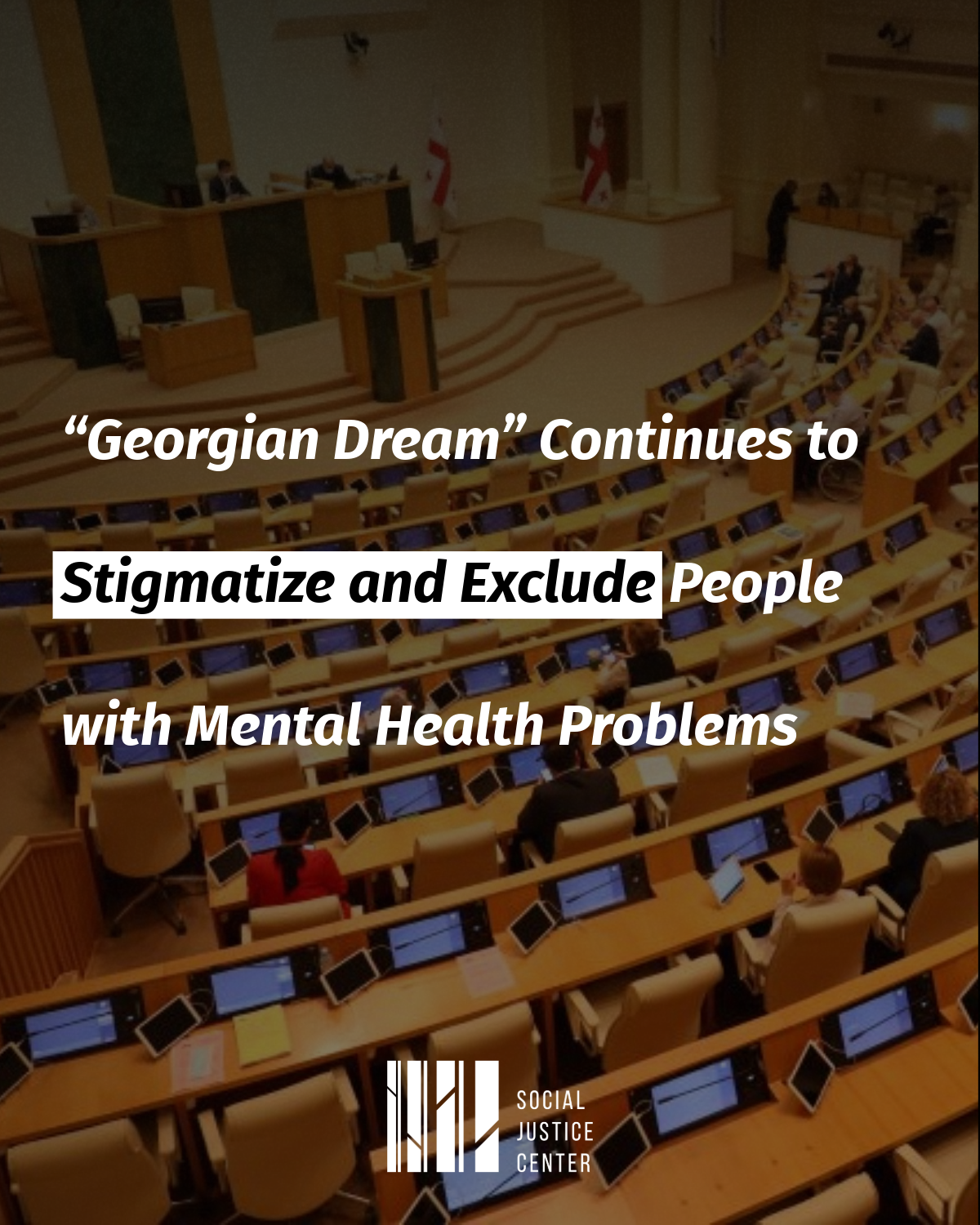
On December 15, a package of legislative amendments adopted by MPs of Georgian Dream was made public. Among other issues, the amendments concern the creation of a unified information database of people with mental health problems, as well as users of narcotic substances and alcohol. We believe that these changes disregard human rights–based approaches, establish discriminatory policies based on health status, and violate the principle of confidentiality of personal data. Given its content, the changes will, on the one hand, lead to even greater stigmatization and exclusion of persons with mental health problems, and, on the other hand, increase the risks of the state instrumentalizing information about mental health for political purposes.
The legislative amendments package was initiated by the Government of Georgia back in 2024 and envisages amendments to 15 laws.[1] A few days ago, on December 9, Parliament adopted it at the third reading. According to the explanatory note, the stated aim of the amendments was the absence of a comprehensive information database and the difficulties caused by the lack of relevant data.
The amendments provide that by March 1, 2026, the Ministry of Internally Displaced Persons from the Occupied Territories, Labour, Health and Social Affairs of Georgia (hereinafter – “the Ministry”) will create a unified information database of “persons with mental health problems, alcoholism, drug addiction, and toxicomania”. Information will be entered into the database by relevant public and private medical institutions. In cases provided for by law, this information will be accessible to relevant state bodies. The criteria for entering data into the database will be defined by the Ministry at a later stage. It is highly likely that the Ministry will also define the categories of persons to whom these rules will apply.
The primary justification for creating the database, as stated in the legislative amendments, is ensuring public safety. According to the government, a challenge exists in determining whether a person’s health condition complies with the requirements established by Georgian legislation in processes such as issuing a firearms license, granting the right to carry service-issued weapons, granting a driver’s license, and other similar procedures. According to the Ministry of Internal Affairs, the inclusion of a person’s information in this database will also result in the suspension of already issued permits (e.g., firearms license).
The changes have already drawn responses from mental health and addiction professionals, social workers, psychologists, and community representatives. They have assessed the initiative negatively, stating that beyond the announced restrictions, the legislative changes will encourage stigmatization, create significant barriers to accessing services, and become a mechanism of harassment and punishment.
An analysis of the legislative amendments clearly shows that their content contradicts both international standards and the fundamental principles of mental health care:
One of the greatest risks posed by the law is the political instrumentalization of mental health and addiction issues. Namely, amendments to the Law “On Police” authorize the police to obtain information from the database when placing a person in a temporary detention isolator. According to the explanatory note, the purpose of this change is to take into account the needs of detainees. In reality, however, a norm that grants police the authority to request such information without clear safeguards could be used against opposition-minded activists detained by the police. It is particularly noteworthy that a similar law has been adopted in the Russian Federation. As in Georgia, a special registry containing information on individuals’ mental health conditions will come into force in Russia on March 1, 2026, and the justifications for its creation are similar to those cited in Georgia.
Unfortunately, despite years of advocacy aimed at establishing and implementing human rights-based approaches, the legislative framework and practice are deteriorating significantly. Instead of encouraging access to support services - as Parliament itself emphasized a few years ago - and ensuring a sense of safety for service users, with confidentiality as a key component, the system turns certain health conditions into sources of stigma and further obstructs access to essential services. Moreover, the adopted changes clearly increase the risk of pressure and harassment against activists and political opponents, turning mental health into one of the main tools of political battle.
The Social Justice Center will monitor the process of adoption and the content of the regulations related to the unified register by the Ministry, as well as the practical implementation of the legislation, and will provide the public with information on the risks and rights violations identified in this area.
[1] Amendments to the Laws of Georgia “On Weapons”, “On Mental Health”, “On Traffic”, “On Licenses and Permits”, “On License and Permit Fees”, “On State Property”, “On Police”, “On the Fees and Time Limits for Services Provided by the Legal Entity under Public Law called the- Service Agency of the Ministry of Internal Affairs of Georgia”, “On Public Safety”, “On Private Security Activities”, “On Narcotic Drugs, Psychotropic Substances and Precursors and Narcological Assistance”, “On the Rights of Persons with Disabilities”, “On Medical Practice”, “On Public Health” and “On Health Care”.
The website accessibility instruction