საერთო ცხელი ხაზი +995 577 07 05 63


საერთო ცხელი ხაზი +995 577 07 05 63
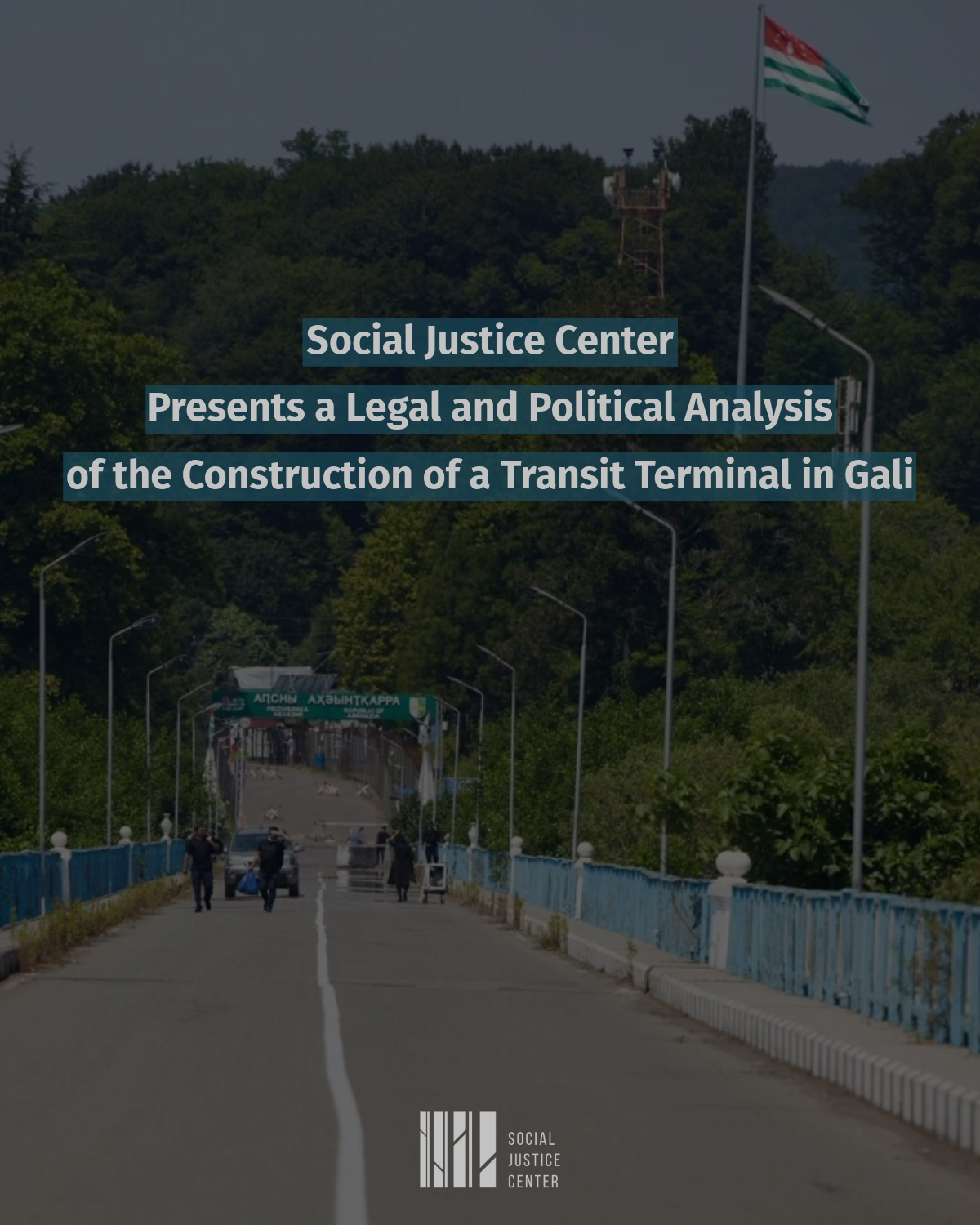
Social Justice Center assesses the project for the construction of a transit terminal in Gali and considers that the development of the existing infrastructure fits neither within the framework of a peace policy nor within the policy of non-recognition, while the silence of the “Georgian Dream “ government raises suspicions and questions.
Over recent weeks, information has been regularly circulating about the construction of a new transit/customs terminal[1] in the Gali, near the Enguri River, which, according to public sources, is already at the final stage of completion. Public discussion of the project began in December 2025; however, information about the construction of this transit infrastructure had been known to the public since 2023. As stated by Abkhaz sources, the newly built “customs terminal” near the Enguri is almost ready to process cargo, with only technical system equipment remaining to be installed.
The Georgian side has not reacted to this issue even once; officials have merely denied the existence of any formal agreement with the Abkhaz/Russian side[2]. The inaction and silence of official Tbilisi regarding the ongoing transit project in Gali raise questions about possible covert negotiations between Tbilisi and Moscow/Sokhumi.
Significant information about the Gali terminal became publicly available through statements by Astamur Akhsalba, head of an Abkhaz transit/logistics company and of the Eurasian integration platform “Assembly of the Peoples of the World,” established on the initiative of the President of the Russian Federation. According to him, the project had been quietly underway for years without public disclosure in order to avoid the risk of its disruption.
According to Akhsalba, the terminal is intended to serve the transit of cargo from third countries (China, India, Iran, Azerbaijan, and others) toward Russia. The focus will be on countries interested in the shortest transport routes to southern Russia (Rostov-on-Don, Krasnodar, Sochi). Akhsalba does not rule out interest from European countries either—countries that currently cannot engage in transit and trade with Russia due to sanctions—although he does not specify which countries he has in mind.
The potential transit scheme would function as follows: the main cargo will consist of consumer goods—household appliances, vegetables, and other products. If cargo originates, for example, from Iran, Iranian freight vehicles with their drivers, would be able to enter the territory of occupied Abkhazia, travel to Ochamchire, unload the cargo at a railway terminal, and then leave the region. If necessary and subject to appropriate security checks, transport could continue further into Abkhazia. Since Abkhaz roads are not prepared for heavy transit traffic, it is planned that the railway terminal opened in Ochamchire will be connected to the Gali transit terminal.
It is noteworthy that in recent days media reports have suggested that Igor Giorgadze may be behind the Gali transit “hub”/“terminal.”[3] He is one of the deputy secretaries general of the “Assembly of the Peoples of the World,” which is the organization implementing the construction of the Gali terminal. On the Assembly’s website, Igor Giorgadze is listed as the president of the Moscow-registered autonomous non-commercial organization “Georgia Abroad.”
In addition to the Gali terminal, the development of transit infrastructure and new projects is actively underway in Abkhazia with direct Russian intervention and support. In particular, in March 2025 a container terminal was launched near the port of Ochamchire, connected to the main railway line and capable of storing 1,200 containers. The Abkhaz side assigns this newly opened infrastructure facility not a local function, but the role of a distribution terminal for cargo moving along international transport routes.
Furthermore, since 2023, railway infrastructure on the Psou–Ochamchire section has been repaired, and Russian freight trains have been operating intensively in Abkhazia since that year.[4]
Against the backdrop of the full-scale war launched in Ukraine, the development of transport infrastructure in Abkhazia openly demonstrates Russia’s objective: to create a reliably functioning new transport corridor[5] that would connect Russia with Asian countries through Abkhazia and Georgia, thereby compensating for the economic damage caused by sanctions.
It is noteworthy that the Abkhaz side itself acknowledges that the transit project entails political and legal challenges in relation to Georgia, which, according to them, could only be resolved after the conclusion of a non-use-of-force agreement with Georgia.[6]
The Georgian side has officially denied its involvement in the project and has described the steps taken by the Abkhaz side toward developing transit as speculation. At the same time, critical views regarding the Gali terminal have also been expressed within Abkhazia, where it is believed that the project will serve only Russian and Georgian interests, while Abkhazians themselves will not benefit. The Abkhaz Telegram channel “Abkhazia Analytical Center” writes that this transit scheme helps Russia circumvent sanctions, with Tbilisi acting as a “lifeline” in the process.[7]
Within this scheme, as explained above, Georgia acts as the importer—it purchases the cargo, prepares the documentation, and the goods acquire Georgian origin. Georgia then becomes the exporter and sells the cargo to Russia, which reaches Russian territory via Gali. In this case, the Georgian side is a full-fledged participant in the transaction, not merely a transit country. The function of a transit corridor in this scheme is left solely to Abkhazia. According to the Analytical Center, Abkhazia gains only a 0.1% customs fee from this project.[8]
The international legal framework governing occupation establishes that an occupying power acts as a temporary administrator of a specific territory and not as its sovereign. Sovereign rights—including customs, border, and transit infrastructure, as well as other fiscal and policy matters related to the circulation of goods—belong to the entity exercising de jure sovereignty.[9] A de facto or occupying regime has no right to create arrangements that are characteristic of a sovereign state, including so-called border and cargo-control mechanisms. A customs terminal serving logistics for transportation “from third countries to Russia,” and involving the entry of freight vehicles bearing Iranian, Turkish, or Armenian license plates, in practice functions as a border crossing point of international significance.
The legal-political doctrine of non-recognition, in turn, requires the non-recognition of any regime or action that would grant legal force or legitimacy to the acts of a de facto occupying authority.
Georgia’s Law on the Occupied Territories establishes a special legal regime for these territories and regulates, in multiple respects, the interaction of third parties with the occupied territories. Under Article 6 of the law, international air and maritime traffic, as well as railway transport and international road freight transportation, are prohibited in the occupied territories. Such prohibited activities are permissible only in exceptional cases, with special authorization issued in accordance with procedures established by a legal act of the Government of Georgia, and only if they serve Georgia’s state interests, the peaceful resolution of the conflict, de-occupation, the restoration of trust among populations affected by war, or humanitarian purposes.
In such a situation, the Government of Georgia could have taken, at a minimum, the following steps: used all international forums to condemn any attempt to establish a “customs/border” checkpoint without Georgia’s consent as an illegal act and another incident violating the country’s territorial integrity; facilitated the documentation of the violation at international platforms in order to describe and substantiate in detail why the establishment of such terminals and transit routes constitutes part of the consolidation of occupation and, moreover, a continuation of Russia’s annexation policy; mobilized diplomatic resources to disseminate information to relevant states, including interested private companies, regarding the illegality of such transit.[10] However, none of these measures were taken by the “Georgian Dream” government. The silence and complete inaction demonstrated by the Georgian side, at first glance, amount to a violation of the legal framework of the non-recognition policy.[11]
It should also be noted that the Georgian side similarly responded with silence to the opening of an airport in Sokhumi,[12] the opening of a port in Ochamchire, the deployment of a permanent Russian fleet, and other instances of growing Russian influence in Abkhazia. Against the backdrop of changes in foreign policy, this raises numerous questions regarding Georgia’s plans toward the conflict regions and the processes unfolding in this regard with Russia.
Clearly, beyond the policy of non-recognition and rigid international legal order, there exist counterarguments focused on reconciliation, trust-building, and conflict transformation, whereby states may use economic leverage to promote trade and economic rapprochement between divided societies. Such decisions may be perceived as legitimate by the parties to the conflict, as they may serve longer-term national interests. However, it is notable that neither the Abkhaz nor the Georgian side (and even less so the Russian side) attributes any trust-building or conflict-transformation significance to this process. On the contrary, they entirely disregard each other’s involvement in it.
Contemporary approaches to conflict transformation and peace policy are based on certain minimum standards, without which any economic or infrastructure initiative cannot be considered a peace-promoting process. Among these standards are inclusivity, genuine participation and benefit for the local population, transparency, reduction of power asymmetries, and the involvement of neutral international mediators. When assessed against these criteria, it is evident that the construction of the Gali transit terminal meets none of these requirements and therefore does not fit within the logic of peace policy.
The Georgian side explicitly states that it is not involved whatsoever in the opening of the terminal, which is itself problematic, as it amounts to an official declaration that Georgia has neither interest in nor claims regarding what type of customs facility is being opened on its occupied territory. On the other hand, the Abkhaz side openly declares that the Georgian side will be involved in the process only if it signs a non-use-of-force agreement with Abkhazia, thus communicating in the language of ultimatums.
It is noteworthy that as early as 2011, Georgia and Russia signed an agreement envisaging the restoration of transit traffic across Abkhazia and the Tskhinvali region. The monitoring of cargo (essentially performing a customs-like function) on both sides of the boundary was to be carried out by a private Swiss company, SGS. However, the agreement never entered into force, as the geographical locations for the placement of the relevant infrastructure could not be determined. At the time, Tbilisi opposed any form of customs control by Sokhumi due to the risks associated with recognition.
For years, the restoration of transport links through Abkhazia was associated with trust-building and the normalization of Georgian-Abkhaz relations. This issue has not lost its significance today, and it is clear that shared economic interests could have a positive impact on relations between Abkhazians and Georgians. However, as the circumstances described above demonstrate, no such purposeful dialogue has taken place between the Abkhaz and Georgian sides.
Moreover, the closed and non-transparent nature of the process related to the construction of the transit corridor, the complete exclusion of international organizations, and the absence of communication between Tbilisi and Sokhumi on this matter raise serious doubts that the project serves anything other than Russian interests. In addition, it raises concerns about high-level corruption and the circumvention of sanctions. Unfortunately, it is evident that the Georgian side does not actively resist Russia’s pursuit of its interests in the region, and that strategic inaction and silence only deepen Russia’s annexation policy.
It is unequivocal that this transit initiative reflects a stark power asymmetry in the region, which, rather than transforming the conflict, contributes to its preservation and entrenchment. In this model, Russia acts as the architect and primary beneficiary of the project; Georgia functions as an instrumental economic link; and Abkhazia serves as a controlled space. Such a structure does not create preconditions for equality, trust, or cooperation and instead reinforces an imperial model fundamentally incompatible with the idea of peace.
At the same time, it is important to note that the existing scheme does not perceive Abkhazia as an economic or political subject, but merely as a geographical space—a transit corridor through which Russia advances its economic and geopolitical interests. The fact that the Abkhaz side derives minimal economic benefit from the project further demonstrates that the process lacks genuine objectives related to local development, employment, or social welfare.
Furthermore, the human dimension is entirely disregarded in this process. The Gali transit terminal does not imply the facilitation of movement for people, the restoration of family ties, or the strengthening of humanitarian contacts. It signifies openness solely for cargo, while people continue to remain isolated and marginalized, with restricted rights and uncertain security conditions.
Conclusion
Thus, the construction of the Gali transit terminal is not an isolated infrastructure initiative and cannot be regarded as a neutral economic project. The existing factual circumstances clearly indicate the formation of a new transport corridor on a territory occupied by Russia, aimed at weakening the sanctions regime, circumventing Russia’s economic isolation, and consolidating the occupation of Abkhazia. In this process, Abkhazia is functionally transformed into a transit space, and if the infrastructure becomes operational, Georgia’s role will extend beyond that of a mere “passage route” and turn it into a participant in a trade-customs scheme, which is particularly problematic.
From the perspective of international law, the operation of such a terminal flagrantly contradicts both the legal framework of occupation and the fundamental principles of the non-recognition policy. The creation of “customs” and “border” infrastructure by a de facto regime constitutes an arbitrary appropriation of sovereign powers, while the silence and inaction of the Georgian authorities in response to this process effectively weaken the country’s declared legal positions and create a risk of legitimization.
Equally problematic is the peace policy dimension. Although economic relations and transit projects can theoretically be used as instruments for trust-building and conflict transformation, in the case of the Gali terminal there is no evidence of inclusive dialogue, orientation toward the interests of the local population, or involvement of international mediators. On the contrary, the process is characterized by secrecy, lack of transparency, and ultimatum-based rhetoric, which fundamentally contradicts the logic of reconciliation.
Ultimately, the construction of the Gali transit terminal raises serious questions regarding Georgia’s foreign and peace policy. The absence of a consistent response by the “Georgian Dream “government, the failure to actively raise the issue on international platforms, and the non-use of legal mechanisms not only weaken the non-recognition policy but also create the impression of strategic inaction that serves Russia’s annexationist interests in the region. In this situation, it is essential to create space for political and public debate that will shape fair positions grounded simultaneously in international law, genuine peace objectives, and respect for the interests of local communities.
[1] Radio Free Europe / Radio Liberty, “New Transport Terminal on the Enguri — Who Provided a ‘Lifeline’ to Russia?”, December 10, 2025. Available at: https://www.radiotavisupleba.ge/a/ახალი-სატრანსპორტო-ტერმინალი-ენგურზე/33618471.html
[2] Publika, “Kobakhidze on the Gali Terminal: ‘No Steps Have Been Taken on Our Side in This Direction,’” December 10, 2025. Available at: https://publika.ge/kobakhidze-galshi-terminalis-shesakheb-chveni-mkhridan-aravitari-nabiji-ar-gadadgmula-am-mimartulebit/
[3] Radio Free Europe / Radio Liberty, “The Enguri Terminal and Igor Giorgadze,” January 23, 2026. Available at: https://www.radiotavisupleba.ge/a/ტერმინალი-ენგურთან-და-იგორ-გიორგაძის-კავშირი/33656927.html
[4] Transkorr.ge, “With the Launch of the Ochamchire Container Terminal, Abkhazia Has Declared Its Intention to Perform a Transit Function,” March 7, 2025. Available at: https://transcor.ge/ოჩამჩირის-საკონტეინერო-ტ/
[5] Geabconflict.ge, “Transit Policy in the Caucasus – Is a Corridor via Abkhazia Realistic?”, December 2, 2025. Available at: https://geabconflict.net/blog/transit-geopolitics-in-the-caucasus-is-a-corridor-through-abkhazia-possible/
[6] Versia.ge, “Secretly Built Customs Terminal in the Gali District — Russia Creates a New Route to Circumvent Sanctions,” Available at: https://www.versia.ge/?option=com_content&view=article&id=4284:2025-12-10-14-11-09&catid=20&Itemid=170
[7] Jamnews.net, “‘Tbilisi Will Gain, Moscow Will Circumvent Sanctions, Sukhumi Will Be Left with Pennies’ — Perspective from Sukhumi on the Transit Terminal,” December 16, 2025. Available at: https://jam-news.net/analysis-georgia-will-profit-from-transit-russia-will-bypass-sanctions-while-abkhazia-will-get-only-scraps/
[8] Jamnews.net, “‘No Benefit?’ — Perspective from Abkhazia on the New Transit Terminal,” December 13, 2025. Available at: https://jam-news.net/whats-in-it-for-us-views-from-abkhazia-on-new-transit-terminal/
[9] Benvenisti, The International Law of Occupation (2nd ed.), Chapter 7 – Economic exploitation and administration, pp. 153–170; Ian Brownlie, Principles of Public International Law (8th ed.), pp. 105–110 (Territorial sovereignty).
[10] Articles on Responsibility of States for Internationally Wrongful Acts, Article 41 – pp. 113–115.
[11] Legal Consequences for States of the Continued Presence of South Africa in Namibia (ICJ Reports 1971), §125–127.
[12] Social Justice Center, “The Policy of Silence and Inaction Regarding the Conflict Regions Is Concerning,” November 13, 2024. Available at: https://socialjustice.org.ge/en/products/dumilis-da-umokmedobis-politika-konfliktebis-regionebtan-dakavshirebit-shemashfotebelia
The website accessibility instruction