საერთო ცხელი ხაზი +995 577 07 05 63


საერთო ცხელი ხაზი +995 577 07 05 63
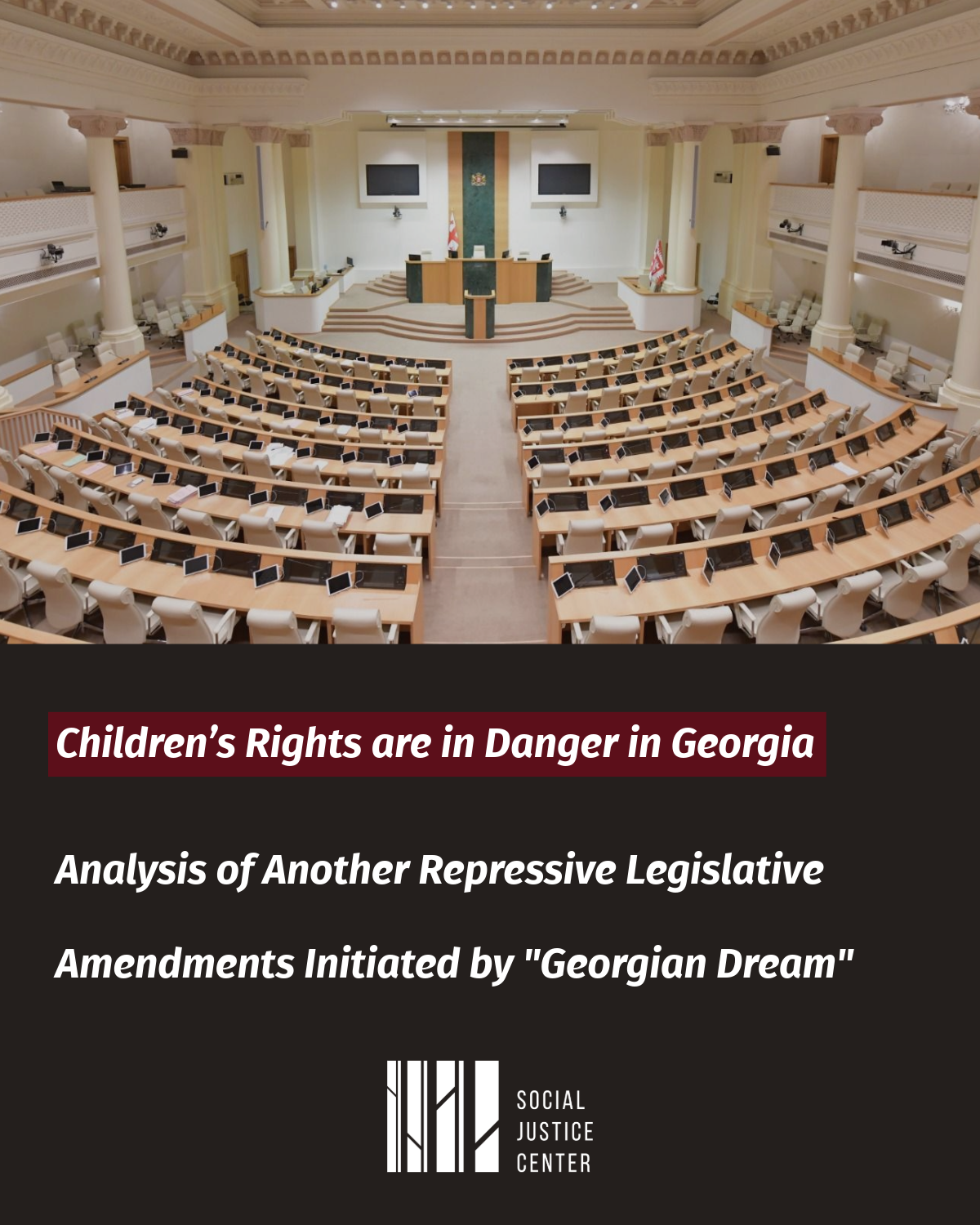
The Social Justice Center responds to the legislative package initiated by the PMs of “Georgian Dream,” which envisages the development of special measures toward children under the age of 14 who have committed an unlawful act. Among other things, the draft law provides for placing children in a specialized institution, which is practically equivalent to a freedom-restricting regime. The Social Justice Center believes that these amendments, instead of achieving their declared goal - the rehabilitation and support of minors, will result in a gross violation of children’s rights and a serious setback in the state of their protection.
The author and initiator of the legislative amendment package is 8 deputies of “Georgian Dream”.[1] It consists of one draft law (“Draft Law on the Rehabilitation and Support of Minors in Conflict with the Law”) and draft amendments to 7 legislative acts. According to the authors of the draft law, its development was prompted by the absence of regulations that would fully regulate the issues of response and rehabilitation concerning a person who has not reached the age of criminal liability, as well as the absence of an institution that would be intended for those children for whom the use of another, less intensive measure was not effective.
The draft law applies to a minor whose commission of an unlawful act envisaged by the Criminal Code is confirmed by the probable cause standard, and who had not reached the age of 14 before committing this act. The draft law outlines the stages and corresponding interventions of the so-called rehabilitation and support process for minors in conflict with the law. For this purpose, an LEPL - “Rehabilitation and Support Center for a Minor in Conflict with the Law” (hereinafter - the Center), is established under the Ministry of Justice. It is precisely the Center to which those children will be redirected, for whom the commission of an unlawful act envisaged by the Criminal Code is confirmed by the prosecutor’s summary decision. More precisely, according to the draft law, the rehabilitation and support process of a minor in conflict with the law includes: redirecting him/her to the Center, assessing his or her condition and individual needs, involving him or her in appropriate services or programs, and monitoring his or her participation in these programs and subsequent condition. If necessary, the minor may be transferred to a rehabilitation and support home. It is precisely the placement of children in this institution that represents the main challenge of the draft law.
According to the draft law, children aged 10–18 who have committed an act defined as an offense under the Criminal Code at the age of 10–14 will be redirected, by court decision, to a Rehabilitation and Support Home. The draft law establishes the grounds on which a minor may be placed in this special institution. Specifically, the grounds for redirecting a child in conflict with the law to this institution are the following cases: 1. When a child in conflict with the law is placed in state care for the purpose of alternative care and the implementation of the relevant service/program is not possible; 2. When the legal representative of the child in conflict with the law repeatedly fails to comply with the multidisciplinary team’s decision regarding the child’s enrollment in the service/program; 3. When, according to the prosecutor’s summary decision, it is confirmed that after enrolling in a service or program, the minor has committed an intentional unlawful act for which the maximum penalty does not exceed five years of imprisonment; 4. When, according to the prosecutor’s summary decision, it is confirmed that the minor has committed an unlawful act for which the maximum penalty exceeds five years of imprisonment, regardless of whether the minor is enrolled in a service or program.
Additionally, although the draft law states that placing a child in the facility does not constitute a punitive measure and that the decision is made by a court, the regulations concerning conditions of placement and living in the facility demonstrate that, in practice, it is equivalent to restricting minors’ liberty and placing them in a closed institution. Specifically, the draft law states that a child in conflict with the law who is placed in the Rehabilitation and Support Home is authorized to move freely within the premises of the home; however, the law does not clearly establish this as a guaranteed right for the child. The draft law also provides that the minor is prohibited from leaving the Rehabilitation and Support Home without the consent of the director or a person designated by the director. Only if positive progress is demonstrated by the child in conflict with the law, he/she will be allowed to temporarily leave the home, accompanied by the legal representative. The draft law stipulates that the rules for temporary leave, visiting hours and procedures, as well as security measures to be implemented, will be determined by the Minister of Justice. Minors will also receive their education within the Rehabilitation and Support Home itself and will not have the opportunity to attend or receive education on-site in regular educational institutions (such as general schools, vocational colleges, or universities).
It is evident that the draft law contradicts international standards on the protection of children's rights. In particular, the following issues are problematic:
Research highlights the severe impact that measures restricting or depriving children of their liberty have on them. For example, according to a study conducted under the auspices of the United Nations, deprivation of liberty can have sharply negative effects on children’s physical and mental health, their development, and their future lives. The research shows that children deprived of liberty experience fear, isolation, trauma, harm, as well as discriminatory and stigmatizing attitudes.
At a time when Georgian Dream has, in recent years, adopted repressive laws under the pretext of protecting children and families, it is now itself grossly violating the rights of minors and disregarding their needs. The ruling party is not willing to recognize the principles of the Juvenile Justice Code that it enacted itself, to meet international standards on the protection of children’s rights, and to implement preventive policies, while through its initiatives, it is depriving of a future those children who, due to various systemic factors (including poverty, social vulnerability, and family trauma), have committed acts that are formally considered unlawful.
We live in a country where more than 378,000 children are registered in the database of socially vulnerable persons; more than 278,000 minors receive subsistence allowance, and children experience significant material and social deprivation. They lack access to quality education, healthcare, social support, and a safe environment. Yet the government fails to grasp the reality in which minors must live and sees the only solution to their problems the lowering the age of responsibility and imposing punishment.
We call on Georgian Dream not to adopt the legislative package and instead to focus on preventive policies aimed not at punishment, but at providing appropriate support to children and strengthening families.
The Social Justice Center is monitoring the process of discussing and adopting the legislative package and will periodically provide the public with updated assessments on this issue.
[1]Rati Ionatamashvili, Archil Gorduladze, Tengiz Sharmanashvili, Davit Matikashvili, Zurab Kadagidze, Tornike Cheishvili, Salome Jinjolava, Aluda Ghudushauri.
[2] It should be noted that, according to crime statistics registered in Georgia, in 2022–2024, 228 children under the age of 14 committed crimes, and the majority of these offenses were classified as serious. See, https://news.ge/2022-2024-%E1%83%AC%E1%83%9A%E1%83%94%E1%83%91%E1%83%A8%E1%83%98-%E1%83%93%E1%83%90%E1%83%9C%E1%83%90%E1%83%A8%E1%83%90%E1%83%A3%E1%83%9A%E1%83%98-14-%E1%83%AC%E1%83%9A%E1%83%90%E1%83%9B%E1%83%93%E1%83%94-228-%E1%83%91%E1%83%90%E1%83%95%E1%83%A8%E1%83%95%E1%83%9B%E1%83%90-%E1%83%A9%E1%83%90%E1%83%98%E1%83%93%E1%83%98%E1%83%9C%E1%83%90/.
The website accessibility instruction