საერთო ცხელი ხაზი +995 577 07 05 63


საერთო ცხელი ხაზი +995 577 07 05 63
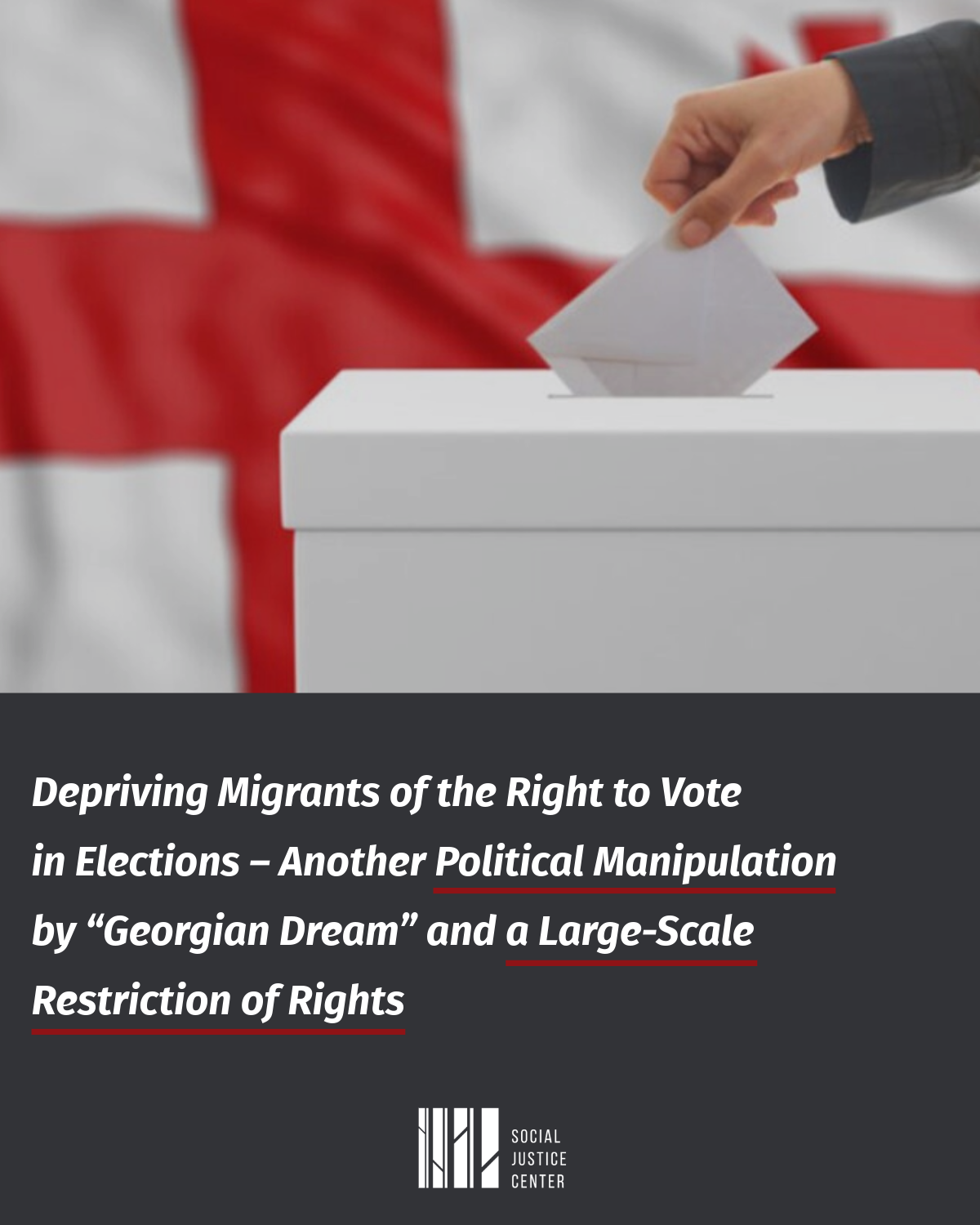
On 17 November, at a briefing held in the Parliament of Georgia, Shalva Papuashvili announced that a draft law introducing a revised Election Code had been initiated. The most severe change in this draft concerns the de facto deprivation of the right of Georgian citizens residing abroad to vote in parliamentary elections.
According to Papuashvili, nothing changes in terms of these individuals’ electoral rights—whether active or passive—just the “voting procedure” is being altered. Specifically, mirroring the rules for local self-government elections, citizens will be able to cast their vote in parliamentary elections only within the state borders of Georgia. As the official justification for adopting these amendments, “Georgian Dream” cited the risks of “influence from foreign jurisdictions and political environments” and “informational manipulation” affecting Georgian emigrants, as the state “cannot prevent interference” outside the country[1].
According to the assessment of Social Justice Center, this legislative initiative represents one of the gravest steps in Georgia’s democratic backsliding and the consolidation of authoritarianism. Contrary to the Constitution and international human rights standards—and grounded in “Georgian Dream’s” conspiratorial and anti-Western propaganda narratives—it effectively nullifies the ability of Georgian citizens living abroad to exercise their active electoral rights. This initiative disregards the essential political and economic engagement of our citizens in emigration and delivers yet another grave blow to the country’s democratic future.
The Constitution of Georgia defines the form of state governance as a democratic republic, in which the source of state authority is the people. The people exercise this authority both directly (e.g., through referendums) and through representative democracy[2]. Representative democracy primarily entails the election of the country’s highest representative body—the Parliament—through universal, free, equal, and direct suffrage.
According to the Constitutional Court of Georgia, elections are an institutional mechanism that activates democracy. For “the rule of the people” to exist, the people must participate in politics, and elections are the best means for such participation. Elections generate in individuals the feeling and belief that they are directly participating in governing the state. Only on this basis do other attributes of a democratic system emerge[3]. At the same time, elections can strengthen democracy, national development, human rights, and security—or, conversely, unequal and unfair elections can undermine them. Authority is legitimate only when decision-makers are chosen through free and fair elections. Elections must ensure that individuals assume public office in accordance with the will of the people. Therefore, in order to comply with the Constitution, elections must adequately reflect the will of the electorate[4].
To ensure the clear expression of citizens’ will, one of the fundamental principles of elections in democratic states is universality. To realize this principle, it is not sufficient merely to provide voters with a formal opportunity to cast a vote by opening polling stations. It is essential that the right be exercised without unjustified obstacles—that is, the state must take all effective measures to ensure that individuals can enjoy their most significant civil-political right in a democratic society. Only the adequate translation of voters’ preferences into parliamentary mandates can secure an effective and functioning democracy. “Authorities are obeyed because they come to power according to common and recognized rules. The proper exercise of the right to vote creates long-term prospects for governance and a stable, legitimate democratic system.”[5]
Naturally, the constitutionally guaranteed right to vote is not absolute, and its restriction is permissible when it has a constitutional substantive basis (e.g., individuals serving sentences for serious crimes or those legally declared as persons requiring support and placed in appropriate institutions), or when technical and non-substantive conditions related to organizing elections and ensuring genuine expression of will apply (e.g., voting within a predetermined time frame on election day, presenting identification documents, etc.). However, such restrictions must be assessed with extreme scrutiny and according to the principle of proportionality. They must serve a legitimate aim, be suitable, necessary, and proportionate. Most importantly, a so-called “procedural” restriction established by law must not reach a point where the exercise of the right becomes practically impossible, calling into question the right’s very existence.
It is noteworthy that the Constitution of Georgia grants the right to participate in elections to all Georgian citizens who have reached the age of 18, and it explicitly defines the groups excluded from this right. This demonstrates the broad and inclusive nature of the constitutional guarantee of electoral rights, which allows new exclusions only through constitutional amendments. Accordingly, the practical deprivation of a constitutionally guaranteed right for hundreds of thousands of citizens through legislative amendments to the Election Code is unconstitutional.
In adopting this decision, “Georgian Dream” also disregarded the constitutional principle of the social state, which was incorporated into the Constitution during its own period of governance. This principle obliges the state to care for maintaining and strengthening the connection of compatriots living abroad with their homeland. Clearly, this principle should first and foremost be expressed in the unwavering protection of their electoral rights—the most effective means for citizens to participate in and influence social and economic policy.
Restricting the right to vote in parliamentary elections for Georgian citizens living abroad by allowing voting only within the state’s territorial borders constitutes a clear territorial limitation on electoral rights without a legitimate purpose. Abstract references to “foreign interference” made by the ruling party are unsubstantiated and unsupported by empirical evidence. Claims about informational influence are vague and suggest an intention to interfere with citizens’ freedom of thought and expression. Moreover, it is unclear why, in an era of modern technologies, social networks, and widespread access to media via the internet, citizens outside the country would be less informed or engaged in important domestic events and discussions—and how a several-day pre-election visit to Georgia would suddenly reverse this.
The blanket deprivation of voting rights on the pretext of preventing uninformed choices contradicts even the relatively conservative standards of the European Court of Human Rights. The Court does allow for proportionate restrictions on out-of-country voting (under Article 3 of Protocol No. 1 of the European Convention), provided that such restrictions do not undermine the essence of the right, do not interfere with the free expression of electoral will, and are not automatic or blanket in nature[6]. The Court requires that restrictions must not take the form of blanket prohibitions[7]. For example, the Court considers a blanket ban on all convicted prisoners[8] or all individuals under guardianship to be a violation[9].
Contrary to these standards, in justifying its blanket restriction, Georgian Dream relies on assumptions about emigrants’ level of informedness—an approach that effectively scrutinizes the substance of their political choices, which violates the essence of suffrage and the principle of non-interference with the free expression of electoral will. Moreover, depriving individuals of the right to vote in order to prevent “external interference” is absurd, as it is the responsibility of state institutions to ensure elections are conducted freely, fairly, and by secret ballot.
While the European Court recognizes—in theory—that reduced state influence over emigrants may constitute a legitimate basis for limited restrictions[10], this argument cannot be invoked in the Georgian context in good faith. The overwhelming majority of Georgians abroad are compelled economic migrants driven out by domestic unemployment, with neither the motive nor, generally, the opportunity to obtain citizenship of the host country. Their lives are directly influenced by the political, economic, and social conditions in Georgia, where their families remain.
Accordingly, limiting the voting rights of Georgian citizens abroad through a territorial requirement—which, in the current legal, economic, and political context, is equivalent to removing the right altogether—cannot be reconciled with the standards of the Georgian Constitution or international human rights law. Under these circumstances, the large-scale, de facto deprivation of a fundamental political right for hundreds of thousands of individuals amounts to evident arbitrariness, clearly inconsistent with human rights doctrine, under which state interference must not be driven by unconstitutional or hidden motives, and must not undermine the essence of democracy or the right itself.
In this case, the political and unconstitutional motives underlying the initiative are apparent (see below).
In the Georgian context, the restriction of electoral rights is not limited to legal changes alone; it clearly serves political objectives. It is evident that the de facto deprivation of voting rights for citizens living abroad is intended to exclude opposition-leaning voters, based on the results of recent elections, and constitutes a political manipulation targeting the upcoming parliamentary elections. More specifically, the results of the 2024 elections show[11] that “Georgian Dream” suffered a complete electoral defeat at polling stations opened abroad[12].
Research shows that migration does not diminish citizens’ connection to their state. On the contrary, diasporas often remain among the most active and engaged social, economic, and political groups. Migrants maintain family, economic, and social ties, send remittances, participate in political protests, and often demonstrate even greater political engagement than the domestic population. This trend is clearly observable in Georgia as well. Migrants mobilize actively during elections; they also support and finance political and social activism in Georgia. In the 2024 parliamentary elections, Georgians abroad displayed extremely high readiness and mobilization—many traveled hundreds of kilometers to exercise their voting rights and reach the polling stations that the government had opened abroad, which were insufficient in number despite consistent demands from citizens and civil society[13].
Migrants also play an active role in the country’s social and economic life. Even a few key statistics demonstrate the scale of migration’s impact on Georgia’s socio-economic reality. According to the National Bank of Georgia, the volume of remittances in 2024 reached 9.1 billion GEL[14]—roughly one-quarter of the national budget. The majority of these transfers come from the United States and EU member states. By the amount of remittances per capita, Georgia ranked 12th globally in 2024[15]. Moreover, the share of remittances in Georgia’s GDP has been steadily increasing in recent years, even as GDP itself grows by roughly 10% annually. While in 2016 remittances accounted for about 10% of GDP, by 2023 this figure had reached 14%[16]. These figures also reflect the depth of poverty and economic inequality in the country—fundamental drivers of migration.
Statements by “Georgian Dream” claiming that migrants can simply return to Georgia on election day in order to vote are profoundly unfair. They ignore the legal, immigration-related, employment-related, and financial constraints faced by migrants living abroad. Very often, migrants are unable to come to Georgia even for personal reasons or during severe family tragedies. Under these circumstances, the ruling party is effectively stripping a large portion of Georgian citizens of their political rights entirely, a decision that will have massive consequences for hundreds of thousands of people.
In political science theory, such state practices are referred to as “selective disenfranchisement”—the deliberate removal of rights or political power from one or more groups for the benefit of political elites. This is an authoritarian mechanism that excludes disobedient, critical, or politically undesirable citizens from the nation’s political community, thereby deepening alienation and conflict. Moreover, it contributes to the phenomenon known as “people-shrinking” or “demos-shrinkage,” whereby ruling elites unilaterally redefine who counts as “the people,” effectively destroying political, ideological (and, where relevant, ethnic, religious, and cultural) pluralism that historically exists within societies.
Amid an acute political crisis and the rise of authoritarianism in Georgia—where the human rights situation deteriorates daily, the country has over one hundred political prisoners, opposition leaders are persecuted, political parties face potential constitutional bans, civil society institutions are being dismantled, and socially active citizens are constantly pressured—it is evident that restricting the active voting rights of citizens living abroad represents yet another severe step toward authoritarian consolidation. The political regime appears to be adopting measures aimed at stabilizing its long-term hold on power, further weakening societal and political pluralism and diminishing citizens’ capacity to exercise oversight over the state.
What makes this process particularly unjust, and alarming is that the state is targeting precisely those citizens whose hard labor, sacrifice, and financial contributions sustain the country’s economy—and whose emigration is, in fact, a structural consequence of the state’s persistent failure to fulfill its own social obligations.
[1] Full Text of Shalva Papuashvili’s Statement - “This decision is fundamentally based on the obligation established for the state under Article 24 of the Constitution of Georgia to ensure the free expression of will, which also implies that this must be expressed free from external interference... Generally, individuals receive information about the country’s existing political and economic environment and its societal needs from two sources—first, the media, where information is received in a more filtered form, interpreted according to editorial policy; and second, so-called unfiltered information, which a person receives directly through interaction with society or with the state. In an era of disinformation and false narratives, information obtained from these two sources may be radically contradictory. This circumstance increases the risk that a citizen physically detached from the country will make an uninformed choice. Therefore, establishing the rule of in-person voting within the territory of Georgia enhances the resilience of elections, reduces the influence of external actors, and ensures a more adequate and informed choice. This model fully complies with international standards and is used in countries such as Ireland, Malta, Israel, and Armenia. As before, every Georgian citizen will have the full right and opportunity to vote in elections. The only requirement is to come to the homeland once every four years and cast a vote in Georgia.”
[2] Constitution of Georgia, Article 3.
[3] Decision of the Constitutional Court of Georgia (27 December 2010), No. 1/1/493, in the case “Citizens’ Political Associations ‘New Rights’ and ‘Conservative Party of Georgia’ v. Parliament of Georgia”, II-8.
[4] Decision of the Constitutional Court of Georgia (14 April 2016), No. 3/2/588, in the case “Citizens of Georgia – Salome Kinkladze, Nino Kvetenadze, Nino Odisharia, Dachi Janelidze, Tamar Khitarishvili, and Salome Sebiskveradze v. Parliament of Georgia”, II-10.
[5] Dissenting opinion of Justice Teimuraz Tugushi, Constitutional Court of Georgia, Decision of 29 November 2024, Nos. 3/7/1848, 1849, II-50.
[6] Shindler v. the United Kingdom, §§100–103.
(In recognizing the proportionality of restricting voting rights after 15 years of residence abroad, the Court took into account the high quality of parliamentary and committee deliberations, indicating serious consideration of the competing interests. See §§103, 117.)
[7] Ibid., §103; Hirst v. the United Kingdom (No. 2) [GC], no. 74025/01, §§62, 82, ECHR 2005-IX; Ždanoka v. Latvia[GC], no. 58278/00, §105, ECHR 2006-IV.
[8] Hirst v. the United Kingdom (No. 2) [GC].
[9] Alajos Kiss v. Hungary, no. 38832/06, §43, 20 May 2010; Strøbye and Rosenlind v. Denmark, nos. 25802/18 and 27338/18, §113, 2 February 2021.
[10] Shindler v. the United Kingdom, §105.
[11] Results of the 26 October 2024 parliamentary elections, polling stations abroad, https://archiveresults.cec.gov.ge/results/20241026/#/ka-ge/election_57/tr/prop/unit/0 .
[12] Vote counts in polling stations opened abroad, Netgazeti, 2024, https://netgazeti.ge/news/748677/ .
[13] “60 Polling Stations Abroad — In Which Cities Will Migrants Be Able to Vote?” Radio Liberty, 2024, https://www.radiotavisupleba.ge/a/%E1%83%A1%E1%83%90%E1%83%93-%E1%83%A8%E1%83%94%E1%83%AB%E1%83%9A%E1%83%94%E1%83%91%E1%83%94%E1%83%9C-%E1%83%AE%E1%83%9B%E1%83%98%E1%83%A1-%E1%83%9B%E1%83%98%E1%83%AA%E1%83%94%E1%83%9B%E1%83%90%E1%83%A1-%E1%83%94%E1%83%9B%E1%83%98%E1%83%92%E1%83%A0%E1%83%90%E1%83%9C%E1%83%A2%E1%83%94%E1%83%91%E1%83%98/33137847.html .
[14] National Bank of Georgia data on remittances, https://nbg.gov.ge/page/puladi-gzavnilebi .
[15] Forbes Georgia: “Georgia Ranks 12th Worldwide in Remittances Per Capita,” September 24, 2025, based on World Bank data, https://forbes.ge/blogs/erth-mosakhleze-phuladi-gzavnilebith-saqarthvelo-msophlioshi-me-12-adgilzea/
[16] “Potemkin Growth: Why Are Georgian Citizens Rushing to Leave the Country Despite Rising GDP, Growing Exports, and Declining Unemployment?” Social Justice Center, 2025, https://socialjustice.org.ge/ka/products/potemkinis-zrda-ratom-chkaroben-sakartvelos-mokalakeebi-kveqnis-datovebas-mzardi-mshp-s-mzardi-eksportisa-da-shemtsirebuli-umushevrobis-fonze .
The website accessibility instruction