საერთო ცხელი ხაზი +995 577 07 05 63


საერთო ცხელი ხაზი +995 577 07 05 63
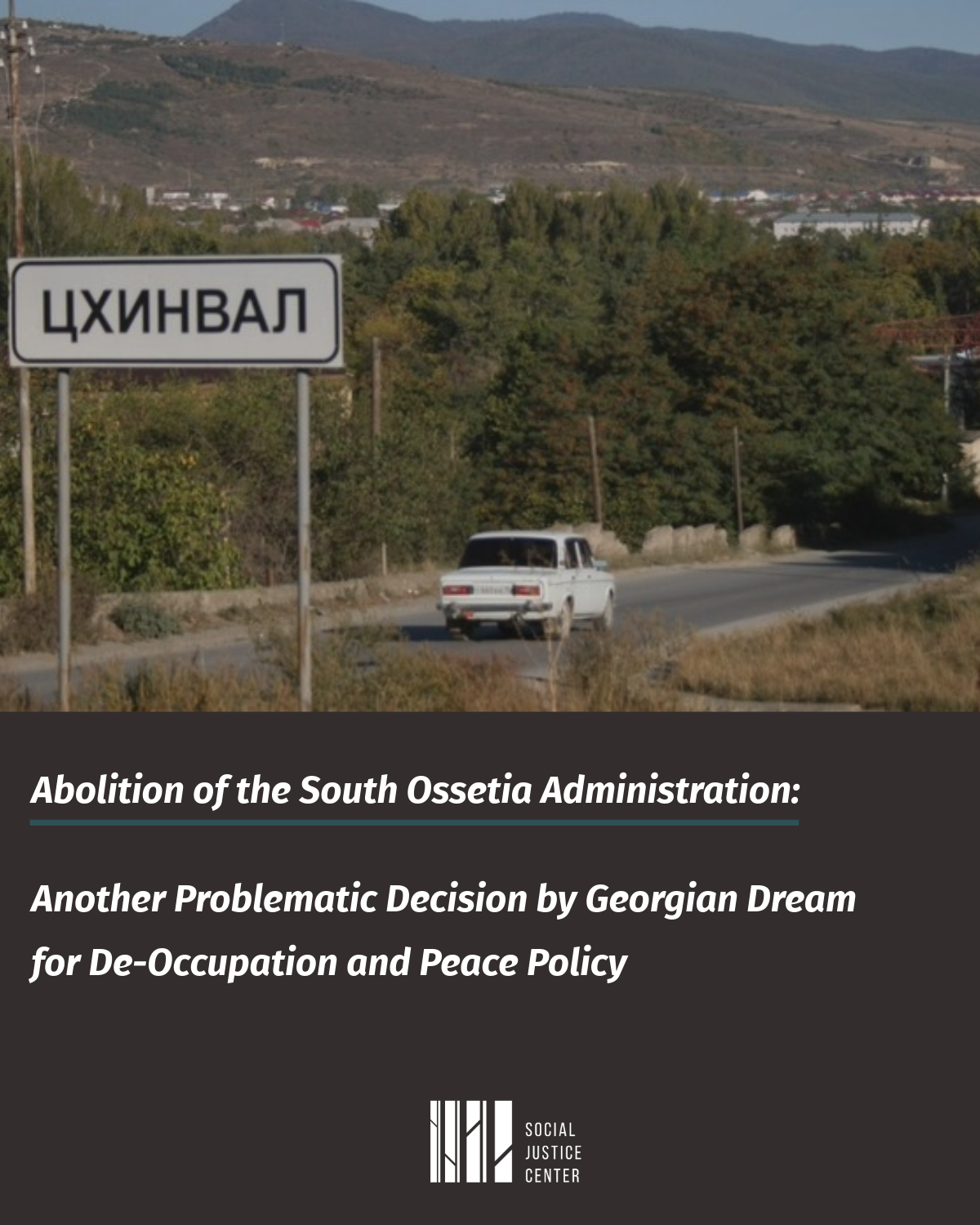
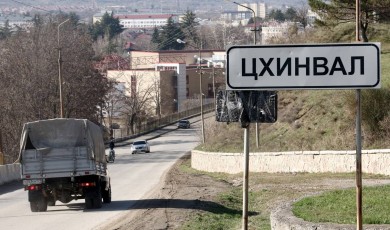
On November 17, 2025, the Georgian Dream government announced a decision to abolish the administration of the administrative-territorial unit that had been established on the territory of the former South Ossetian Autonomous Oblast. This decision was made without any meaningful deliberation with political or civil society groups. Moreover, coming against the backdrop of a shifted rhetoric and new parliamentary assessments regarding the 2008 war – assessments that completely omit Russia’s responsibility from the public discourse – this decision raises numerous questions and doubts.
While announcing this decision, the Georgian Dream Parliament Speaker, Shalva Papuashvili, stated that the United National Movement (UNM) had “betrayed the country” when it restored in 2006-2007 the boundaries of the South Ossetian Autonomous Oblast (which had been abolished in 1990), thereby creating a precondition for occupation. This move by the Georgian Dream government clearly echoes the findings of a temporary parliamentary investigative commission, which the Georgian Dream-controlled Parliament established in February 2025 (under one-party conditions) with the primary task of investigating crimes allegedly committed during the UNM’s time in power. The commission’s report recounts the events of spring 2007, including the creation of a new administrative-territorial unit on the territory of the former South Ossetian Autonomous Oblast, to which Akhalgori Municipality was attached – a step that, in Georgian Dream’s view, later created the problem of Akhalgori’s political and territorial affiliation. It is also noteworthy that the Georgian Dream government has invoked the supposed incompatibility of the term “South Ossetia” with Georgia’s non-recognition policy. According to Shalva Papuashvili, by establishing the temporary administration, the UNM had legitimized the use of this term in official discourse.
In order to analyze this decision by the Georgian Dream, it is important to recall the history and political context of the South Ossetia Administration’s creation, as well as the role it has played in Georgia’s political life. It is equally important to review the conclusions of the temporary parliamentary investigative commission on this issue.
On April 13, 2007, the Parliament of Georgia adopted the Law “On Creating the Conditions Necessary for Peaceful Resolution of the Conflict in the Former South Ossetian Autonomous Oblast.” Based on this law, a temporary state administration was introduced on the territory of the former autonomous oblast until the full restoration of Georgian jurisdiction there. The main objectives of this law were defined as facilitating the peaceful resolution of the conflict and the restoration of constitutional order on the territory of the former autonomous oblast. Its functions included negotiating with the Georgian central authorities on behalf of local political forces and the population in order to define an autonomous status for the former South Ossetian Autonomous Oblast within the Georgian state and to grant it broad political self-governance. In addition, the temporary administrative-territorial unit was tasked with ensuring legality and public order in the territory; protecting the rights of persons and ethnic groups living in the area; supporting the rehabilitation of local infrastructure; developing and implementing socio-economic projects; protecting the Georgian and Ossetian languages, traditions, and cultural heritage; and so forth.
The establishment of the temporary administration was preceded by two parallel presidential elections held in 2006 in the Tskhinvali region. Specifically, in November 2006 the de facto authorities in South Ossetia held a popular referendum that once again affirmed the “independence of South Ossetia” from Georgia, as initially declared in the early 1990s. A de facto presidential election was also conducted, in which the incumbent Eduard Kokoity won with 96% of the vote. In parallel to this, an “alternative election” was organized in the Georgian- and Ossetian-populated villages under Tbilisi’s control, orchestrated by the “Salvation Union of South Ossetia,” in which Dimitri Sanakoev (who was supported by Tbilisi) won around 80% of the vote. Sanakoev promptly formed an alternative government with an administrative center based in the village of Kurta. As Sanakoev later testified to the parliamentary investigative commission, the creation of the new administration was driven by the belief that the future of the Tskhinvali region lay within a united Georgia. Whereas Kokoity did not rule out the possibility of renewed armed conflict, Sanakoev was convinced that the conflict should be resolved under the framework of the Sochi (Dagomys) Agreement, through peaceful negotiations.
The jurisdiction of the Temporary Administration formally extended over the entire territory of the former South Ossetian Autonomous Oblast (the former districts of Tskhinvali, Znauri, Akhalgori, and Java), and its administrative center was located in the village of Kurta.[1]
The administration’s activities were funded from the state budget. In recent years, it was consistently allocated 2.4 million Georgian Lari (GEL) annually, which was directed toward various social and educational projects, social assistance for displaced persons, and medical support. One of the main goals behind creating the Temporary Administration was to establish a representative structure for the Ossetian community that could serve as a counterpart for dialogue and jointly implement rehabilitation projects. Prior to this, international aid earmarked for the region’s recovery was effectively monopolized by Kokoity’s de facto authorities.
The administration consisted of three structural units, employing up to 80 people: a Department of Internally Displaced Persons, Health and Social Protection; a Department of Education, Youth and Sports; and a Department of Culture. It is also notable that the Temporary Administration was included in the Geneva International Discussions as part of the Georgian delegation, giving the Tskhinvali region a voice within the Georgian side’s official negotiating team.
Ultimately, the Temporary Administration bore largely symbolic political significance. It primarily served as a channel for providing certain public services and state budget resources to the municipalities under its purview, rather than acting as an independent political player in conflict resolution. Nonetheless, in a situation where the former South Ossetian region/Tskhinvali region had no de jure representation of its own (unlike, for instance, the government-in-exile of the Abkhazian Autonomous Republic), this administration functioned as a local governing body recognized and supported by Tbilisi. It filled a representational gap by standing as the legitimate local administration from Georgia’s perspective. It should be noted that the creation of this body was met with some criticism from peace process experts at the time, who warned that it risked deepening confrontation between the parties and further polarizing Georgian and Ossetian communities.
As mentioned above, the government’s decision to abolish the South Ossetia Administration aligns closely with the conclusion of the Parliament’s Temporary Investigative Commission. The commission’s report stated that “the creation of a temporary administrative-territorial unit on the territory of the former South Ossetian Autonomous Oblast by the United National Movement was a step aimed at restoring the Soviet-era autonomous oblast that had been abolished in 1991. This move artificially drew the entirely peaceful Akhalgori Municipality – which since 1992 had been under the control of the central government of Georgia – into the conflict zone, which was ultimately used by Russia in 2008 to violate Georgia’s territorial integrity.”
In testimony before the commission, Vasil Maglaperidze – who served as the state commissioner (governor) of Mtskheta-Mtianeti region in 2005-2008 – explained that he learned of the plan to create the new administration only by accident. He noticed a draft law introduced in Parliament which proposed transferring Akhalgori Municipality (previously part of Mtskheta-Mtianeti) to the new territorial unit. From Maglaperidze’s account, it appears that no one was able to explain to him why such changes were necessary; likewise, this change remained perplexing to the residents of Akhalgori at the time.[2]
According to Dimitri Sanakoev’s testimony, the idea of establishing the Temporary Administration was presented to him by then-Minister of Internal Affairs Vano Merabishvili, who explained that the intention was to focus on development and redirect funding to villages in the Tskhinvali region, and that it was not aimed at provoking conflict. The Ministry of Internal Affairs – specifically Deputy Minister Amiran Meskheli – oversaw the administration’s activities at that time. Sanakoev recounted that his relationship with the Ministry was constantly tense, given the volatile situation in the Tskhinvali region, and that he often had to urge the Georgian side to refrain from returning fire during security incidents.[3]
It appears that the decision to abolish the South Ossetia Temporary Administration was based directly on the Temporary Investigative Commission’s conclusions and interpretation of these events.
It is clear that the Georgian Dream government continues to make unilateral decisions on the issues of national importance without conducting any consultations with opposition political parties, civil society organizations, expert communities, or the populations affected by the conflicts. Over the past two years, there has been a series of sudden and unexpected decisions related to conflicts and war. These have occurred in the context of a radical shift in Georgia’s foreign policy orientation, an aggressive de-Europeanization campaign, and a markedly softened rhetoric toward Russia. This context has heightened public suspicions and fears about the true goals and motivations of the Georgian Dream government in the realm of de-occupation and peace policy. The strategic uncertainty created by such policy moves in the fields of security and conflict unfortunately contributes to growing public distrust, undermines stability, and ultimately increases the country’s vulnerability to external influences.
It must be emphasized that the context in which the decision to abolish the South Ossetia Administration was made is an integral part of its significance. The decision is grounded in the investigative commission’s conclusion, by which the Georgian Dream government pinned full responsibility for the 2008 war on the previous government, effectively erasing any consideration of Russia’s responsibility. This revisionist narrative was further buttressed by a statement of apology made by Georgian Dream’s founder Bidzina Ivanishvili in Gori during the pre-election period. Thus, it appears that step by step the Georgian Dream government is attempting to alter the previously accepted state narrative regarding the conflicts and the 2008 war, removing from public discourse any acknowledgment of Russia’s responsibility. Such an approach runs counter to the state’s positive obligations in pursuing de-occupation and marks a departure from the established frameworks in law, policy, and rhetoric that have guided Georgia’s approach to these issues since the war.
The emerging geopolitical context, Georgia’s strained relations with Western partners, and the Georgian government’s statements that resonate with the views of Russia’s political elite all give rise to suspicions that new geopolitical interests and an entirely new dynamic in conflict policy may lie behind these decisions. It should be noted that such steps by Tbilisi also create uncertainty for people living in the Tskhinvali region and for the conflict-affected population on the Georgian-controlled side of the dividing line. They even fuel fears of possible new back-room deals between Tbilisi and Moscow. This kind of strategic ambiguity could in turn spark new developments on the ground in the conflict zones – a possibility that the Georgian Dream government appears not to have taken into consideration.
In taking these steps, the Georgian Dream government is also disregarding one of the most fundamental principles of international law – the principle of attribution of conduct to the State – which holds that “the conduct of any State organ shall be considered an act of that State under international law, regardless of whether the organ exercises legislative, executive, judicial or any other functions, whatever position it holds in the organization of the State, and whatever its character.”[4] Consequently, decisions made based on narrow party interests, and a radical change of paradigm in policies on war and conflict, will have long-term effects on the country’s future, and may ultimately alter international policies and approaches toward Georgia’s security and conflict issues.
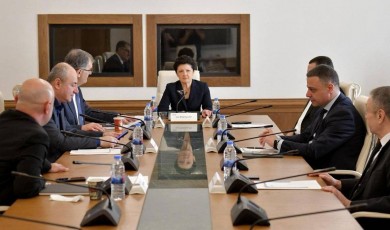
It is also important to note that abolishing the South Ossetia Administration without offering any alternative political mechanism not only paradoxically weakens (or even nullifies) Tbilisi’s own representation among the actors in the conflict and peace process (despite any legitimate criticisms of specific institutions), but it also fundamentally changes the configuration of forces in the Geneva International Discussions format. In the Geneva Discussions, the Georgian delegation has included representatives of the Abkhaz government-in-exile as well as representatives of the former South Ossetia Temporary Administration. With this decision, however, the equilibrium of representation on the “Tskhinvali side” of the Georgian delegation is disrupted. As of now, Georgian Dream officials have not provided answers to the questions that this move has raised within Georgian society.
Interestingly, Georgian Dream has attempted to rhetorically balance these recent decisions by emphasizing a hard-line stance on the non-recognition policy, seemingly in order to assuage public discontent. For example, in connection with the abolition of the administration, Georgian Dream representatives argued that using the term “South Ossetia” is inappropriate under the non-recognition policy – with Shalva Papuashvili asserting that the UNM, by creating the temporary administration, had cemented the usage of this term. However, Papuashvili’s claim does not stand up to scrutiny: as early as the 1992 Sochi Agreement and the subsequent agreement establishing the Joint Peacekeeping Forces, “South Ossetia” is explicitly mentioned as a party, and those documents were signed by the leaders of Russia and Georgia as well as by representatives of North and South Ossetia.[5] It should also be noted that dozens of legal acts can be found in Georgia’s official Legislative Herald – including acts adopted under the Georgian Dream government – that use this same term “South Ossetia” in their text.
The Social Justice Center will continue to monitor these developments and will provide the public with further analytical documents and assessments on this issue.
[1] Investigative Commission Report, 2025, p. 324.
[2] Investigative Commission Report, 2025, p. 323.
[3] Ibid., p. 324.
[4] Articles on the Responsibility of States for Internationally Wrongful Acts, Article 4.
[5] Agreement on Further Development of the Georgian-Ossetian Peaceful Settlement Process and on Joint Control Commission, available at: https://peacemaker.un.org/sites/default/files/document/files/2024/05/ge941031agreementfurtherdevelopment.pdf; Georgia-Russia 1992 Sochi Agreement, available at: https://tile.loc.gov/storage-services/service/ll/llglrd/2019669920/2019669920.pdf.
The website accessibility instruction