საერთო ცხელი ხაზი +995 577 07 05 63


საერთო ცხელი ხაზი +995 577 07 05 63
Introduction
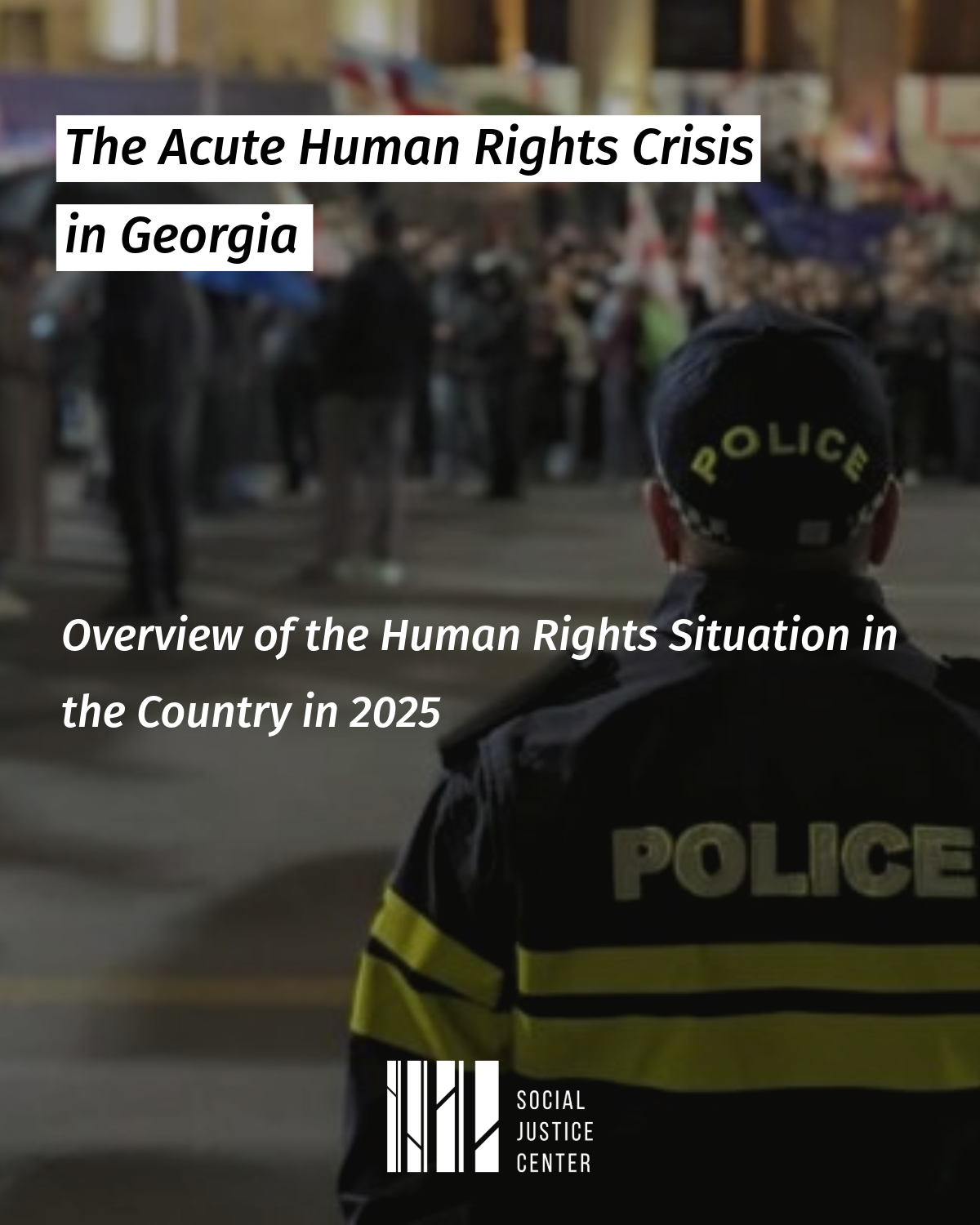
On the occasion of International Human Rights Day, the Social Justice Center traditionally presents an overview of the main trends and cases of human rights violations in Georgia during 2025. It is evident that this overview is not exhaustive and primarily reflects assessments related to issues encountered in the organization’s work.
The accelerated and aggressive process of autocratization in Georgia took alarming forms in 2025. “Georgian Dream,” in addition to fully capturing state institutions—including the systems of general courts and the Constitutional Court—has, through unconstitutional and unlawful mechanisms, significantly weakened the political opposition, institutionally dismantled civil society, pushed the media to the brink of financial crisis and collapse, and substantially restricted citizens’ civil and political rights. Through legislative changes adopted by a parliament suffering from a crisis of legitimacy, the depletion of the legal system from human rights standards and its growing degradation have assumed rapid and extremely arbitrary forms. Even a cursory review of amendments to legislation on assemblies and demonstrations, freedom of speech and expression, and the Code of Administrative Offenses clearly demonstrates the authorities’ deliberate intent to restrict and weaken the level of recognition and protection of civil and political rights in the country. Correspondingly, the sharp increase in the duration of administrative detention and fines, restrictions on various forms of expression at assemblies, the criminalization of road blockages, and the removal of safeguards protecting freedom of expression in cases of insult and defamation have emerged as grave examples of the institutional persecution of dissenting opinions.
Alongside dramatic institutional and legal changes, the process of authoritarian entrenchment was accompanied by mass violence manifested during the spring and autumn protests of 2024—violence that remains uninvestigated to this day. Even a comparison of data provided by the Public Defender regarding violence used during different protest periods reveals an unprecedented escalation of brutality in Georgia. Specifically, among individuals detained during the June 20–21, 2019 protests and visited by Public Defender representatives, 30.2% reported ill-treatment; during the March 7–9, 2023 protests—20.8%; during the April–May 2024 protests—51.1%; among those visited between November 28, 2024 and March 1, 2025—60%; during the first days of the dispersal of winter protests (November 29–December 2, 2024)—79.5%; and among 25 individuals visited on February 2–3, 2025, 22 persons, or 88%, reported ill-treatment.
In the process of consolidating authoritarian governance, “Georgian Dream” has aggressively employed strategies of disinformation, propaganda, polarization, and the cultivation of hatred, undermining social cohesion and creating internal social and cultural hierarchies. The legal situation of specific groups designated as hostile by the regime has deteriorated sharply. Particularly noteworthy is the effective abolition of the rights of LGBTQI people in Georgia and the normalization of political homo/bi/transphobia.
It is evident that the authoritarian context and logic of governance inflict harm and suffering not only on political opponents but on the broader population as well. Throughout the year, there was a clear tendency by “Georgian Dream” to demonstratively ignore (for example, the protests of residents of Balda, Chiatura, and those evicted from Tvalchrelidze Street) and repress social grievances. Anti-democratic legislative changes will ultimately have severe consequences for all social groups and strata.
The full report can be found in the attached file.
The website accessibility instruction