საერთო ცხელი ხაზი +995 577 07 05 63


საერთო ცხელი ხაზი +995 577 07 05 63
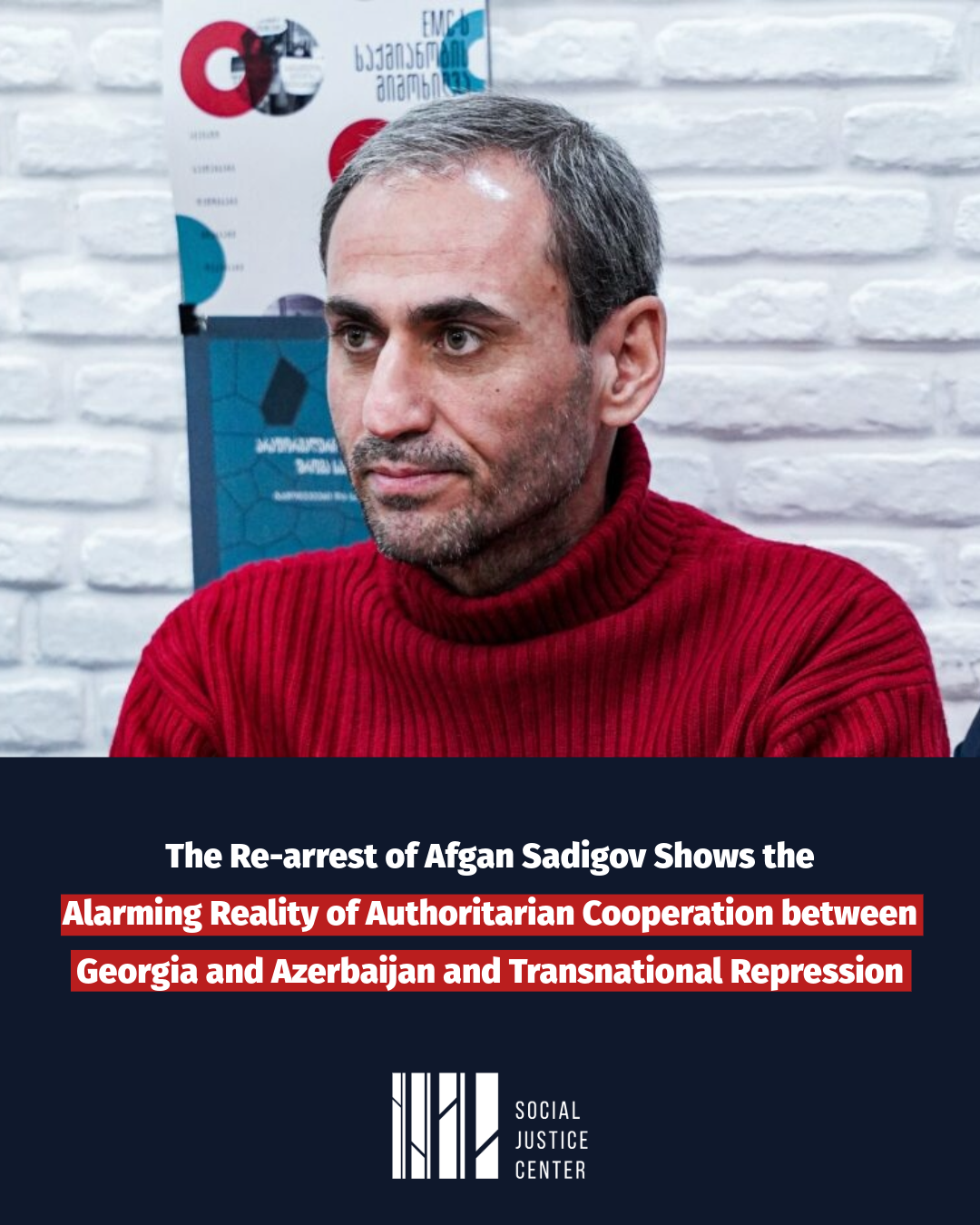
The Social Justice Center responds to the case of Afgan Sadigov’s arrest in Azerbaijan and indicates that the developments against the journalist demonstrate the gravest experiences of transnational repression and coordinated political persecution by Georgia and Azerbaijan.
As is known to the public, yesterday, June 8, Afgan Sadigov’s wife, Sevinch Sadigova, disseminated information that her husband, Afgan Sadigov, editor-in-chief of the Azerbaijani media outlet Azel.Tv, was detained by several masked persons dressed in civilian clothes. On the same day, we learned from Afgan Sadigov’s lawyer in Azerbaijan that the journalist had been taken to the prosecutor’s office, and later a court hearing was held in his case, at which he was ordered to be held in pre-trial detention until July 30.
It is important to say that Afgan Sadigov’s detention took place in the framework of the same criminal case that had originally served as the basis for initiating his extradition from Georgia to Azerbaijan. The proceedings were supposedly terminated on April 1, 2026, which, in turn, became the basis for his handover to Azerbaijan despite the decision of the European Court of Human Rights.
Overview of the context and factual circumstances of the case
As is known to the public, on August 3, 2024, Georgian law enforcement officers detained Afgan Sadigov for the purpose of extradition to Azerbaijan. According to the extradition materials, he was accused of committing a crime under Articles 182.2.2 and 182.2.4 of the Criminal Code of the Republic of Azerbaijan.
Specifically, the case materials stated that in early August 2023, Afgan Sadigov called, via WhatsApp, the representative of the head of the executive authority of the administrative-territorial unit of the village of Kurkend in Neftchala, threatened him, and demanded 3,000 manats from him; in return, he promised that he would not disseminate on social networks a video showing him cutting a birthday cake on which an eight-pointed star was depicted. In addition, in early October 2023, Afgan Sadigov contacted the chairperson of the Khazarkend municipality and demanded 6,000 manats from him; otherwise, he threatened to publicize the criminal acts committed by him.
Despite the fact that there was no evidence in the case that would confirm the commission of a crime by Afgan Sadigov, Georgian courts groundlessly accepted Azerbaijan’s request and last year allowed his extradition, which was suspended only on the basis of the decision of the European Court of Human Rights on the application of an interim measure.
Later, on April 1, 2026, the Prosecutor’s Office of Azerbaijan terminated the criminal prosecution against Afgan Sadigov. On the basis of this information, on April 3, the Prosecutor’s Office of Georgia applied to Tbilisi City Court with a motion and requested the cancellation of the bail and other interim measures applied against the journalist, including the ban on leaving the country, which the court granted on the same day. On April 4, practically the next day, at around 22:00, Afgan Sadigov was detained in his residential apartment by dozens of employees of the Ministry of Internal Affairs and the rescue team, under the pretext of insulting a law enforcement officer.[1]
On the same day, at around 04:00, Judge Tornike Kochkiani issued a decision on Afgan Sadigov’s expulsion to Azerbaijan, which the relevant agencies began enforcing in those very minutes, and within several hours the journalist was handed over to Azerbaijan at the land border.[2]
After returning to Azerbaijan, Afgan Sadigov was detained several times precisely because, according to the database, the criminal case against him had not been terminated and there was a technical error that had not yet been corrected.
Later, on May 26, 2026, after Afgan Sadigov managed to obtain a passport, the journalist attempted to leave the country and reunite with his family, but the Azerbaijani authorities did not allow him to do so. At the scene, law enforcement officers explained to Afgan Sadigov that the criminal case pending against him had not been finally terminated, even though official documents confirm that the Prosecutor’s Office of Azerbaijan terminated this case on April 1.
Then, on June 8, the Azerbaijani authorities unexpectedly detained the journalist and resumed criminal prosecution against him. More precisely, according to the explanation of Afgan Sadigov’s lawyer in Azerbaijan, the Azerbaijani court reconsidered the old criminal case, in which Azerbaijan had officially terminated the investigation on April 1, on the basis of a complaint by the alleged victim, and instructed the prosecutor’s office to reopen and review the criminal case. Within the framework of the investigation reopened in this way, Afgan Sadigov was immediately detained by the prosecutor’s office.
Legal assessment of the case and calls
Afgan Sadigov’s arrest in the same case clearly creates a reasonable suspicion of high-level coordination between the Georgian and Azerbaijani authorities for the purpose of transnational repression and the abuse of legal procedures.
It should be noted that transnational repression is considered one of the most dangerous practices of contemporary authoritarian regimes and includes cases in which states attempt, beyond their own borders as well, to control the movement, activities, and security of critical journalists, human rights defenders, and political opponents. Afgan Sadigov’s case is a clear example of precisely such a practice, because his persecution is no longer limited to the jurisdiction of only one state and includes the sequential actions of various state institutions, the final result of which was the deprivation of the journalist’s liberty.
It is especially noteworthy that the case concerns the same criminal charges on the basis of which his extradition had previously been requested, and later the Azerbaijani authorities themselves decided to terminate the prosecution. Under these conditions, the reactivation of the criminal case and the journalist’s arrest raise serious questions about the use of criminal justice mechanisms for political purposes and the gross and deliberate violation of conventional obligations.
These suspicions were further intensified back in April by the circumstance that Afgan Sadigov’s expulsion from the country coincided with the visit of the President of Azerbaijan, Ilham Aliyev, to Tbilisi and his meeting with Bidzina Ivanishvili. In addition, in May of this year, information also became known about the protocol of the bilateral coordination council, according to which the new section of the Baku-Tbilisi-Kars railway was put into full operation. In addition, a 20-year intergovernmental agreement was signed between Georgia and Azerbaijan on the basic conditions for the supply of electricity and transit traffic.
The chronology of events creates the impression that criminal procedures were used to achieve a predetermined political outcome. Initially, the termination of criminal prosecution made it possible to remove the legal restrictions in force against Afgan Sadigov in Georgia and to expel him from the country, while subsequently the reactivation of the same case gave the Azerbaijani authorities the opportunity to detain him immediately. Such a sequence further strengthens the suspicion that legal mechanisms were used not in the interests of justice, but to achieve specific political goals.
Unfortunately, for many years Georgia has demonstrated a loyal attitude toward Azerbaijan and, among other things, has not shied away from disregarding the absolute principles of human rights protection. In Afgan Sadigov’s case, Georgia, for the first time in recent history, openly and demonstratively violated the decision of the European Court of Human Rights and, despite the binding decision on the application of an interim measure, handed over the persecuted journalist to Azerbaijan.
The Social Justice Center will, in the shortest possible time, provide the European Court of Human Rights with information about Afgan Sadigov’s detention. On April 10, the Court also addressed a question to the parties as to whether, despite the existence of an interim measure, Afgan Sadigov’s handover to Azerbaijan violated his right to apply to the European Court. Today, Afgan Sadigov’s re-arrest in Azerbaijan on the basis of the same case practically confirms the risks and arguments related to his deportation to Azerbaijan to which we, and many international organizations, had pointed.
At the same time, Afgan Sadigov’s case creates a dangerous precedent for other exiled journalists and human rights defenders in the region. If states can ensure the return of critical individuals and their subsequent re-arrest by practically disregarding international protection mechanisms, including the interim measures of the European Court of Human Rights, this significantly damages the effectiveness and credibility of the international human rights protection system.
The Social Justice Center once again expresses concern over the violation of Afgan Sadigov’s rights in Azerbaijan, especially under conditions where there are high risks of arbitrary political persecution and torture and ill-treatment against him in prison. Under these conditions, we call on the Azerbaijani authorities to immediately release Afgan Sadigov and not to allow torture and/or inhuman treatment against him.
The Social Justice Center continues to defend Afgan Sadigov’s interests before the European Court of Human Rights. It will also use other human rights mechanisms to protect the rights of the persecuted Azerbaijani journalist.
[1] The Statement of the Social Justice Center: “By forcibly removing Afgan Sadigov to Azerbaijan, Georgia has violated a binding decision of the European Court of Human Rights”, April 6, 2026, available at: https://socialjustice.org.ge/en/products/afgan-sadigovis-azerbaijanshi-gadzevebit-sakartvelom-adamianis-uflebata-evropuli-sasamartlos-gadatsqvetileba-daarghvia.
[2] Ibid.
The website accessibility instruction