საერთო ცხელი ხაზი +995 577 07 05 63


საერთო ცხელი ხაზი +995 577 07 05 63
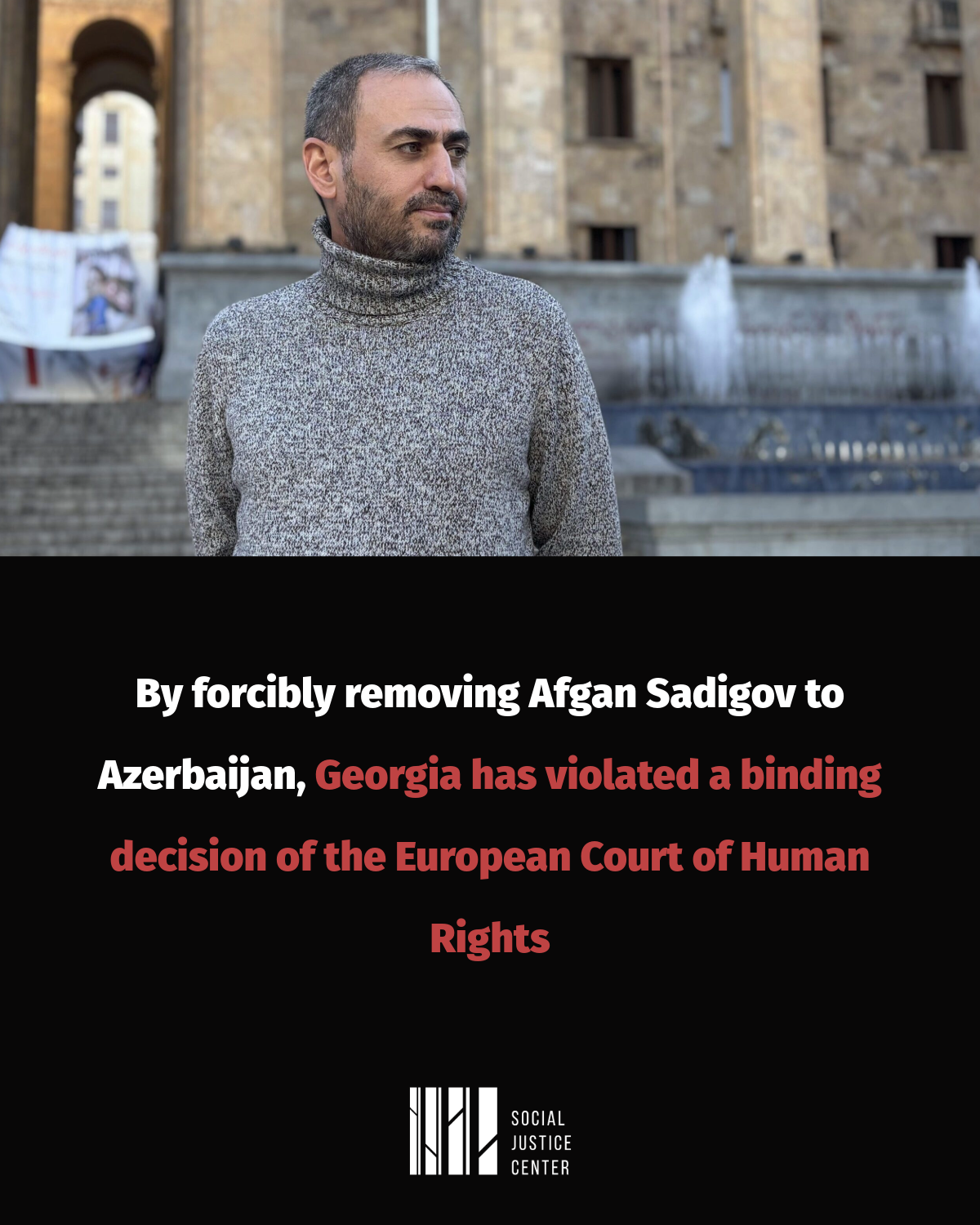
As is publicly known, in the early hours of 5 April, Azerbaijani journalist and editor Afgan Sadigov was expeditiously expelled to Azerbaijan, without being afforded the opportunity to leave the country voluntarily. Through this decision, the Georgian authorities, for the first time in the country’s recent political and legal history, have openly disregarded a ruling of the European Court of Human Rights concerning the application of an interim measure.
The chronology of developments in recent days in Afgan Sadigov’s case in Georgia, as well as the accelerated and artificially orchestrated processes, indicate that the Georgian and Azerbaijani authorities acted in close coordination and with bad faith, with the aim of transferring Afgan Sadigov to Azerbaijan and subjecting him to punishment, notwithstanding the binding nature of the European Court’s decision. As of today, Afgan Sadigov remains entirely unprotected in Azerbaijan, facing a very high risk to his life, health, and personal security.
The precise chronology of events is as follows:
On 2 April 2026, Afgan Sadigov and the Social Justice Center - an organization representing the Azerbaijani journalist at both domestic and international levels - became aware that, on 1 April of the same year, the Republic of Azerbaijan had informed Georgian law enforcement authorities that criminal proceedings against Afgan Sadigov in Azerbaijan had been discontinued. Based on this information, the Prosecutor’s Office applied to the Tbilisi City Court, requesting the annulment of the bail and other interim measures imposed on the journalist, including the restriction on leaving the country. The court granted this motion on 3 April.
Following this decision, Afgan Sadigov planned to expedite procedures for obtaining a humanitarian visa and to depart with his family to a European country where they have been granted political asylum.
However, within one day of the 3 April decision, on 4 April at approximately 22:00, dozens of officers from the Ministry of Internal Affairs and emergency response units arrived at Afgan Sadigov’s residence and arrested him on the spot. Sadigov recalls that the manner of arrest was notably aggressive, although no physical violence was used against him.
Immediately upon receiving notification of the arrest, the Social Justice Center attempted for several hours to determine Afgan Sadigov’s whereabouts. This effort involved, inter alia, the Public Defender (Ombudsperson) of Georgia. It was only after approximately two hours that an investigator from the Ministry of Internal Affairs contacted us and informed us that a hearing on an administrative offence case against Afgan Sadigov had been scheduled before the Tbilisi City Court.
It is important to note that the investigative authorities were informed of the identity of Afgan Sadigov’s legal representatives, and the detained journalist himself requested the involvement of his lawyers. Nevertheless, the court appointed a public lawyer from the Legal Aid Service. Only following the insistence of this appointed lawyer was it subsequently possible for us to establish contact.
As became clear during the court proceedings, administrative proceedings had been initiated against Afgan Sadigov under Article 173(2) of the Code of Administrative Offences, which concerns the insult of a law enforcement officer. According to the court, the basis for initiating the administrative offence proceedings was a Facebook post published by Afgan Sadigov, in which he wrote: “Where there is dictatorship, police officers are ready to sell and trample on everything in exchange for a salary and a police uniform, and they do so with love, dedication, and pride.” Although the post was dated 1 April, the administrative offence report indicated 3 April as the date of publication. Furthermore, an unofficial translation of the post was submitted to the court, which had not been properly certified.
During the hearing, in addition to seeking a finding of administrative liability, the Ministry of Internal Affairs requested the imposition of expulsion as an additional sanction against Afgan Sadigov. In substantiating the request for expulsion, the Ministry relied, on the one hand, on the allegation that Afgan Sadigov had been found liable for administrative offences on 62 occasions in connection with road blockages during protests held near the Parliament building; and, on the other hand, it referred to a conclusion by the State Security Service of Georgia. According to that conclusion, “on 13 March 2026, written (classified) information was received from Azerbaijani counterparts indicating that the individual in question poses a threat to the national security of Georgia. In light of the above circumstances and the existing risks, it is not advisable for this individual to remain on the territory of Georgia, and it is appropriate that he leave the country.”
During the court proceedings, we sought to demonstrate to the judge that, on the basis of the European Court of Human Rights’ decision to indicate an interim measure, Georgia was prohibited from transferring Afgan Sadigov to the Republic of Azerbaijan until the European Court had examined the merits of the case. The substitution of the extradition procedure with an expulsion mechanism did not alter the obligation of non-transfer to Azerbaijan. However, the court adjudicating the case effectively failed to engage with this argument and did not even permit the attachment of the European Court’s decision on the interim measure to the case file. The judge entirely disregarded our formal legal submission that only the European Court itself was competent to lift the interim measure, and that the Court had not yet examined the new factual circumstance - namely, the discontinuation of criminal proceedings against Afgan Sadigov in Azerbaijan - and, accordingly, had not assessed whether the interim measure should be maintained or lifted.
Moreover, we filed a motion requesting the summoning of a representative of the Ministry of Justice, as this body represents the Government of Georgia in proceedings before the European Court and would therefore have been in a position to provide the court with authoritative clarification regarding the scope and procedures of interim measures. The court dismissed this motion as well.
We also emphasized before the court the necessity of granting Afgan Sadigov the opportunity to leave the country voluntarily, as well as the ongoing process related to securing a humanitarian visa and political asylum for his family. However, the court rejected this request, relying on a statement submitted by the Ministry of Internal Affairs indicating that Sadigov’s passport had been deactivated by the Azerbaijani authorities and that, consequently, travel to a third country would not be possible.
The conduct of the hearing, including the disregard of all our motions, combined with the expedited consideration of the case during nighttime hours and the heavy mobilization of police forces within the court building, gave rise to a reasonable suspicion that the Azerbaijani journalist would be transferred to Azerbaijan that very night.
Ultimately, at 04:00, Judge Tornike Kochkian ordered the expulsion of Afgan Sadigov to Azerbaijan. The relevant authorities commenced enforcement immediately, and within a few hours the journalist was transferred to Azerbaijan via the land border.
According to Afgan Sadigov, he was not subjected to ill-treatment during the transfer process, and after being questioned in Baku, the migration authorities allowed him to return home.
At present, Afgan Sadigov is residing with a relative in Baku. However, he lives under the constant expectation of renewed, fabricated, and politically motivated criminal prosecution, and consequently faces risks of detention, imprisonment, and torture or inhuman treatment - risks that he has already experienced on multiple occasions in the past, as critically documented by numerous international organizations, and which formed the basis for the European Court’s indication of an interim measure in his case.
A further illustration of this vulnerability occurred today, on 6 April, when Afgan Sadigov was taken from the street to a police station after initially being surveilled by law enforcement officers, who then informed him that he was wanted, without promptly clarifying the reasons for stopping him and transferring him to the station. This created the impression for both Sadigov and his relative that he was being detained. It later emerged that the purpose of the police action was to remove him from a wanted persons database and to collect his fingerprints, after which, approximately 40 minutes later, the journalist was allowed to return home.
It should be noted that, in light of the developments between 1–4 April and the necessity of indicating a new interim measure against Georgia in this case, we addressed the European Court already on the night of 4 April. However, it appears that the date of expulsion had been pre-selected by the Georgian and Azerbaijani authorities to coincide with the Easter holidays, when the Court was not in session. On 6 April, the Social Justice Center once again provided the Strasbourg Court with updated information regarding the case.
It is important to recall that the European Court of Human Rights first prohibited the transfer of Afgan Sadigov to Azerbaijan by its decision of 14 January 2025. Subsequently, following the submission of the Georgian Government’s position, the Court, by its decision of 28 February 2025, extended this restriction until the completion of its examination of the case. We reiterate that the Strasbourg Court indicates interim measures only in exceptional circumstances, where there is an imminent risk of irreparable harm to the applicant’s rights. In Afgan Sadigov’s case, the Court found that his transfer to Azerbaijan would entail a real risk of a violation of Article 3 of the European Convention on Human Rights, which prohibits inhuman or degrading treatment.
The examination of Afgan Sadigov’s case on the merits before the Strasbourg Court is now nearly complete. Both respondent States, Azerbaijan and Georgia, have already submitted their observations to the Court, and our reply was also filed several weeks ago.
According to the Rules of Court and the Practice Directions of the European Court of Human Rights, interim measures are binding on the respondent State and may only be lifted by a decision of the Court. A State is not entitled to unilaterally consider that an interim measure has ceased to apply due to a change in circumstances, including the discontinuation of criminal proceedings by Azerbaijan. The Strasbourg Court has not adopted any decision lifting the interim measure, and it therefore remains in force. Furthermore, according to the Court’s established case-law, a State may not circumvent an interim measure by resorting to alternative domestic procedures.
In one case against Russia (Savriddin Dzhurayev v. Russia, no. 71386/10, 25 April 2013), concerning the applicant’s extradition to Tajikistan, the Court emphasized the importance of taking into account the purpose and spirit of an interim measure. In that case, the purpose of the interim measure was to protect the applicant from ill-treatment by the Tajik authorities. Similarly, in Afgan Sadigov’s case, as noted above, the interim measure was indicated on the basis of Article 3 of the Convention. The risk of ill-treatment does not depend on the legal form of transfer—whether by extradition or expulsion. In the same judgment, the Court underscored that, given the vital role played by interim measures within the Convention system, Contracting States are under a strict obligation to comply with such measures. The Court found it unacceptable for authorities to circumvent interim measures by using alternative domestic procedures to transfer an applicant to the receiving State.
In light of the above, the Social Justice Center considers that, in Afgan Sadigov’s case, the Government of Georgia has breached its obligation to comply with a binding decision of the European Court, having fully disregarded the interim measure despite the fact that it had neither been modified nor lifted by the Court.
Furthermore, the Tbilisi City Court failed to provide Afgan Sadigov with the opportunity to leave the country voluntarily, a right to which he was entitled. The argument relied upon by the Ministry of Internal Affairs - that Sadigov’s passport had been deactivated and that, therefore, he could only be expelled to Azerbaijan - was unfounded. In this respect, the Ministry relied on an outdated letter sent in 2024 by the Azerbaijani Ministry of Internal Affairs, indicating that Sadigov’s passport had been deactivated due to a custodial measure imposed on 11 May 2024. However, neither the Ministry nor the court considered the fact that criminal proceedings against Afgan Sadigov had already been discontinued by the Azerbaijani authorities, and therefore the grounds and preconditions for the deactivation of his passport no longer existed. In this context, the Georgian authorities did not even attempt to obtain updated information and instead relied on obsolete data.
More broadly, it should be noted that in recent periods the “Georgian Dream” government has introduced a number of legislative amendments to the legal framework governing the rights of foreigners, significantly weakening international protection mechanisms available to them. In particular, amendments to the Code of Administrative Offences introduced a new type of administrative sanction—expulsion of a foreign national from Georgia and a ban on re-entry. At the same time, the amendments established a new rule whereby an appeal against a first-instance court decision does not suspend its enforcement, thereby granting the State excessive and discretionary powers to carry out expedited removals of foreign nationals without proper judicial scrutiny. It was precisely these legislative changes that enabled the Georgian authorities to expel Afgan Sadigov in an accelerated manner, without even awaiting a decision from the appellate court.
Particularly serious criticism must be directed at the application of Article 173(2) of the Code of Administrative Offences in this case, under which general, abstract, and value-based criticism expressed on social media was construed as an administrative offence against law enforcement officers. Critical expression on political and public matters lies at the very core of the right to freedom of expression protected by Article 10 of the European Convention on Human Rights. According to the Court’s case-law, State institutions, including the police, are required to display a higher degree of tolerance towards criticism, especially where such expression does not contain incitement to violence or hate speech. Accordingly, both the vague and overly broad wording of Article 173(2), as well as its expansive and repressive interpretation, are manifestly incompatible with the fundamental principles of the rule of law and freedom of expression, and may produce a significant chilling effect on society.
As the above facts and legal assessments demonstrate, the sequence of actions undertaken by the Georgian and Azerbaijani authorities in Afgan Sadigov’s case gives rise to a strong suspicion that they acted in a synchronized manner and in close coordination, with the aim of persecuting and punishing the journalist. In the context of the visit of the President of Azerbaijan, Ilham Aliyev, to Tbilisi on 6 April, the expulsion of Afgan Sadigov to Azerbaijan further underscores the political nature of these developments.
This case transcends the scope of an individual violation and points to a systemic problem in Georgia’s approach to its international legal obligations. The disregard of an interim measure indicated by the European Court of Human Rights not only constitutes a violation of the rights of the individual concerned but also undermines the effectiveness of the Convention system as a whole.
At the same time, the case clearly reveals a pattern of abuse of legal forms, whereby the State effectively replaced the prohibition of extradition with an expulsion procedure, thereby formally preserving an appearance of legality while substantively violating the requirements of international law. Such practices indicate that legal mechanisms are being used not to protect human rights, but to achieve predetermined political outcomes.
The role of the judiciary in this process is particularly troubling. The proceedings demonstrated that the court failed to act as an independent and impartial arbiter, did not ensure equality of arms, and did not engage with the key legal issues of the case. In such circumstances, the judiciary functions not as a guarantor of rights, but rather as a formal legitimizing body for decisions taken by the executive. The expedited nature of the proceedings, their conduct during nighttime hours, and the complete disregard of the defense’s arguments create the impression that the State acted on the basis of expediency, which is incompatible with the normal, rules-based functioning of the legal system.
This case also fits within a broader pattern of transnational repression, whereby authoritarian regimes seek to pursue and silence critical voices beyond their borders. In this context, Georgia’s actions raise the risk that the country may become complicit in such practices, thereby significantly damaging its international reputation.
In light of the above, the Social Justice Center calls upon the State of Azerbaijan to ensure the full protection of Afgan Sadigov’s safety and liberty.
At the same time, the organization continues to represent Afgan Sadigov before the European Court of Human Rights, including through active communication with the Strasbourg Court and the Committee of Ministers regarding Georgia’s failure to comply with the Court’s decision, the latter being responsible for supervising the execution of the Court’s judgments.
The website accessibility instruction